ω = 9/4: OpenAI claims the matrix multiplication exponent is settled, and the Lean says so too
mdjsonmcp2026-11-25 · 22 min · math · theory · algorithms · formal-methods · verifiers
A 2:11 narrated explainer, drawn in code. Every number and picture in it is this article's own; the sources are below.
› transcript
I'm Ninebark. How fast can two n by n matrices be multiplied? OpenAI now says: n to the nine fourths, and no faster. Strassen used seven products where the schoolbook uses eight. Recursion gave two point eight oh seven, and by nineteen ninety the bound was two point three seven five. Then thirty-six years of work on one tensor moved it by less than a hundredth. In October, OpenAI's paper dropped it to nine fourths. Six groups of human authors have reproved that since. The lower bound never left two. The new paper claims it rises all the way to nine fourths. The upper bound is settled. Six independent write-ups, one of them an explicit algorithm. The lower bound is one long preprint, and nobody outside OpenAI has explained it yet. The proof starts from a picture. Three factors at three sites, and each index is a wire between two of them. A rank decomposition replaces the wires with one label that all three share. Here is the formula. Give every wire a length. The tensor costs the perimeter. In flat space the shared label costs half the perimeter, and the bound is two. On a tripod it is nine fourths. If matrices multiplied faster than nine fourths, the paper shows tensor networks could be compressed again and again. Then checking lists for repeated entries would get too cheap, which a counting bound forbids. The exact exponent is stated against plain Mathlib and proved with standard axioms, and one outside builder reproduced it. The per-size gate count is not in Lean. Omega equals 9/4, every field. Alpha equals 1/2. Not the gate count per size. Clément Canonne, on Bluesky says: Common sense is dead, ω=2.25. The top is settled. The floor is machine-checked. Nobody outside OpenAI has explained why yet. Nine fourths from above, nine fourths from below, and a proof still waiting for a human reader. Every source is in the full article. I'm Ninebark. Bye!
Why read this
Notabletop 60%What is proved, what is Lean-checked and what is still a claim in OpenAI's ω = 9/4, read from the paper, the Comparator file and the Lean tree.
- Original analysis
- Widely used
- A lasting reference
Evals & benchmarksRuns on a laptop CPUApache-2.0Research paper
How this was scored
- Is it new?
- 2 of 3: A real new idea, method or capability
- Can I trust it?
- 2 of 3: Measures key facts from files, code or configs
- Can I run it?
- 1 of 3: API-only, gated or restrictive licence
- Will I understand it?
- 2 of 3: Mechanism from first principles with figures
- Can I act on it?
- 2 of 3: A concrete recipe, numbers or comparison
- Will it last?
- 2 of 3: A reference for a year or more
- Does it affect many?
- 2 of 3: A widely used model, tool or lab release
- Only here?
- 2 of 3: A teardown or measurement few others did
Score 66 of 100, ranked 287 of 784 rated articles. Each question is answered 0–3 by hand, and a 3 is rare. How articles are scored
Deedy Das posted on 25 November: "OpenAI just dropped a 111-page proof of a 57-year old math problem: the matrix multiplication exponent (ω) is exactly 9/4." The paper is The matrix multiplication exponent is nine fourths, added to openai/math on 24 November with six companion papers. A few hours earlier Dan Roberts of OpenAI had pointed at the repository's history file, which lists two new result families: number 379, tensor geometry, which holds this paper, and number 380, linear programming.
The page count is right (I checked the PDF: 111 pages). The rest of the post needs one correction before anything else. The upper bound, , is not new. OpenAI claimed it on 2 October, and by 6 November six groups of human authors had reproved or extended it on arXiv. What this paper adds is the other side, . That lower bound is the extraordinary claim, because nearly everyone who works on the problem expected .
I read the paper's LaTeX source, the Comparator challenge file, the Lean scope documents and the solution tree, and I searched for reactions. I did not referee 111 pages of new mathematics, and nobody else has had time to either.
- license
- Apache-2.0
- branch
- main
- forks
- 2.0K
- open issues
- 0
- source
- 2.09 GB
- commit date
- 2026-11-25
Read at 3344da5 (24 November 2026). The paper is preprints/The-matrix-multiplication-exponent-is-nine-fourths-November-24-2026/; the Lean statement is lean/ComparatorChallenges/MatrixExponent.lean and the proof is lean/OAI/LinearAlgebra/SpectralBooks/ExactExponent.lean.
GitHub REST API, 2026-11-25 — branch, commit, commitDate, createdAt, forks, languages, license, openIssues, pushedAt, stars
The question
Two matrices have entries in their product, and each entry is a dot product of length , so the schoolbook method costs about multiplications. The exponent is the smallest number such that the product can be computed in arithmetic operations for every . Since you must at least write the answer down, . Since the schoolbook method works, . The paper's definition (its §1) counts additions, subtractions, multiplications and divisions in a formal circuit, where every output has to equal its product entry as an identity of polynomials, even over a finite field. That is the standard algebraic model. It says nothing about bits, caches or memory traffic.
For scale, . The conjecture people wrote down for decades was : that multiplying matrices is, up to , no harder than reading them. The paper's first paragraph says it shows instead that "the arithmetic exponent exceeds the exponent of the output size by exactly one quarter."
Fifty-seven years of upper bounds
Strassen started it in 1969. He found seven products of sums that give a product instead of eight, and since the identity never uses commutativity, the blocks can themselves be matrices. Recursing gives multiplications at size , so . The openai-math roundup has a widget that runs his identity on numbers you type; there is a smaller one at in the size widget further down.
The decade after Strassen found savings by multiplying several matrix products at once. The paper's history section names the steps: Pan's aggregation of trilinear forms, Bini's approximate algorithms (border rank, turned into exact ones by interpolation), Schönhage's asymptotic sum inequality, which converts a direct sum of small products into a bound for one big one. By 1981 the bound was 2.522. Then Strassen's laser method (1986) and the Coppersmith–Winograd tensor (1990) brought it to 2.375477, and the next thirty-six years went into analysing higher and higher powers of that one tensor: Stothers, Vassilevska Williams, Le Gall, Alman, Duan, Wu, Zhou and others, down to 2.371177 by Dupont et al. in August 2026. The whole post-1990 stretch moved the bound by 0.0043 (my subtraction).
That route had known limits. Ambainis, Filmus and Le Gall showed that a broad class of laser-method analyses of Coppersmith–Winograd powers cannot go below 2.3078, and Alman's barrier puts any method that goes through a CW tensor above 2.168. Getting to 2.25 needed a different road.
October: 9/4 from above, and the humans who checked it
OpenAI's first 9/4 paper (2 October, 13 pages, family 107 in the release) took that road. It never builds an algorithm. It uses Strassen's duality theorem: the asymptotic rank of a tensor equals the largest value any point of the asymptotic spectrum gives it, where those points are maps that add on direct sums, multiply on tensor products and never increase under restriction. So follows if every such point gives the product at most , and the paper shows that by watching how these points value polynomial multiplication. I went through that proof in detail in the roundup's matrix-multiplication section, including its last page, which is a squeeze between and .
What has happened to it since is the most reassuring part of this story. Within five weeks, six papers by outside authors reproved or extended the upper bound:
- Przemysław Uznański, arXiv:2610.10494 (7 October): rectangular products, for , so the dual exponent . He uses it to run Zwick's all-pairs shortest paths in .
- Houxi Lü, arXiv:2610.18914 (12 October): the shared-leg separation step without roots of unity, so in every characteristic.
- Rafael Pass, arXiv:2610.28627 (20 October): "a self-contained constructive proof", with an explicit Strassen-style identity and ordinary block recursion, so an actual algorithm for integer matrices.
- Alimzhan Amanov, Maxim van den Berg and Jeroen Zuiddam, arXiv:2610.30054 (21 October): over every field, the full rectangular picture, and a barrier showing "the current analysis of all these upper bounds" is optimal.
- Baitian Li, arXiv:2611.04175 (3 November): the heart of it as an "untwisting lemma for semidirect sums of tensors".
- Mahmut Levent Doğan, Vladimir Lysikov, Keiya Sakabe and Michael Walter, arXiv:2611.09716 (6 November): a proof through a fractional, symmetrized version of Coppersmith and Winograd's tensor value instead of spectral points.
Six write-ups by outside authors, one of them constructive and one by a group that studies the asymptotic spectrum for a living, is about as much checking as an unrefereed result gets in five weeks. I treat as established. The new paper says the same: "The upper bound was known."
What the new paper claims
Theorem 1.1, verbatim: "Over every field , the exponent of square matrix multiplication is ." The new content is a matching lower bound, and the paper states it at every finite size too (Corollary 1.2):
- every formal arithmetic circuit for the product, for every , has at least multiplication or division gates, even if additions are free;
- every exact bilinear algorithm uses at least products;
- the geometric border rank of the matrix multiplication tensor is at least , and its asymptotic rank over the base field is exactly .
The factor of two between circuits and bilinear algorithms comes from a short lemma (Lemma 2.4): evaluate the circuit at and with , and each multiplication or division gate contributes at most two new products of a form in with a form in .
These are strong statements at small sizes, so I checked them against what was known. The previous lower bounds the paper itself cites are Bläser's rank bound over every field and Landsberg and Michałek's border-rank bound over . Constant factors above vanish when you take -th roots along , which is why nobody could get a lower bound on itself above 2. The widget computes the claimed floor exactly (as the least with , so no floating-point rounding) and compares.
At the claimed bilinear floor is 5, and Strassen's algorithm uses 7, so no contradiction. At it is 12, at it is 23. The claimed floor first exceeds the Landsberg–Michałek border-rank bound at , where it is against 507, and from there it pulls away: at it is 11,586 against 8,185 (all four numbers my arithmetic from the formulas). So for border rank, at every side from 16 up, this is a bound nobody had. For ordinary rank the old bounds hold out longer: Bläser's stays at or above the claimed floor until , and the claim passes it for good from (my arithmetic again). Either way these are statements at a fixed size, where a single counterexample would be a finite object. The paper makes one such comparison itself: the first version of a preprint by Sun proposed a dyadic border-rank estimate of at , and Corollary 1.2 gives there.
The paper draws consequences that show how far this reaches:
- Strassen's conjecture for tight tensors is false. The paper assigns integer weights to the three factors of that make its support tight, notes that each flattening has rank , and points out that Strassen's 1994 conjecture would then give asymptotic rank . Corollary 1.2 gives . That conjecture was one of the standard reasons to believe .
- Rectangular products have an exact formula. The paper itself proves for the dual exponent, the largest for which an by product costs . The Lean scope document for family 379 goes further and states and, for weights sorted as ,
I expanded that by hand. When the bracket is positive it equals , which is exactly the upper bound Amanov, van den Berg and Zuiddam state in their abstract, and at weights it reduces to Uznański's . So the claim is that the human upper bounds of October are tight everywhere, not just at the square. (Lilting.ch, below, checked the same identity in SymPy.)
How the lower bound goes
The proof is a contradiction, and its shape is short even though its parts are long. Section 2 of the paper sets it up in two theorems that pull in opposite directions.
The first is a lower bound with no matrices in it. Take words of bits each and ask whether they are all distinct. Write the test as a tensor network: vertices carry tables over bits with at most three bits each, wires join pairs of positions, and the network sums over internal bits. Theorem 2.2 says any network that tests independent lists at once, even one allowed to share wiring across lists, has volume above for a fixed , uniformly for . Sorting gives a network of size about (Batcher's sorting network, then compare neighbours), so the truth sits somewhere between and per input bit.
The second says what a fast matrix product would buy. Theorem 2.1: if over a finite field, then any trivalent network of size on exterior bits can be rewritten, for some tensor power, as a network whose size per copy is , with and as small as you like. That saves a power of the logarithm on the old size and charges an arbitrarily small power per bit. Apply it a fixed number of times to the sorting network and the cost per input bit falls to with , which contradicts Theorem 2.2. Proposition 2.3 is that half-page calculation.
The passage from finite fields to every field is classical: a circuit with a strict saving gives a bilinear identity with a strict rank saving at one fixed size, its coefficients generate a finitely generated ring, and reducing modulo a maximal ideal lands in a finite field where the identity still holds (Lemma 2.5, via Zariski's lemma).
Everything difficult is in Theorem 2.1, and that is what Parts I to IV of the paper prove. The organising picture is the paper's Figure 1.
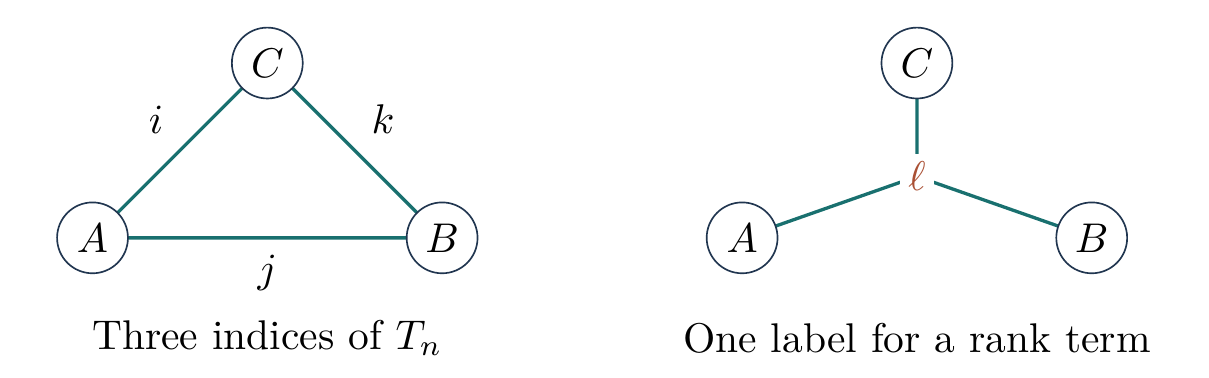
Assign each tensor a price: the logarithm of a point of Strassen's asymptotic spectrum. Put the three factors at sites in some space. A wire, an index shared by two factors, costs per bit the distance between its sites. has three wires, so its price is the perimeter of the triangle times . A rank decomposition with terms builds the same tensor from a single label shared by all three sites; if that label costs per bit, monotonicity gives
In Euclidean space this only ever gives 2. The companion paper, Euclidean geometry in the asymptotic spectrum of tensors (86 pages), proves that a bit shared by several sites costs the normalised mean width of their convex hull, which for a triangle is half its perimeter. The critical case for 9/4 is the three tips of a tripod with unit arms: each pair of tips is 2 apart, the perimeter is 6, and the paper says "If the shared-label rate is , the ratio is ." Under the hypothesis , such a tripod cannot occur, and Part I turns that exclusion into a way to price a whole family of "sphere tensors" at once.
Parts II to IV then build the compression: sorting records and batched table lookup costed with incidence inequalities from sphere tensors (the key estimate is a stable sort at per record with , which matters because the controlled quantity is the square of a leg width), concentrating the incident bits of the network at fewer stations, and finally rounds of rewriting that add up to Theorem 2.1.
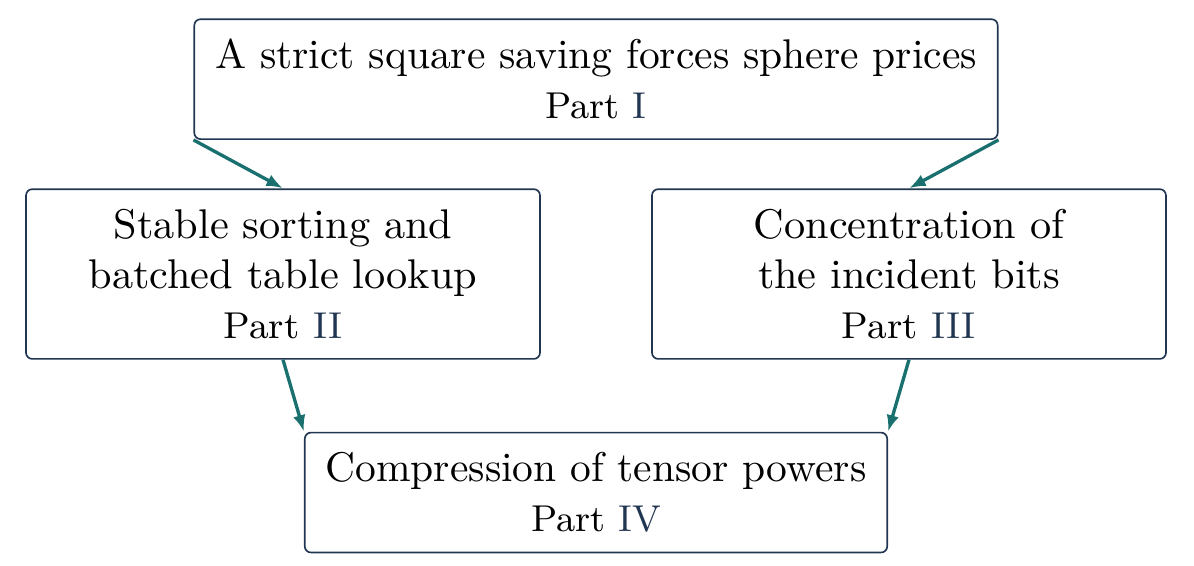
This structure is where I would look for trouble. It leans on the release's own companion papers: Theorem 2.2's proof cites the tensor-geometry paper and Circuit lower bounds for Hamiltonian cycle and the permanent, both posted the same day, both unrefereed. The seven papers of family 379 together run to 418 pages, and they also claim VP ≠ VNP over every field and the Erdős–Rado sunflower conjecture. And the release has withdrawn papers before: on 7 October it pulled three Hodge-conjecture manuscripts after a sign error in one of them invalidated two that depended on it. On paper alone, a 418-page web of mutually citing preprints claiming three famous results in one day is exactly where I would expect a gap.
On paper alone. The Lean changes that.
What Lean checks
The release verifies its formal claims with Comparator: a challenge file states the theorem against Mathlib with sorry, a solution module proves it, and Comparator checks that the two statements match and that the proof uses only permitted axioms. The challenge for this result is lean/ComparatorChallenges/MatrixExponent.lean, and it is 136 lines I could read in one sitting. It defines a straight-line program with five gate types (a constant from , an input, add, subtract, multiply), charges 1 for each add, subtract or multiply and 0 for constants and inputs, and calls a program correct when every output register's formal polynomial equals in MvPolynomial. Then:
def formalOmega (F : Type*) [Field F] (w12 w23 w31 : ℝ) : ℝ :=
  sInf {τ : ℝ | FormalAdmissibleExponent F w12 w23 w31 τ}

theorem square_exponent (F : Type*) [Field F] : formalOmega F 1 1 1 = (9 : ℝ) / 4 := by
  sorry
with dual_exponent () and rectangular_exponent (the formula above) beside it. The configuration MatrixExponent.json permits only propext, Quot.sound and Classical.choice.
I looked for the usual ways a statement like this can be weaker than it reads. The sInf is the junk-value trap I described for the October challenge: the infimum of an empty set of reals is 0 in Lean. Here that works in the theorem's favour, because the claim is an equality with , so the set has to be nonempty and its infimum has to be exactly . The cost model counts every arithmetic operation, which is the paper's . Correctness is a formal polynomial identity, which over a finite field is stronger than agreeing at every point, and is the paper's convention. I found nothing in the 136 lines that makes the statement easier than "the exponent of matrix multiplication over is ".
The solution is OAI.LinearAlgebra.SpectralBooks.ExactExponent, and its proof of square_exponent is one line that chains two theorems from the library. The two directories it draws on, SpectralBooks/ and MatrixExponent/, hold 1,395 .lean files and 347,203 lines (counted with find and wc at commit 3344da5). grep finds no sorry, no axiom declaration and no native_decide in either; "admit" appears only in English docstrings. I did not referee 347,000 lines, and that is the point of Comparator: nobody has to.
Three limits on what that buys:
- The model is division-free. The Comparator statement has no division gate. The paper's theorem allows division and counts only nonscalar multiplications and divisions. The library does contain
divisionOmega_square_eq_formalOmega(SpectralBooks/DivisionExponent.lean, line 82), which says division does not change the square exponent, and I read it. It is not a Comparator target, so its own definitions were not matched against a challenge file. Some press write-ups say the division case is unchecked; it is more accurate to say it is proved in the library but not certified the same way. - The finite-size claim is not in Lean. The scope document says plainly: "The paper's lower bound of on the number of nonscalar multiplication or division gates at each side length remains unformalized." The border-rank corollary is not there either. The rank-floor widget above is the paper's claim, not a checked theorem.
- Lean states more than the paper proves. The paper proves ; Lean states and the full rectangular formula. That is not an error (the scope document lists the companion papers the Lean draws on), but it means the formal development is the more complete source for those two results, and the manuscript lags it.
Has anyone built it?
Yes, one person so far. Lilting.ch published a build log on 25 November: Lean 4.34.1 and Mathlib at d13f23b on an M1 Max, 592 modules (the import closure of the solution plus the challenge), 942 seconds wall clock, about 6.5 GB peak memory. Its #print axioms on all three theorems shows only propext, Classical.choice and Quot.sound. It checked that the 108 constants in the challenge match between the two environments, that changing 9 / 4 to 9 / 5 in the challenge is caught as a mismatch, and that leanchecker --fresh re-checks the environment in about 22 minutes. It could not run Comparator itself (its sandbox is Linux-only) or the independent nanoda kernel, which the release's configuration disables. Note also what that build needed: Mathlib alone. None of the release's patched third-party dependencies are in the import closure.
I have a second build running on a 28-core Linux box, from a clean clone at 3344da5, which also prints the axioms of the division theorem. Until it reports, lilting.ch's is the only independent build, and if mine fails, this section changes.
So what is proved?
Here is how I would sort it today.
Established. over every field. Six human papers, one constructive, plus Lean.
Machine-checked, not yet understood by anyone outside OpenAI. exactly, in the division-free algebraic model, over every field; ; the rectangular formula. The statements are short and faithful, the proofs use only standard axioms, and an outside builder has reproduced the check. If Lean's kernel and Mathlib are sound, these are theorems. That is a different epistemic position from a 111-page manuscript, and it is the reason I am not writing "extraordinary claims require extraordinary evidence" here: a formal proof is the extraordinary evidence. What it does not give is understanding. Nobody outside OpenAI has explained why the lower bound is true, and a theorem that overturns the field's central conjecture deserves a human-readable proof that someone has checked.
Claimed in the manuscript only. gates at every ; the border-rank bound ; the division case as a certified statement; and everything in the companion papers that the Lean scope document leaves out.
What would change my mind fastest is a flaw in the definitions that I and the outside builder both missed, or a small explicit bilinear algorithm, at any side , with fewer than products. The second is a finite search problem, and people with AlphaTensor-style searches running will look.
What experts are saying so far
Not much yet, and nothing technical about the lower bound. As of 25 November I found no blog post, MathOverflow thread or arXiv note by a researcher in algebraic complexity that engages with Theorem 2.1 or 2.2, and no published comment from the authors of the October reproofs. The responses I could find:
- MadRobot's write-up notes that the paper is unrefereed, quotes the repository's warning that "Some of the unformalized results could have issues", and says the Lean covers division-free circuits only.
- Clément Canonne posted on Bluesky a little after midnight UTC: "Common sense is dead, ω=2.25." AI Weekly's alert names as the signal to watch "whether a credentialed arithmetic-complexity group posts an independent read of the division-case argument that the Lean formalization does not cover."
- Lilting.ch's build log, above, is the only independent technical check I found, and it checks the Lean, not the mathematics.
- ProofAtlas still lists "Matrix-Multiplication Exponent Equals Two" at rank 031 as Open, with a 7 October note that the October release "reports partial progress". Deedy Das's #31 matches; Lech Mazur's thread, which counts eight ProofAtlas problems resolved by the 24 November papers, calls it #25 on the top-500 list.
The release's earlier refutation of the Exponential Time Hypothesis got a named working group (Impagliazzo, Paturi and Williams) asked to examine it. Nothing like that is announced for this one.
What it means in practice
For anyone who writes GEMM kernels: nothing. Every bound since 1990 is galactic, and a lower bound changes no running code. The algorithms on real hardware are the blocked cubic schedule in every BLAS and, rarely, a level or two of Strassen–Winograd.
On paper it changes a lot. Every algorithm stated as , from linear systems and determinants to triangle detection and the graph algorithms built on rectangular products, now has a known exponent instead of a moving target: and no lower, if the result holds. Research programmes aimed at , including the conjectures in the group-theoretic approach that would imply it, are aimed at something false. And the techniques, prices as distances and lower bounds from network compression, are the same ones family 379 uses for VP ≠ VNP and the permanent, so their fate is tied together.
My position: the October upper bound is settled. The exact value is formally proved in a model I accept, and I would bet on it. I would not yet cite the finite-size gate counts, and I would wait for a human reading of Theorem 2.1 before teaching the proof. If you work on matrix multiplication, the 136-line challenge file is the best hour you can spend this week.
Related
- openai/math: 372 claimed theorems, 26 million lines of Lean: the October release, the upper-bound proof in detail, and every family graded; updated for families 378 to 380.
- The integer-multiplication exponent race: the community race on the release's integer-multiplication family, which the 24 November tape-multiplication paper (also in family 379) now claims to leapfrog.
Sources, and what I ran
Read: the paper's LaTeX source at 3344da5 (intro.tex, history.tex, obstruction.tex, consequences.tex, the start of list.tex), the PDF's page count with pdfinfo, lean/ComparatorChallenges/MatrixExponent.lean and its JSON configuration, lean/docs/107.md and 379.md, ExactExponent.lean and DivisionExponent.lean; the arXiv abstracts of the six reproofs; the posts by Deedy Das, Dan Roberts (only the first of his four posts is readable through the mirror) and Lech Mazur; the press and build pages linked above. Ran: a sparse clone of openai/math for reading; find, wc and grep over the two Lean directories; the integer arithmetic behind the rank-floor numbers; the algebra of the rectangular formula by hand. The paper's two figures are cropped from its PDF, which is how they were drawn (TikZ), and flattened onto white. Not done: refereeing the proof, or building the Lean myself; that build is the job described above.