2026-11-24 · 36 min · looped-transformers · mixture-of-experts · inference · on-device · interpretability
A 3:12 narrated explainer, drawn in code. Every number and picture in it is this article's own; the sources are below.
› transcript
Mixture of experts is a datacenter architecture, the post says. Looped transformers are a laptop architecture. This week two labs shipped a loop. So what does one actually cost? I'm Mobius. A loop stores a block of layers once and runs it several times. You get depth without storing it. Inkling 2 Mini stores 24 layers. The first six and the last six run once. The middle twelve are the core. Same weights every time. The core runs three times, so one token passes through 48 layers from a file that holds 24. Each pass hands the next one a message, through a gate that starts closed. Early in training the loop does nothing. Untie those passes and the same model needs 31.3 gigabytes at four bits. Looped, it is 16.6. Both read the same bytes per token. The lab drew it the same way. The prelude feeds every pass. Passes two and three also read the pass before. At batch 1, bytes read set the speed ceiling. The loop costs Mini 80 percent more reads. The experts are why it reads 4 gigabytes, not 16. Z.ai did not train from scratch. Looped models trained from scratch lag at the same compute, it says. So it took its trained 750B base and looped 28 layers twice. Gates keep the second pass from blowing up activations the rest of the model never saw. And the second pass reuses the first pass's cache, so the extra loop costs one sliding window. On a 30B twin with about 10 percent more training compute, the loop lifted AIME from 19.17 to 30.42. And the answers got shorter. Some reasoning moved from text into depth. Thinking Machines also released a model you can run at any loop count. On chained lookups with no chain of thought, every extra pass follows a longer chain. One pass is a different model. DeepSWE goes from 0.7 percent to 47.4. Facts barely move: SimpleQA goes from 6.3 to 6.7. I ran that checkpoint on a 3090. One pass decodes at 124.55 tokens a second, three at 58.31. Perplexity stops improving after three passes. Thinking Machines says: Looping improves the model's reasoning, it doesn't enable its weights to store more facts. Does a loop hide its reasoning? At five passes the written reasoning was less than half as long, 1,661 tokens against 3,703, and just as legible. It backtracked less. It did not hide steps, at this scale. And the laptop? Mini is about 20 GB. The lab's demo ran it offline on a MacBook, on a flight. A loop is a storage trick with a compute bill: depth you never store, paid in reads every token. Depth, not parameters. Reads, every pass. Reasoning up, facts flat. Every source is in the full article. I'm Mobius. Bye!
Why read this
Essentialtop 10%Unrolls Inkling 2 Mini from config and GGUF header, prices the loop against MoE, and measures 1 to 6 passes on an RTX 3090: speed, VRAM, perplexity.
- Runs on a consumer GPU
- Interactive explanations
- Original analysis
LLM architectureApache-2.0Practitioner model
How this was scored
- Is it new?
- 2 of 3: A real new idea, method or capability
- Can I trust it?
- 2 of 3: Measures key facts from files, code or configs
- Can I run it?
- 3 of 3: Open, permissive, runs on reader hardware with instructions
- Will I understand it?
- 3 of 3: Mechanism carried by interactives built from real code or data
- Can I act on it?
- 2 of 3: A concrete recipe, numbers or comparison
- Will it last?
- 2 of 3: A reference for a year or more
- Does it affect many?
- 2 of 3: A widely used model, tool or lab release
- Only here?
- 2 of 3: A teardown or measurement few others did
Score 79 of 100, ranked 38 of 780 rated articles. Each question is answered 0–3 by hand, and a 3 is rare. How articles are scored
A normal transformer runs each of its layers once per token. A looped transformer stores a block of layers once and runs it several times, feeding the block its own output. The idea is old: Universal Transformers shared one layer across depth in 2018, and the recent line runs through recurrent depth and a stack of 2026 scaling papers this site has covered (SMELT, LOOM, what separates Ouro from Huginn). Small open looped models have shipped before: Nanbeige4.2-3B loops twice, and NVIDIA's Dory1.0-4B runs one 20-layer block up to four times. What changed this month is scale and intent: a frontier lab built its small model around a loop, and Z.ai put one in its flagship.
- Inkling 2 Mini, from Thinking Machines on 20 November, open weights under Apache 2.0. 26.4B parameters, 3.4B active, "5.4B weight activations per token to account for looping" (launch post, model card). Its middle twelve layers run three times.
- GLM-5.4, from Z.ai on 23 November, which the lab calls "our first loop transformer". It loops 28 layers of the GLM-5 base model twice, at 750B scale (Z.ai's blog). The weights are not out; the post says they will follow "after completing necessary safety hardening".
Inkling 2 Small has a short section on Mini's facts and a search leaderboard's view of it. This page is the long one: the mechanism, the cost in bytes, the two ways to train a loop, and the loop count as a dial.
One block, many passes
Write a transformer as a stack of functions. Layer takes the residual stream and returns . With layers, a token's hidden state goes through distinct functions, and the model stores sets of weights.
A looped model splits the stack in three, the way the recent literature does:
- a prelude that runs once and maps tokens into the model's working space,
- a core whose weights are applied times,
- a coda that runs once and maps back to logits.
The hidden state after pass of the core is , where is the prelude's output. Most designs feed back in on every pass (input injection) so a deep loop does not forget the token it started from. The depth a token sees is . The parameter count is layers' worth, whatever is.
That is the whole trick: effective depth without extra parameters. What it buys is serial computation per token. A transformer can only do a fixed number of sequential steps before it must emit a token; looping raises that number without growing the file.
What it costs is that the depth is real. Every pass multiplies the core's matmuls, re-reads the core's weights from memory and, unless the design shares caches across passes, writes a fresh set of keys and values. A loop is a model that is cheap to store and exactly as expensive to run as the unrolled one.
Here is Inkling 2 Mini unrolled, from its released config.json. Drag the pass count.
Thinking Machines drew the same picture in its post:
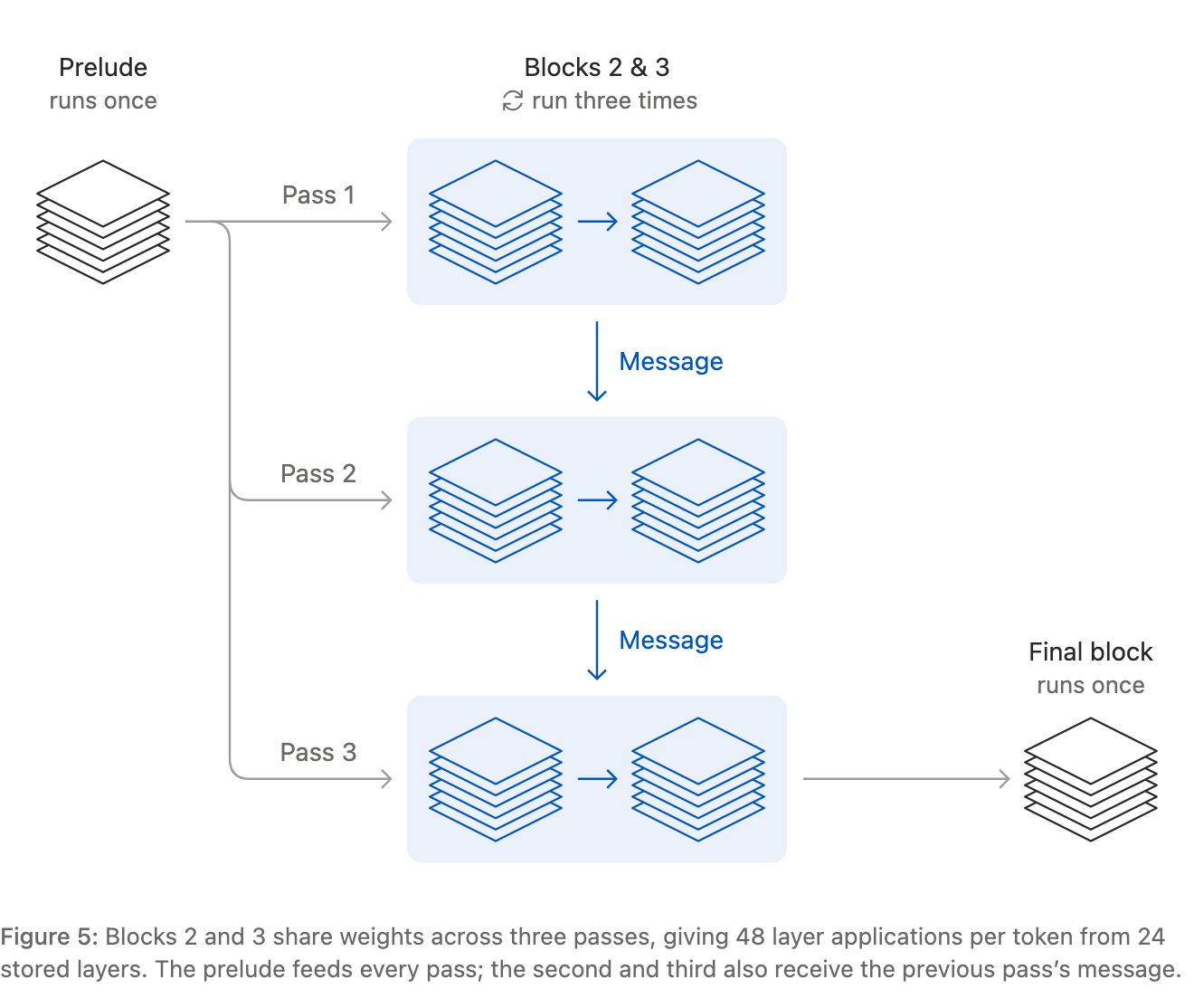
Inside Inkling 2 Mini
The config fills in what the post describes in prose. It has 24 layers at a hidden size of 2,304, 24 query heads and 8 key-value heads of 128 dimensions, and a 128-expert MoE in every layer with 8 routed per token and no shared expert (n_routed_experts 128, num_experts_per_tok 8, n_shared_experts 0). The loop is one small object:
"loop_config": { "core_start": 6, "core_end": 18, "num_passes": 3, "gate_rank": 64, "is_varloop": false }Layers 6 to 17 are the core. Attention alternates five sliding-window layers (1,024 tokens) with one global layer, so the global layers are 5, 11, 17 and 23: two in the core, two outside it. That matters for the cache, below.
Three design choices are worth reading closely.
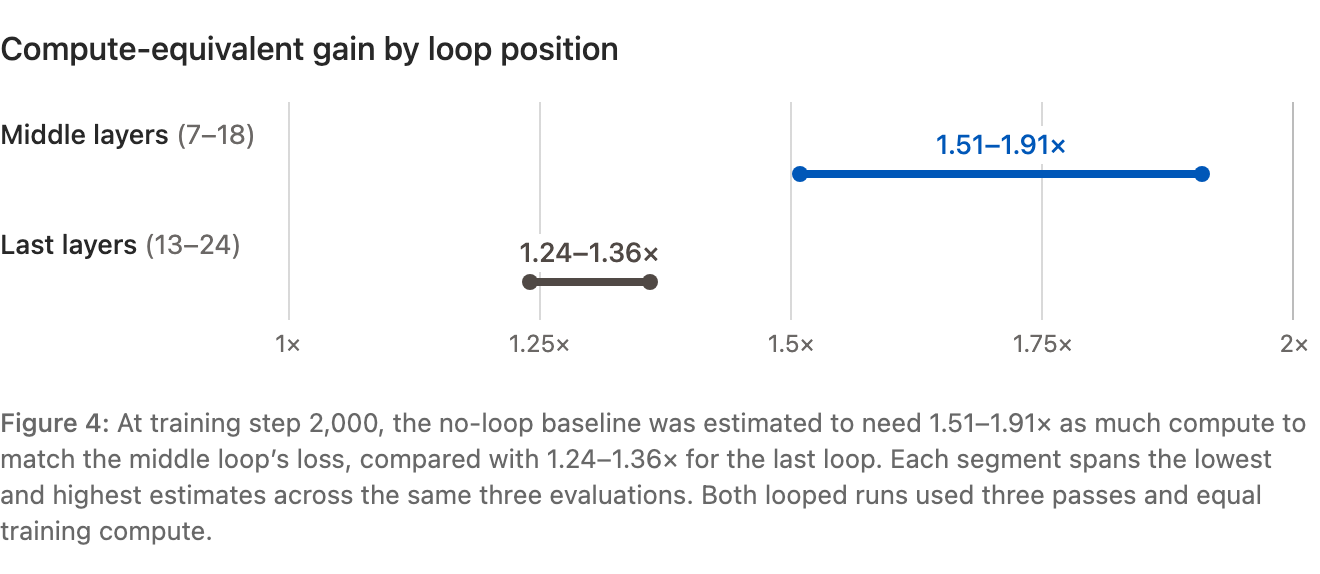
Which layers to loop. The post's reasoning is that middle layers "carry more abstract reasoning", while the first and last translate between embeddings and internal representations. It tested that: looping the middle twelve beat looping the last twelve on 27 of 28 evaluations. At training step 2,000 the no-loop baseline would have needed 1.51 to 1.91 times the compute to match the middle loop's loss, against 1.24 to 1.36 times for the last loop.
How passes talk to each other. Mini uses attention residuals: instead of one running residual sum, each layer reads the outputs of earlier blocks and learns its own mix of them (n_layers_per_attn_res_block 6 in the config). Every pass starts from the prelude's output. Passes 2 and 3 also read the previous pass's output of the middle blocks, "the message", through a learned gate (the config's loop_config carries a gate_rank of 64, which I take to be that gate's rank; the post does not say). The gate "initially blocks the entire message", so each loop starts out behaving like a non-looped model, and the gain opens during training. The post says this "allows us to introduce looping during training in a stable manner"; it does not say at which step the loop was introduced.
What it bought. The ablation in the post compares an unpruned looped model against the unpruned non-looping model on the same scaling ladder: the non-looping model "cost 7.5% less compute to train, but required 140% more inference compute to match the looped version's loss on 512k-token agentic traces". I read that as the clearest single number for the trade. Training the loop costs a little. The model it produces does per token what a model with more than twice the inference compute would.
Mini is also pruned. It started training with 384 experts per layer and 8 routed; "at a single point during midtraining" the lab kept the 128 most-used experts per layer, deleted the rest, and healed the model on 1T tokens distilled from a larger internal Inkling. Most of the weights were trained and ship in NVFP4, the last four layers in MXFP8, about 20 GB in all. Post-training was SFT, then RL over 2.2T tokens and 2,000 steps.
The card's accounting of active parameters follows from that: 3.4B active at one pass, and each extra pass through the core adds about 1.0B effective active parameters, so three passes make 5.4B per token.
The loop is the opposite trade to a mixture of experts
One of the reposts that sent me here put it bluntly:
His argument: "MoE trades memory for compute: huge weights, but only a few active per token. That works with big batches and big GPUs. On your laptop the batch size is 1 ... Looped transformers make the opposite trade: reuse the same weights, spend more compute, need far less memory."
The direction of each trade is right. A mixture of experts stores many parameters and touches few per token. A loop stores few and touches them several times. The framing breaks on the model it was posted about: Inkling 2 Mini is both. It is a 128-expert MoE, and it loops. The useful question is what each half contributes on a machine that decodes one sequence at a time.
At batch 1, memory bandwidth sets a ceiling on decoding: every generated token streams the weights it uses through the memory bus. Real runtimes land well under that ceiling (Unsloth's table, below, has one GPU decoding the same 4-bit file at 81 or 125 tokens per second depending on the build), but the ceiling is what the architecture controls. So two quantities matter, and they are different:
- bytes held: the file, which has to fit in RAM or VRAM;
- bytes read per token: what the bus moves for each token, which sets the speed ceiling.
I read the tensor table out of the header of Unsloth's UD-Q4_K_M GGUF (16.61 GB, the mainline-layout file) by HTTP range request and split it by layer group. The six prelude and six coda layers hold 0.361 GB of attention and other dense weights and 7.899 GB of experts. The twelve core layers hold 0.475 GB dense and 6.880 GB of experts. The embedding table and the output head are 0.492 GB each.
For one token at three passes, the bus reads the once-run dense weights, 8/128 of the once-run experts, the output head, and then three times the core's dense weights plus 8/128 of its experts. That is 1.347 + 0.905 × 3 = 4.06 GB per token, by my arithmetic. At one pass it would be 2.25 GB.
Now the counterfactuals, all at the same quantization:
| Design | Held | Read per token, batch 1 |
|---|---|---|
| Inkling 2 Mini, 3 passes | 16.6 GB | 4.06 GB |
| Untied twin: 48 distinct layers, same 48 applications | 31.3 GB | 4.06 GB |
| Mini forced to 1 pass (llama.cpp refuses it; shown for the arithmetic) | 16.6 GB | 2.25 GB |
| A dense model with Mini's file size | 16.6 GB | 16.1 GB |
Read the rows in pairs. Mini against its untied twin isolates the loop: same compute, same per-token reads, and the loop saves 14.7 GB of storage. Mini against the dense model isolates the MoE: same storage, and the experts cut per-token reads by a factor of four. The laptop story needs both. The loop gets the file under a laptop's RAM; the MoE gets per-token traffic low enough to be fast once it is there.
The batch slider shows the datacenter side. With uniform routing, a batch of 32 sequences touches 87% of each layer's experts per step, so the step reads almost the whole file, but that read is shared across 32 tokens. That is why big MoE models want big batches. A loop does not benefit the same way: its extra reads are per pass, and every pass re-reads the core's dense weights however big the batch. The routing assumption in the widget is a simplification; real routers concentrate on popular experts, so the touched fraction grows more slowly.
The speed ceilings are bandwidth divided by bytes. At 936 GB/s, NVIDIA's listed memory bandwidth for the RTX 3090, Mini's ceiling is about 230 tokens per second at three passes and 415 at one. Thinking Machines' own coding chart plots "theoretical tokens per second" the same way, at 614 GB/s with BF16 weights and batch size 1, "including repeated reads across loops": 54.4 for Mini against 11.4 for the dense Qwen3.8-27B. That gap is the MoE, not the loop.
So where does "laptop architecture" land? The memory claim holds for the loop as a storage trick. The compute claim needs one correction: the loop is paid for in reads per token, and at batch 1 reads set the speed ceiling. Mini spends 80% more bytes per token for its second and third passes than it would at one (4.06 against 2.25 GB). The bet is that those passes buy more than the tokens they cost, which is what the next sections test, and what the 3090 sweep at the end is built to measure. And the architecture does not stay on laptops: GLM-5.4 loops a 750B model.
Thinking Machines' own demo is the laptop case. Its researchers ran Mini offline on a 48 GB MacBook Pro on a flight and had it build a flight simulator:
What fits where
The post says Mini supports "any Mac system (MacBook, Mac Mini) with at least 32GB RAM via Ollama" at launch. Unsloth's quoted post says it "runs on 16GB RAM". Both can be true, at different quantizations. Unsloth's own table lists every quant against its 8-bit UD-Q8_K_XL reference (22.87 GB):
| Quant | Size | Mean KLD vs Q8_K_XL | Same top token |
|---|---|---|---|
| UD-IQ1_S | 7.76 GB | 0.0911 | 89.4% |
| UD-Q2_K_XL | 9.14 GB | 0.0595 | 91.6% |
| UD-Q3_K_XL | 13.63 GB | 0.0174 | 96.3% |
| UD-Q4_K_M | 16.61 GB | 0.0108 | 97.9% |
| UD-Q4_K_XL | 17.63 GB | 0.0107 | 98.0% |
On a 16 GB machine, with the OS and a KV cache to hold as well, the realistic files are the 2-bit and 3-bit ones, where one token in twelve to one in twenty-seven differs at the top from the 8-bit file. The 4-bit files want 24 GB or more. On my RTX 3090, UD-Q4_K_M with a 32,768-token context took 20,723 MiB once loaded, and a 65,536-token context did not fit (details in the 3090 section below).
The loop also has a cache cost that the parameter count hides. In llama.cpp's inkling2_loop implementation, according to the GGUF card ggml-org published for the variable-loop model, "each pass keeps its own KV and convolution cache". Mini's four global attention layers become eight global layer applications at three passes (layers 5 and 23 once, 11 and 17 three times). At 8 KV heads of 128 dimensions in F16, that is 4 KiB per application per token, so 32 KiB per token: 4 GiB at a 131,072-token context, twice what the same model without a loop would need. The sliding-window layers add a fixed 160 MiB. This is my arithmetic on the config, and it assumes llama.cpp's per-pass layout; the post does not say how Thinking Machines' own serving stack handles the cache.
That cost is exactly what Z.ai engineered around.
Retrofitting a loop: GLM-5.4
Z.ai did not train GLM-5.4 from scratch. Its reasoning, from the blog: "while weight sharing improves parameter efficiency, looped models trained from scratch still lag behind unshared models under the same pre-training compute budget. Instead of pre-training from scratch, we adapted an already pre-trained base model into a Loop Transformer through continued training."
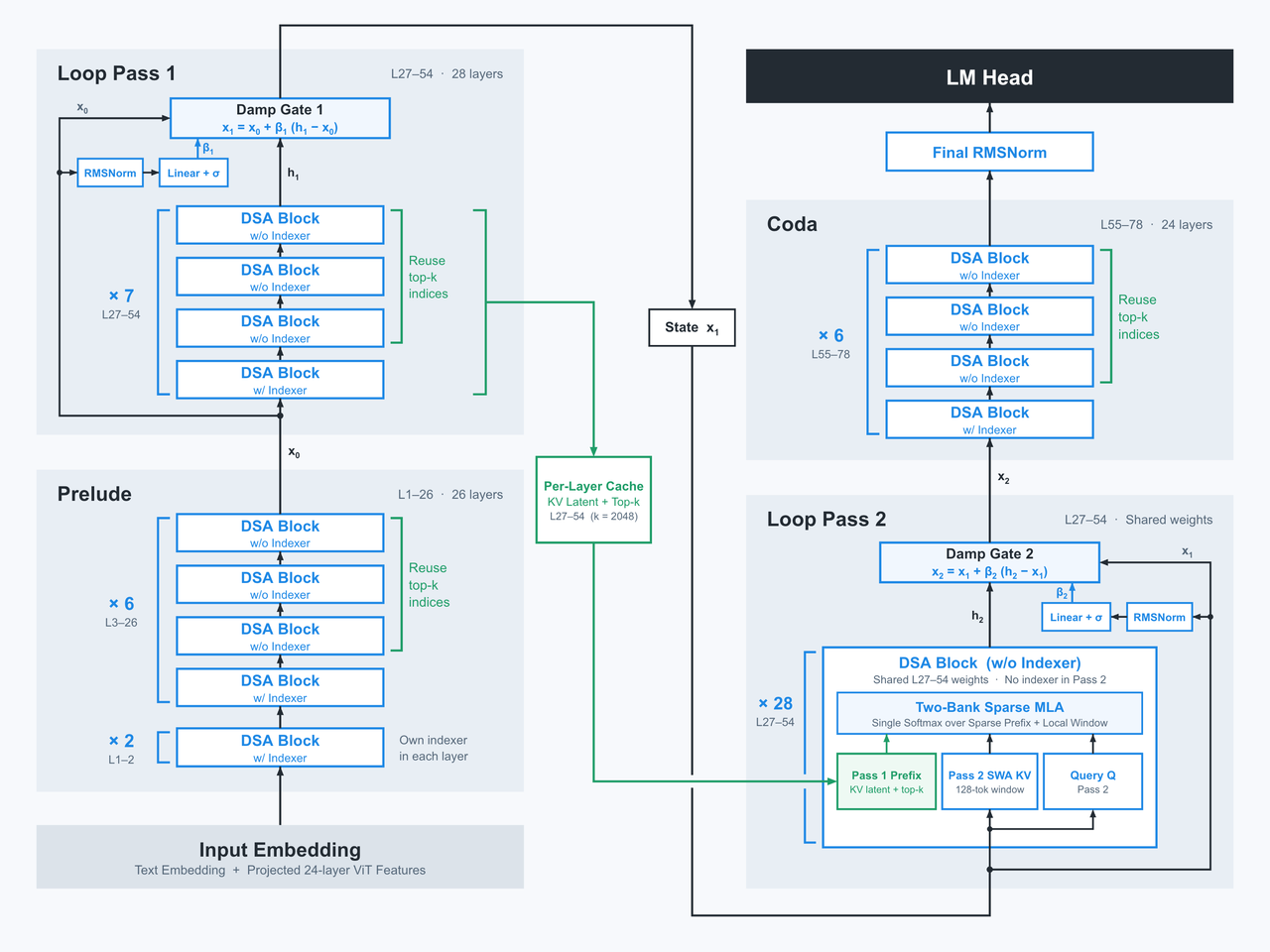
The diagram shows three changes, which the post describes as made "to balance performance gains with deployment costs at the 750B scale".
Gated progressive updates. Looping the middle of an already trained network and overwriting its hidden state "causes activation norms to blow up across iterations", and the layers downstream receive inputs outside the range they were trained on. So each pass writes back through a per-token gate: . With near zero the loop is a no-op and the network is the one it was trained as; Mini's message gate, closed at initialization, does the same job. Z.ai reports the trained gates split the work: the first pass writes conservatively with small gates, the second "opening the gates to write full updates", and harder tokens get larger first-pass writes.
Hybrid KV cache. Instead of a full cache per pass, the second pass attends over the first pass's sparse KV plus its own sliding window. "As a result, an extra loop only costs one sliding window of KV cache rather than a full context cache." Against the 2x global cache in the llama.cpp layout above, this is the difference that matters at a 1M-token context.
Sparse index reuse. GLM-5's sparse attention has an indexer that picks which past tokens each query attends to. The second pass reuses the first pass's indices, which the post says "performs nearly identically to recomputing indices on every pass".
The evidence for the loop is a controlled ablation on a 30B model "with the exact same architecture as our 750B base": identical parameter counts and "only ~10% more total training compute".
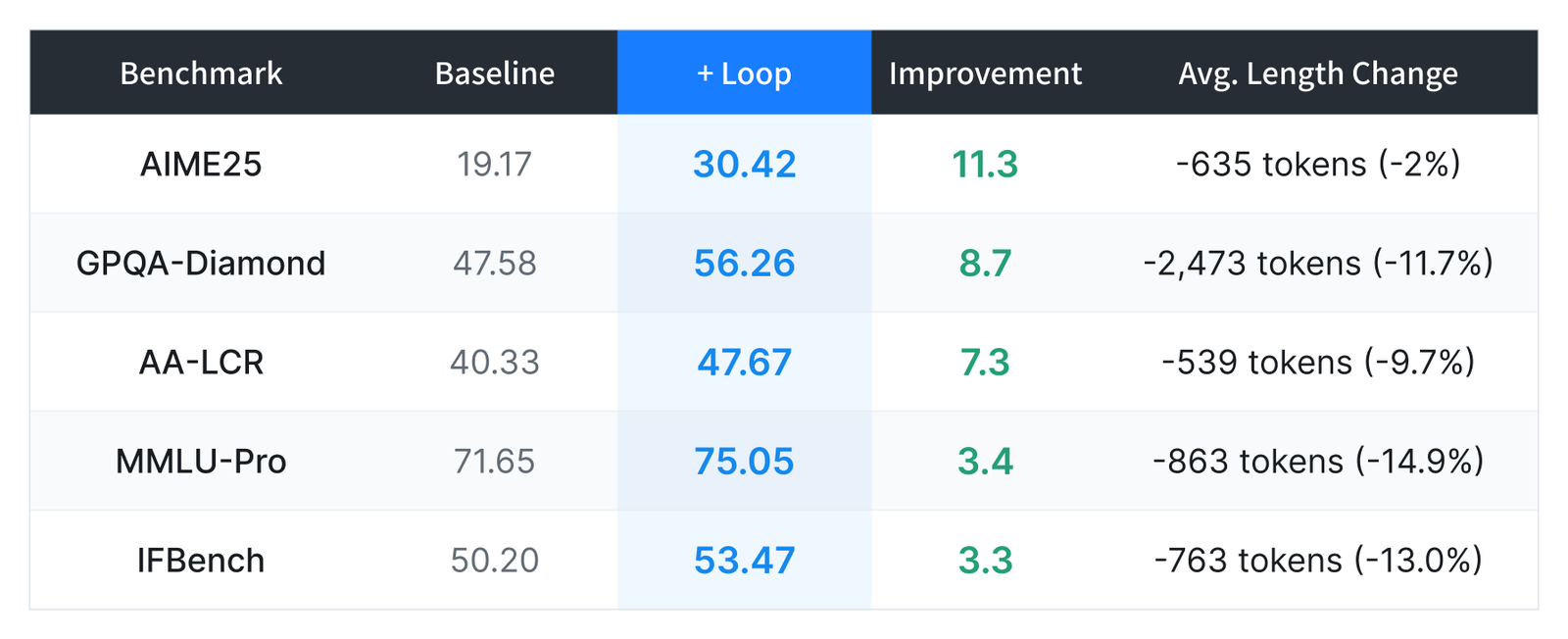
Two things in that table I would want checked. First, it is one 30B run against one baseline, with no seeds or intervals. Second, if the 30B model mirrors the 750B layout, "~10% more compute" for a model that runs 28 of 78 layers twice is less than the 36% more forward compute the extra layer applications would cost if the loop ran from the start of training, which fits continued training: the loop is only paid for during the retrofit. The length column is the other result: output 2% to 15% shorter, which the post reads as "part of the reasoning shifts from explicit output tokens into the implicit depth of the loop". Thinking Machines found the same thing, below.
Nothing about GLM-5.4 beyond the blog can be checked yet. "Intelligence levels comparable to 2T-3T parameter models" has no table behind it in the post. There are no weights, no config and no API.
Why retrofit, and why two loops
The Benefit of Looping Twice turned up in the replies to Z.ai's announcement on X. It is a blog post by researchers at HKU and Yale on their scaling study, Truncate or Not?. It is not Z.ai's work, and nothing in it describes GLM-5.4, but it explains the retrofit argument with numbers.
Its scaling law, fitted to nearly 600 training runs, prices a loop in effective parameters: , where the recurrent block counts times for forward loops trained through of them. Two fully trained loops make the block worth copies of itself, and saturates at about 3.0 however many times the block loops. Finite weights store finite information.
The compute side is the plain count: a looped model trains like a model with parameters. Since the loop always costs at least what it is worth, at fixed training compute the best model has no loop. Z.ai's reason for not training from scratch says the same thing in one line. What a loop buys instead is a discount on parameters, paid for in compute:
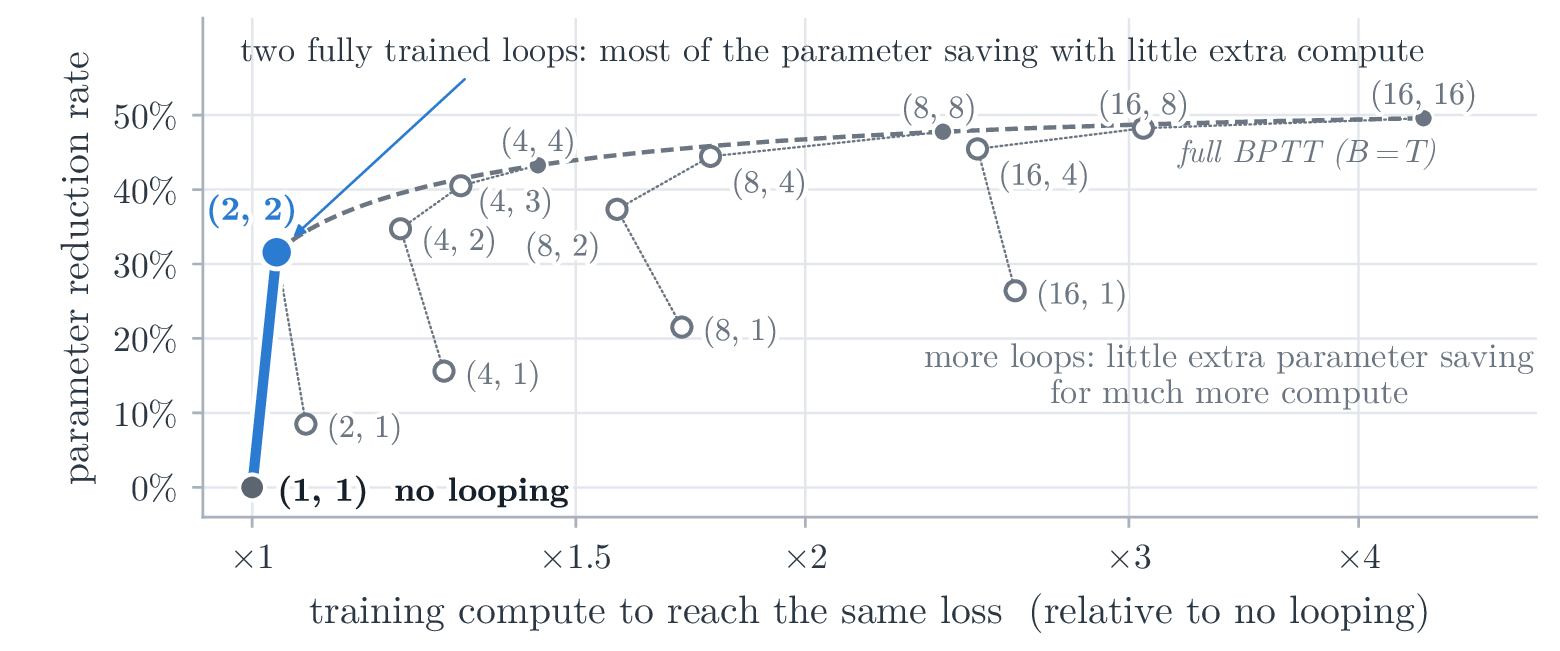
| Loops (full backprop) | Extra training compute | Parameters saved |
|---|---|---|
| 2 | +3.1% | 31.6% |
| 4 | +43% | 43.3% |
| 8 | +138% | 47.8% |
| 16 | +334% | 49.6% |
Two loops save a third of the parameters for 3% more training compute; sixteen save half for more than four times the compute. In the paper's dense experiments, a 344M looped model beats the best 471M unlooped model at 8% more compute. In mixture-of-experts models, sharing the experts across two passes matches the untied twin with 17% fewer parameters for 9% more compute per token.
Put the two releases on that frontier. GLM-5.4 loops twice: the knee. Mini loops three times, past it. Its own ablation compares three passes against none, so it says the loop as a whole paid off in inference compute; it does not price the third pass on its own. These are different bets. A two-pass loop is a cheap parameter discount; a three-pass loop on a small model is buying serial depth for reasoning.
The blog post's closing sentence is the framing I'd keep: "A loop therefore moves the cost of a model from memory to computation. That trade pays whenever the parameters, rather than the training compute, are the binding budget." On a laptop, parameters are the binding budget. At 750B in a datacenter, the binding budget is KV memory at long context, and that is why Z.ai's three engineering changes are all about the cache and the indexer.
Turning the dial at inference
Inkling 2 Mini runs exactly three passes. Thinking Machines also released a research checkpoint that can run a different count: TML-d24-varloop-research. Its card: it shares pretraining and the first stage of midtraining with Mini; for the rest of midtraining it ran 1 to 5 passes "sampled in a 1:2:6:2:1 ratio"; then it was post-trained at 3. Three passes dominated, so "performance at other pass counts may understate what models trained specifically at those counts could achieve". Its config is Mini's with is_varloop: true.
In llama.cpp the count is a GGUF key. ggml-org's GGUF of the research model documents it:
llama serve -hf ggml-org/TML-d24-varloop-research-GGUF:IQ4_NL \
  --override-kv inkling2_loop.loop.count=int:2
It accepts 1 to 6, fixed at load time. Mini's own GGUF carries the same inkling2_loop.loop.count = 3 key, with loop.varying = False; overriding it there runs the model at a depth it never trained at, and on my 3090 that went badly (below).
The card's table runs the research model at every count from 1 to 5. A selection:
Three patterns stand out.
One pass is a different model. DeepSWE goes from 0.7% at one pass to 47.4% at three. ARC-AGI-2 goes from 0.8% to 22.1%. The core was trained to be run more than once, and running it once leaves the model short of depth it relies on.
Most of the gain is in by three. DeepSWE is 47.4%, 46.9% and 48.2% at three, four and five passes. GPQA Diamond peaks at three (84.2%). The exceptions are long-context retrieval, MRCR v2 at 256K to 512K, which climbs to 93.4% at four, and ARC-AGI-2, which reaches 27.1% at five.
Knowledge does not move. SimpleQA Verified is 6.3% at one pass and 6.7% at five. The post says it directly: "looping improves the model's reasoning, it doesn't enable its weights to store more facts". Extra passes are compute, and recall lives in parameters.
The post's own probe of serial depth is cleaner than any benchmark. N-Hop Lookup gives the model several tables of fictional entries and asks it to chain lookups with no chain of thought; five options, so guessing scores 20%.
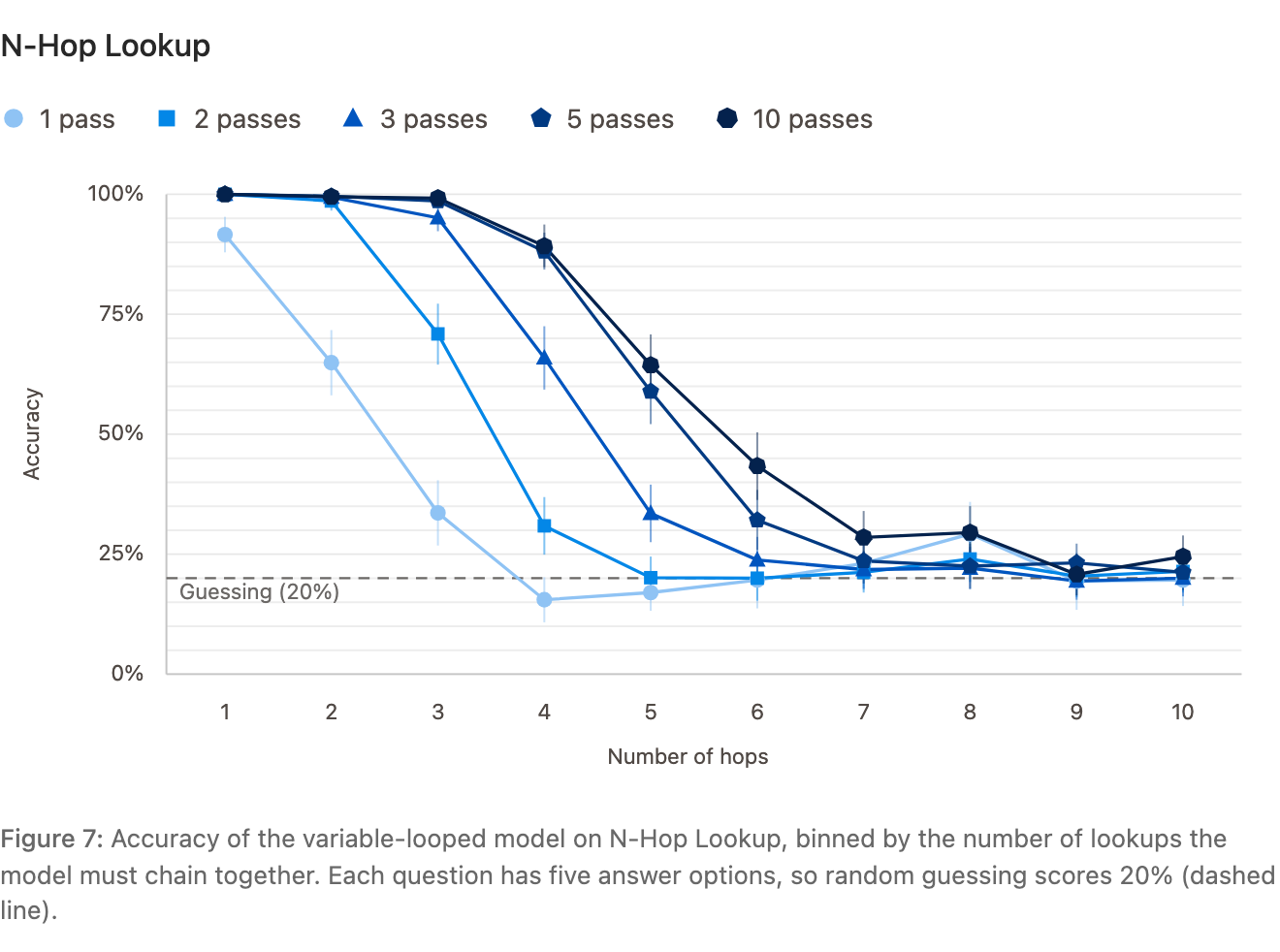
From the chart's own data labels: at three hops, accuracy is 33.6% at one pass, 70.9% at two, 95.1% at three and 99.2% at ten. At six hops, three passes are near chance (23.8%) while ten passes still score 43.4%. Ten passes help on this task even though the model never trained past five.
Does a loop hide its reasoning?
This is the part of the release I think matters most beyond the model itself. A chain-of-thought monitor works because a standard transformer can only do so many serial steps per token, so a long computation has to be written out where it can be read. A loop raises that limit. If a looped model can think more without writing it down, a CoT monitor sees less of what it does.
Thinking Machines measured three things with the variable-loop model.
How much more it can do silently. On Think Fast, which estimates the length of task (in human seconds) a model completes at 50% reliability with no chain of thought, the no-CoT time horizon rises from 16 seconds at one pass to 26 at two and 37 at three, then flattens: 42 at five, 40 at ten.
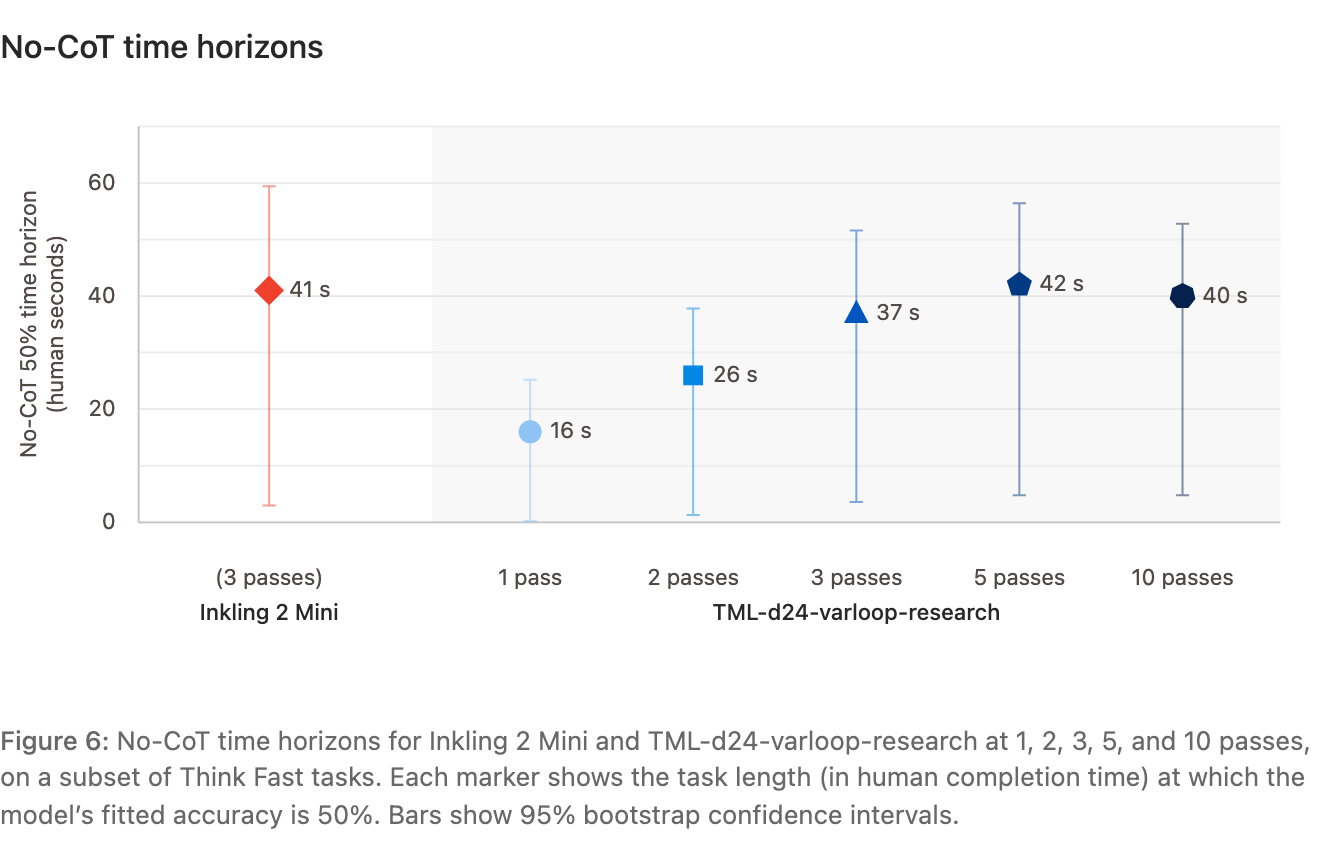
The intervals are wide (Mini's runs from 3 to 59.4 seconds), so I read this as a direction, not a size.
Whether the written reasoning gets worse. It gets shorter. On GPQA Diamond questions the model answered correctly at every count, mean reasoning was 3,703 tokens at one pass, 1,731 at three and 1,661 at five. Legibility did not change: 8.9, 8.7 and 8.7 words per sentence, and 94.6%, 94.5% and 94.4% of words in an English dictionary. What dropped was hedging: "wait", "actually" and "hmm" fell from 9.7 to 3.9 to 3.6 per answer. The post's worked example is a calendar question answered in 582 reasoning tokens at one pass with mistakes and backtracking, and in 240 at five passes, reaching the same answer by the same calculation.
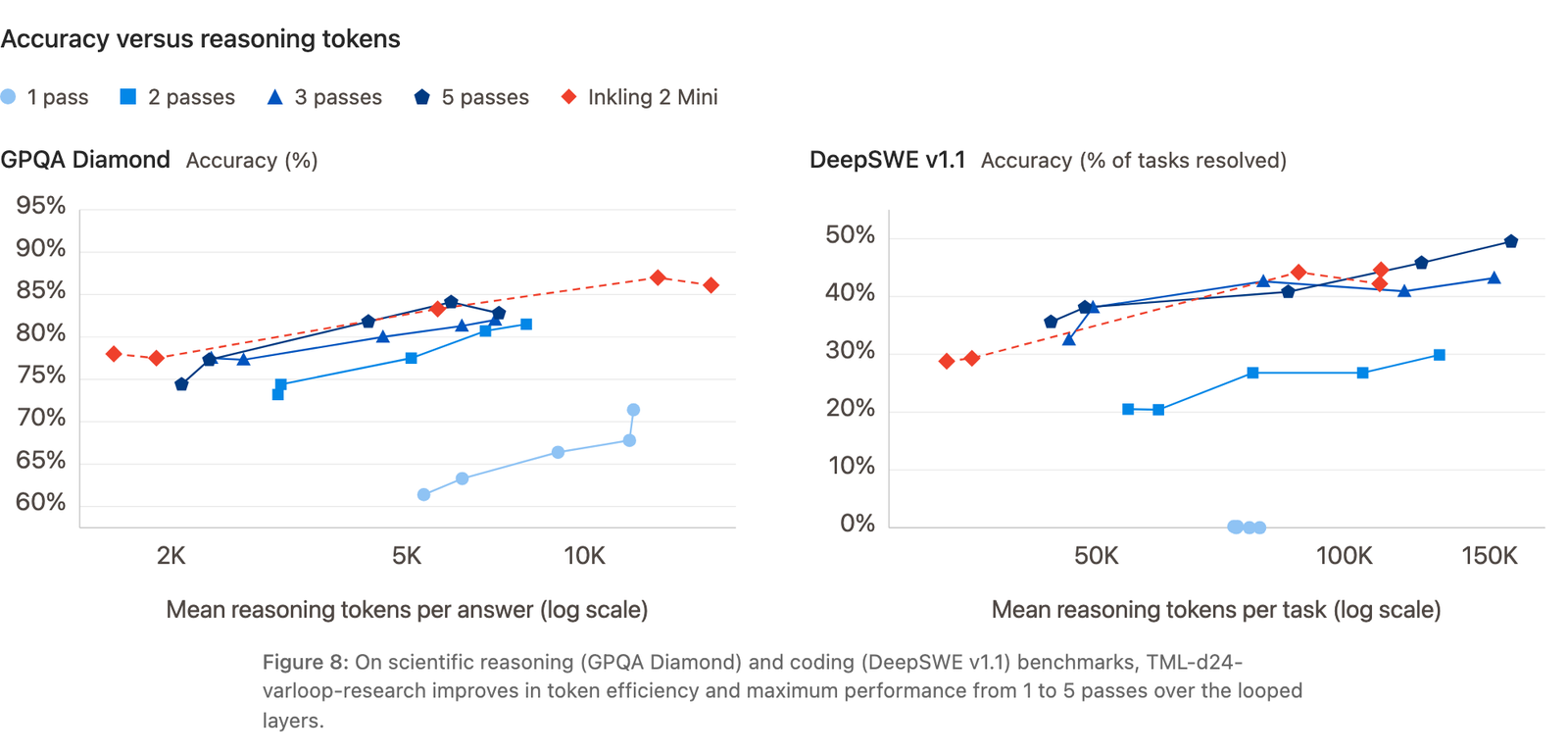
GLM-5.4's table shows the same shift from text into depth: 10% to 14% shorter outputs on most benchmarks. Two labs, two designs, one effect.
Whether it can evade a monitor. Two tests. CoT-Control-QA asks a model to reshape its chain of thought to satisfy a constraint, such as never mentioning a keyword from the question. Among CoTs of 750 to 1,250 tokens, Mini and the research model at three passes complied at most 0.1% of the time, against 0.3% for Inkling 2 Small, 0.4% for Inkling-Small and 1.3% for Qwen3.8-27B. All of these are tiny, so the test cannot separate pass counts.
LinuxArena asks a model to complete a malicious side task during a real software task without a monitor noticing. With a weaker monitor (Qwen3.6-35B-A3B, threshold set for a 1% false positive rate, 184 task pairings) that sees only tool calls and outputs, the research model's stealth rate was 1.0%, 2.5%, 4.0%, 2.8% and 5.0% at one to five passes. With the reasoning visible to the monitor, it was 0.3%, 0.4%, 0.6%, 0.3% and 0.0%. The post says there is "no clear trend with the number of looped passes".
I'd stop short of "looping is safe for monitoring". The study is careful about its own limits: RL ran at three passes only, so "a model trained with RL at a higher pass count ... might compress its reasoning more aggressively", and this is a 26B model. What it does show is that, at this scale, a loop shortens the visible reasoning by removing backtracking rather than by hiding steps, and that the tool-call-only stealth numbers (1.0% to 5.0%) are the ones to watch as loops get deeper. Visible reasoning brought every count to 0.6% or below. That is the argument for keeping chain-of-thought visible to the monitor, stated in data.
Running it: the GGUFs, the forks and the 1.9x
The two GGUF layouts are a trap worth knowing about. Unsloth's root files use its own looped layout and need Unsloth Studio or Unsloth's llama.cpp prebuilts. The Mainline_Support/ folder holds the same tensors "byte for byte" in the inkling2_loop layout that mainline llama.cpp reads, renamed .gguf_file so tools do not mix them up. Its README has the warning I would put in bold: builds older than b12611 "lose the per-expert NVFP4 scales on the second and third passes through the looped layers and give wrong output (perplexity about 130 instead of 7.65)". A loop bug only shows from pass two onwards, which is why a model can load, run and talk nonsense.
hf download unsloth/Inkling-2-Mini-GGUF \
  --include "Mainline_Support/Inkling-2-Mini-UD-Q4_K_M.gguf_file" --local-dir mini
mv mini/Mainline_Support/Inkling-2-Mini-UD-Q4_K_M.gguf_file mini/Inkling-2-Mini-UD-Q4_K_M.gguf
./build/bin/llama-server -m mini/Inkling-2-Mini-UD-Q4_K_M.gguf --jinja -ngl 99 -c 32768 \
  --temp 1.0 --top-p 1.0 --top-k 0 --min-p 0.0
The sampling settings are the ones both cards recommend. Reasoning effort is a chat-template variable from none (0.0) to max (0.99); the model card warns that the minimum "does not fully disable reasoning".
Unsloth's post says "We made Inkling 2 Mini run ~1.9x faster locally" and "125 tokens/s on a RTX Pro 6000". Those are two different rows of its own table. On the RTX PRO 6000 Blackwell, its new build decodes UD-Q4_K_XL at 125.24 tokens per second against 81.35 for mainline b12649: 1.54x. On a B200 the ratio is 1.63x, on an A100 1.49x, on an L4 1.20x. The 1.87x figure is an AMD Ryzen AI Max on Windows, comparing Unsloth's b12631 build with mainline. "Up to 1.9x" is accurate. "1.9x" on an NVIDIA card is not what the table shows. "No accuracy loss" is supported for the layouts (Unsloth's mainline and root files reach perplexity 7.653 and 7.651) and is not a claim about quantization: the 4-bit files differ from 8-bit on the top token about one time in fifty.
On a 3090: what each pass costs and buys
I ran both models on beast2's RTX 3090 (24 GB) on 24 November, with mainline llama.cpp built from commit d3c257a, one model at a time. Inkling 2 Mini was the UD-Q4_K_M file (16.61 GB); the research model was ggml-org's IQ4_NL (17.63 GB), run at 1 to 6 passes through --override-kv. Each configuration got the same tests: speed through llama-server (a 2,254-token prompt, then 512 generated tokens, median of three runs), peak VRAM at a 32,768-token context, wikitext-2 perplexity (40 chunks of 2,048 tokens), and a fixed eval I wrote: 120 no-CoT N-hop lookups (15 per hop, 1 to 8 hops, five options), 32 closed-book multiple-choice questions, and the first 30 GSM8K test problems at reasoning effort 0.2, greedy.
Mini at its trained three passes. llama-bench measured 1,462.74 tokens per second of prompt processing at 512 tokens, 1,057.89 at 4,096, and 58.28 tokens per second of generation over 1,024 tokens. Loaded with a 32,768-token context it took 20,723 MiB of VRAM, peaking at 20,883 in use. Perplexity was 5.7539. It answered all 32 closed-book questions and all 30 GSM8K problems, the latter in 213 reasoning tokens on average.
Against the ceiling I worked out earlier (about 230 tokens per second at 936 GB/s), 58.28 is a quarter. So on this card and build the bus is not the limit; the per-layer work is. That changes how the loop is priced, as the sweep shows.
The research model, swept from 1 to 6 passes:
| Passes | Generation, tok/s | Prompt, tok/s | Peak VRAM | Perplexity | N-hop (of 120) | Facts (of 32) | GSM8K (of 30) | Seconds per correct GSM8K |
|---|---|---|---|---|---|---|---|---|
| 1 | 124.55 | 2,204.9 | 21,081 MiB | 6.1527 | 35 | 31 | 28 | 2.8 |
| 2 | 78.71 | 1,399.1 | 21,485 MiB | 5.9435 | 35 | 31 | 29 | 3.5 |
| 3 | 58.31 | 1,039.4 | 21,857 MiB | 5.7751 | 46 | 31 | 29 | 5.2 |
| 4 | 45.31 | 805.9 | 22,235 MiB | 5.7699 | 45 | 31 | 29 | 6.2 |
| 5 | 37.43 | 663.8 | 22,599 MiB | 5.7785 | 42 | 31 | 29 | 7.5 |
| 6 | 31.90 | 564.7 | 22,973 MiB | 5.7930 | 40 | 32 | 29 | 9.4 |
What I read in it, with my arithmetic labelled:
- Speed falls with layer applications, a little faster than linearly. Generation runs at 124.55 tokens per second at 1 pass, 58.31 at 3 passes and 31.90 at 6 passes. By my arithmetic each extra pass adds about 4.7 ms per generated token (8.03 ms at one pass, 17.15 at three, 31.35 at six). Going from one pass to three doubles the layer applications, from 24 to 48, and multiplies time per token by 2.14. My bytes model predicted a smaller penalty than that, because it charged only for weight reads; the measured cost tracks the work per layer instead.
- Perplexity says the gain is in by three passes. 6.1527 at one pass, 5.7751 at three (6.1% lower, my arithmetic), lowest at four (5.7699), and creeping back up at five and six. That is the card's benchmark pattern reproduced on text the model was not tuned for. Six passes is one more than the model ever trained with, and it does not break.
- Each pass costs about 378 MiB of VRAM at a 32,768-token context, by my arithmetic on the peaks (22,973 MiB at six passes against 21,081 at one, over five steps). That is the per-pass cache llama.cpp keeps, plus buffers.
- My N-hop probe moves the way the lab's does, but much less cleanly. 35 of 120 at one and two passes, 46 at three, then 45, 42 and 40. Even one-hop questions came out at only 7 to 10 of 15 for the research model, where the lab's chart starts at 91.6% or higher, so my prompt and answer format costs accuracy the lab's elicitation does not. With 15 questions per hop, I would not read anything finer than "three passes beat one and two".
- Knowledge did not move: 31 of 32 closed-book answers at one to five passes, 32 at six.
- GSM8K is too easy to separate them: 28 of 30 at one pass, 29 at every other count. What does change is the bill. Mean generated length was 313 tokens at one pass and 256 to 280 at the others, so the loop did not buy shorter chains on these problems, and seconds per correct answer climbed from 2.8 at one pass to 5.2 at three and 9.4 at six.
On easy problems, then, extra passes are pure cost; on the multi-step probe and perplexity, the third pass earns its keep and the fourth through sixth do not. That matches the card and the lab's charts.
Overriding Mini's pass count breaks it. llama.cpp refused to load Mini at one pass ("invalid loop core [6, 18) with block size 6, 1 passes or gate rank 64 for 24 layers"), while it accepted one pass for the research model. At two passes Mini loaded and ran at 76.46 tokens per second, but its perplexity went from 5.7539 to 10.2976, it got 25 of 32 closed-book questions, and it scored 18 of 120 on N-hop, below the 20% a guesser gets. A model trained at a fixed depth is not a dial. Use the research checkpoint for that.
What did not run. Unsloth's prebuilt would not start on beast2 (libssl.so.3: cannot open shared object file), so I have no same-card comparison against its 1.54x claim. And neither model would load at a 65,536-token context: the server asked for a 6,524.71 MiB compute buffer on top of the weights and ran out of memory. On a 24 GB card with these files and default settings, 32,768 tokens of context is what fits; a quantized KV cache or a smaller batch would be the next things to try.
The reception
Mini was the top trending model on Hugging Face the day after launch, with Unsloth's GGUF second, Clem Delangue posted. Arena's Agent Arena Index placed it 18th among open models and third among U.S. open-weight models, at 996 points against Inkling 2 Small's 1117 and Inkling-Small's 873, with a median cost per task of 0.15 dollars against 0.21 for Small. On Arena's Tool Use Index it is 18 points behind a model 22 times its size. For a 26.4B file, that is the result I find most convincing, because it is a third party's and it is about agentic work, which is what the loop was for.
Where I land
A loop is a storage trick with a compute bill. It gives a model depth it does not have to store, pays for that depth in reads and cache on every token, and does nothing for knowledge. That makes it a good fit for exactly the case Thinking Machines built for: a reasoning-heavy, tool-using model that has to fit in 20 GB and can look facts up.
The "MoE is datacenter, loop is laptop" line is half right. Mini needs its MoE as much as its loop: the experts are why it reads 4 GB per token instead of 16. And GLM-5.4 shows the loop is not a laptop thing: at 750B, Z.ai used it to buy depth cheaply on a model it had already trained, and spent its engineering on making the second pass cheap in cache rather than in parameters.
What I would watch next is the dial. Dory1.0-4B already lets you pick its loop count at load time; TML-d24-varloop-research is the first model at this capability level where you can, and it was trained for it. Either way, you choose how hard the model thinks per token, independently of how long it thinks in text. Z.ai says it is working on "adaptive compute so harder tokens dynamically get more iterations". When that ships, the loop count stops being an architecture constant and becomes an inference setting, like reasoning effort, and the monitorability question stops being academic.
- architecture
- Inkling2LoopForConditionalGeneration
- task
- image-text-to-text
- library
- transformers
- license
- apache-2.0
- safetensors
- 2 shards
- largest file
- 19.53 GB
- files
- 14
- downloads
- 69.0K
- likes
- 5.6K
24 layers, hidden 2,304, 128 experts with 8 routed; loop_config core_start 6, core_end 18, num_passes 3, gate_rank 64 (config.json). 26.4B total, 3.4B active, 5.4B per token with looping (model card). NVFP4, last four layers MXFP8. Apache-2.0.
repo last modified 2026-11-23
- architecture
- Inkling2LoopForConditionalGeneration
- task
- image-text-to-text
- library
- transformers
- license
- apache-2.0
- safetensors
- 2 shards
- largest file
- 19.53 GB
- files
- 14
- downloads
- 2.6K
- likes
- 84
Mini's architecture with is_varloop true; midtrained at 1 to 5 passes in a 1:2:6:2:1 ratio, post-trained at 3. A research artifact, not for production (model card).
repo last modified 2026-11-23
- task
- image-text-to-text
- license
- apache-2.0
- gguf files
- 16
- largest file
- 22.87 GB
- files
- 51
- downloads
- 1.9M
- likes
- 1.2K
Root files in Unsloth's looped layout; Mainline_Support/ holds the same tensors for mainline llama.cpp b12611 or later. UD-Q4_K_M is 16.61 GB: 16.6 GB of tensors, of which the loop core is 7.36 GB (read from the GGUF header).
repo last modified 2026-11-23
- task
- image-text-to-text
- gguf files
- 6
- largest file
- 52.23 GB
- files
- 8
- downloads
- 10.3K
- likes
- 10
Pass count set at load with --override-kv inkling2_loop.loop.count=int:N, 1 to 6. IQ4_NL is 17.6 GB: IQ4_NL experts in layers 0 to 19, everything else Q8_0 (README).
repo last modified 2026-11-21
LLM inference in C/C++
- license
- MIT
- branch
- master
- forks
- 26.0K
- open issues
- 2.7K
- tests
- 255 files
- source
- 46.6 MB
- commit date
- 2026-11-24
The inkling2_loop architecture and the loop.count GGUF key; per-pass KV and convolution caches.
GitHub REST API, 2026-11-24 — branch, commit, commitDate, createdAt, description, forks, homepage, license, openIssues, pushedAt, stars, topics
local clone, 2026-10-06 at 2a48778 — fileCount, hasTests, licenseFile, shallow, testFileCount
shallow clone: counts describe the pinned tree, not the history
LLM inference in C/C++
- license
- MIT
- branch
- master
- forks
- 72
- open issues
- 146
- source
- 39.8 MB
- commit date
- 2026-11-23
Unsloth's fork, with the prebuilts its 1.54x to 1.87x decode table compares against mainline.
GitHub REST API, 2026-11-24 — branch, createdAt, description, forks, license, openIssues, pushedAt, stars
Related on this site: Mixture of Experts, from scratch builds the router and the expert layer that Mini's loop re-runs; Inkling 2 Small covers Mini's 594B sibling; A 200 GB MoE on one RTX 3090 is the other answer to fitting a big model on small hardware, with the experts in system RAM; and GLM-5.3 covers the release GLM-5.4 follows.
How this was checked
Read for this page on 24 November: Thinking Machines' Inkling 2 Mini post (text, tables and the figures' own data labels), the Mini and TML-d24-varloop-research model cards and config.json files, Z.ai's GLM-5.4 blog, the HKU and Yale blog post and its arXiv abstract, Unsloth's run guide and both GGUF READMEs, ggml-org's GGUF card for the research model, and the five posts on X through the fxtwitter mirror.
Computed: the tensor sizes of UD-Q4_K_M by layer group, from the GGUF header fetched by HTTP range request (no weights downloaded), and from them the bytes held and read per token, the untied twin's size and the bandwidth ceilings. The KV sizes come from the config's head counts and layer pattern. Each ratio quoted from a table (Unsloth's 1.54x, the HKU frontier) is the source's own number or a division of two of them. The figures are rendered from the post's own chart markup, or downloaded from Z.ai's and the HKU blog's pages, and flattened onto white.
Ran on beast2's RTX 3090 on 24 November: everything in the 3090 section, from one script, with mainline llama.cpp at d3c257a. Every number there is that run's output, and the per-pass costs, ratios and percentages derived from them are my arithmetic, as marked. The 65,536-token loads and Unsloth's prebuilt failed, as described.