2026-11-16 · 24 min · inference · deepseek · speculative-decoding · cuda · rust · kernels
A 2:32 narrated explainer, drawn in code. Every number and picture in it is this article's own; the sources are below.
› transcript
One request. A whole Tetris game in under three seconds. Its makers wrote an engine for exactly one model, DeepSeek V four point one Flash, in Rust and CUDA. What does that speed measure? Hi, I'm Torque. Who does this engine serve, how does one step run on four GPUs, and where does the time go? Picture sixty-four users sending requests at once. This server decodes one of them. The rest wait. So seventeen forty is what one user sees, and all the box makes. Each token picks six experts out of three hundred and eighty-four. A throughput engine sends each token to the GPU that owns its expert. At batch one, some GPUs get double work and one gets none. This engine slices every expert by its width. Each GPU computes a quarter of all six, so the load is even. Then the partial sums are added with plain stores over NV Link. No collective library. Each step is one graph launch. The CPU only reads back the step before. Three draft layers guess six tokens at once. The checkpoint says five; the engine raises it to six. A confidence head picks how many guesses to check, and a switch inside the graph runs that body. All forty layers check the guesses together. On Tetris it keeps five point six tokens a step. On four GPUs a step takes three point three milliseconds. Double the GPUs and it only drops to two point seven one. Fit a line through both, and about two point one milliseconds never shrinks: forty layers of small stages waiting on each other. Even with endless GPUs, that caps one stream near twenty-six hundred tokens a second. An outside model, from a team proposing its own chip, found the same split: about half streaming, the rest waiting. Per GPU it makes four hundred and thirty-five tokens a second. Throughput engines make thirty to sixty times more. One request at a time. One model, on Blackwell only. Temperature fixed at one. And a licence that is not open source. Good code, oversold numbers. One stream on this model is now limited by waiting, not bandwidth. The next win is there. One request, sliced experts, and a fixed cost GPUs cannot buy back. Thanks for watching! Every source is in the full article. I'm Torque. Bye!
Why read this
Notabletop 60%Baseten's DeepSeek engine read from source: one job per replica, TP-sliced experts, a graph-side verify switch, and the bytes behind 1,740 tok/s.
- Original analysis
- A new technique
- Concrete numbers to act on
Inference & servingNeeds datacenter GPUsElastic-2.0Practitioner teardown
How this was scored
- Is it new?
- 2 of 3: A real new idea, method or capability
- Can I trust it?
- 2 of 3: Measures key facts from files, code or configs
- Can I run it?
- 1 of 3: API-only, gated or restrictive licence
- Will I understand it?
- 2 of 3: Mechanism from first principles with figures
- Can I act on it?
- 2 of 3: A concrete recipe, numbers or comparison
- Will it last?
- 1 of 3: Relevant for months
- Does it affect many?
- 1 of 3: A specialist community
- Only here?
- 2 of 3: A teardown or measurement few others did
Score 60 of 100, ranked 436 of 748 rated articles. Each question is answered 0–3 by hand, and a 3 is rare. How articles are scored
On 13 November Baseten posted that it had
"built an inference engine for DeepSeek V4.1-Flash from scratch in Rust and CUDA", with three
numbers: about 1,740 tokens a second decode on 4xB300, about 2,060 on 8xB300, and a 1M-token
prefill in about 12 seconds. "It's open-source." The post quotes a thread by
@saltyph, one of the engineers who built it, that adds "the core engine is just rust + cuda. no
pytorch, no sglang, no dsls, etc." and links the repository,
basetenlabs/deepseek-ultrafast.
The replies split into two camps. One said this beats vLLM and SGLang. The other asked what batch
size, what context, whether decode is speculative, and why doubling the GPUs bought so little. Both
are answerable from the repository, so I read it: 17,319 lines of Rust, 14,242 of CUDA, 131
__global__ kernel definitions, at commit 76766a9. I could not run it. It needs four or eight
Blackwell GPUs and the 510 GB checkpoint, so every speed below is Baseten's, and every byte count and
code path is mine.
- license
- custom
- branch
- main
- forks
- 30
- open issues
- 0
- source
- 1.3 MB
- commit date
- 2026-11-14
GitHub REST API, 2026-11-16 — branch, commit, commitDate, createdAt, forks, languages, license, openIssues, pushedAt, stars
One request at a time
The README's table is more careful than the post. Its four-GPU column is 4 x GB300 (TP4) and its eight-GPU column is 8 x B300 (TP8): two different machines, not one machine with more GPUs. Both have Blackwell Ultra GPUs with 8 TB/s of HBM each, but a GB300 node pairs the GPUs with Grace CPUs, and the engine picks different kernels for each width at runtime (more on that below). The post's "4xB300" is not what the README measured.
The rows are:
| 4 x GB300, TP4 | 8 x B300, TP8 | |
|---|---|---|
| Decode | 1,740 tokens/s | 2,060 tokens/s |
| Step time | 3.30 ms | 2.71 ms |
| Acceptance length | 5.6 tokens a step | 5.6 tokens a step |
| Prefill, 1,000,000 tokens | 13.2 s (76,000 tokens/s) | 11.7 s (85,000 tokens/s) |
All decode rows come from one prompt: "implement the tetris game. output HTML code directly - no
explanation." The reproduction script in the README sends it with "thinking": {"type": "disabled"},
measures from the first streamed token to the last, and prints a line like 5142 tokens at 1,717 tokens/s. It reports ranges too: "We see 1,700-1,770 tokens/s on 4xGB300 and 1,980-2,170 tokens/s on
8xB300", and "Over 30 runs we see 3.24-3.37 ms and 5.1-6.1 tokens/step on 4xGB300, and 2.69-2.74 ms
and 5.3-6.1 tokens/step on 8xB300."
The thing the README does not say in words is in crates/server/src/engine.rs. Each replica pulls
one job off its admission queue, and all of its GPUs work on that job until it retires:
// crates/server/src/engine.rs (abridged)
while let Some(job) = shared.next_job(r, admission)? {
    w.job(&job)?;
    drop(job);
    shared.retired(r);
}
There is no batching. A second request waits until the first finishes (the queue prepares up to six jobs ahead, looking up where their KV cache lives, but decodes one). So 1,740 tokens a second is the speed one user sees and also the total output of the four-GPU box: 435 tokens a second per GPU, or 257.5 on the eight-GPU box. That is the right way to read this engine. It is a latency machine. It answers "how fast can one stream go", not "how many tokens can a GPU make".
The sampling is fixed as well. docs/SERVER.md: "temperature and top_p are fixed at 1; other
values are rejected." Logprobs, structured output and strict tool schemas return 400. The context is a
few thousand tokens; no decode number at long context is published, though the server takes 1,048,576.
The model it was cut for
DeepSeek-V4.1-Flash is an odd model to serve, which is part of why a dedicated engine makes sense. The site's file-level read of the checkpoint has the facts this piece leans on: 40 layers, each with 384 routed experts plus one shared, 6 routed per token; one routed expert is three 2304 x 5120 matrices stored in FP4 with a scale per 32 values; attention, shared experts, routers and the hyper-connection mixers are 7.20 GB, mostly FP8; the routed experts total 288.78 GB; two Engram n-gram tables are another 202.76 GB; and a decoded token reads 13.04 GB at the shipped precision, of which the routed experts are only 4.51 GB.
The config.json adds the parts an engine has to implement:
- Attention with one KV head. 64 query heads of width 512 share a single 512-wide KV (with a
64-wide rotary part), behind a low-rank query (
q_lora_rank1280) and a grouped low-rank output (o_groups8). It is DeepSeek's latent-attention lineage, compressed further. - A sparse indexer. In every layer but the first two, a small indexer (32 heads of width 128) scores the KV and keeps the top 512 positions; attention reads those plus a 128-token sliding window. From layer 20 on, the indexer only looks inside 2,048 candidate blocks of 8 positions that layer 20 pre-selects.
- A causal encoder-decoder with shared KV. The first 20 layers are an encoder. Layers share KV caches in groups that start at layers 2, 8, 14 and 20, and the decoder's whole cache is layer 20's, computed from the encoder's output. A prompt only has to run through half the network, which is where the 1M-token prefill comes from.
- mHC. Four residual lanes (
hc_mult4) mixed by a Sinkhorn-normalised matrix at every block. - Engram. Two lookup tables at layers 1 and 14, about 384 million rows each, read by hashing the last 2 to 4 tokens.
- DSpark. Three draft layers with 128 experts each (3 active), a Markov head of rank 256 and a block size of 5: the drafter that the DSpark article explains.
A general engine has to make every one of these a pluggable piece. vLLM and
SGLang did, and
DeepSeek's own DeepInfer did with TileLang. Baseten's engine makes none of them
pluggable. weights.rs checks dim == 5120 before it picks its MoE path, and the fast all-reduce only
turns on for sm_103 at TP4 or TP8.
One decode step on four GPUs
Every decode step is one CUDA graph, captured once at startup by capture_spec_vadapt and launched
once per step. Step through it:
The drafter is the place the engine departs from the checkpoint. config.json says
dspark_block_size: 5; crates/cuda/src/profile.rs overrides it:
// crates/cuda/src/profile.rs
pub fn dspark_block() -> Option<usize> {
    match get() {
        (Profile::Sm103Tp4 | Profile::Sm103Tp8, _) => Some(6),
        (Profile::Base, tp) if tp >= 8 => Some(7),
        _ => None,
    }
}
So on GB300 and B300 a step drafts 6 tokens: the drafter runs six rows at once (the last committed
token and five copies of a noise token), the draft head proposes a token per row, and the Markov rounds
condition each proposal on the one before. Verification then runs the anchor plus the drafts through
all 40 layers. spec_accept in ops.cu appends c accepted drafts and one sampled token and
advances the position by c + 1, so a step emits between 1 and 7 tokens. The README's mean of 5.6
means the verifier keeps about 4.6 of 6 drafts on this prompt. HTML for a Tetris game is about as
predictable as text gets; prose and reasoning will not do that.
The verify length is chosen on the GPU. A confidence head scores the drafts against a threshold (0.3
on TP4, 0.2 on TP8, with the last two positions held to half and a quarter of it), and a conditional
switch node inside the graph runs one of six pre-captured verify bodies, for 2 to 7 rows. In a
Python engine that decision is a round trip through the host; here it costs nothing the CPU can see.
The host loop in engine.rs launches step n, then reads back step n-1's committed count from a
double-buffered snapshot while n runs, and streams those tokens to the client.
Sampling never gathers the logits either. The vocabulary of 129,280 is split four ways (32,320 ids a
GPU), each GPU reduces its shard to the statistics speculative sampling needs and pushes those to its
peers (samp_stats). One correctness note sits here: on TP4 the verify head is an FP8 copy of the
BF16 LM head, quantised by fp8_quant at load and selected in head() when verify_head_fp8() is
true, which it is only for sm_103 at TP4. Speculative sampling is lossless with respect to the
distribution the verifier computes, and on TP4 that is the FP8 head's distribution, not the shipped
BF16 one. The repo's run --samp-test checks the first case with a chi-square test against the exact
distribution; nobody has published the size of the second difference, and I expect it is small.
What a single-model engine gets to hard-code
The question the post invites is what you buy by not using vLLM or SGLang. Reading the code, it is mostly choices a general engine cannot make because it has to serve batches.
Experts are sliced, not dispatched. The textbook way to run a MoE across four GPUs is expert
parallelism: each GPU owns 96 of the 384 experts and tokens are sent to the GPU that owns their
expert, an all-to-all each way. That is what throughput engines do at large batch, because each
expert's weights are then read once for many tokens. At batch 1 it is a bad deal: six experts land on
whichever GPUs own them, so some GPUs do two experts' work while others sit idle, and you pay two
all-to-alls per layer. weights.rs instead slices every one of the 384 experts by its hidden width
(inter = moe_inter_dim / tp, so 576 of 2,304 columns on each of four GPUs, 288 on eight). Every GPU
computes a quarter of whatever experts the router picks. The load is perfectly even by construction,
and the only communication is the all-reduce the dense layers need anyway. The router itself is
replicated, so every GPU routes every row without talking to anyone.
The all-reduce is a store. There is no NCCL. comm.cu's push kernels write each GPU's partial
sum directly into every peer's receive buffer with system-scope stores over NVLink, using sentinel
values (negative zero) to tell when a slot has arrived, and each GPU adds the four partials itself.
The sum is fused into the epilogue of the next mHC mix. At batch 1 an all-reduce moves a few tens of kilobytes and is pure latency; skipping a library call, a barrier and a separate
reduction kernel is the whole point. Kernels also use programmatic dependent launch (88 pdl_wait
sites) so the next kernel's prologue overlaps the previous kernel's tail.
Everything that does not depend on the hidden state runs early. The Engram lookups hash the last
few token ids, not activations, so engram_fork starts both layers' lookups before layer 0, on a side
stream. Each GPU holds a quarter of each table's rows (about 51 GB of the 203 GB), gathers the rows
it owns and sums with its peers. The indexer's query weights are replicated so its scoring overlaps
the main query projection on another stream. The drafter's KV for the next step is prepared while the
verify head runs.
Shapes are constants. With at most 16 rows in flight (MAX_M = 16), every matmul is a skinny GEMV.
The engine has its own tcgen05 (Blackwell tensor-core) GEMV kernels for FP4 experts and FP8
projections at exactly these shapes, and 17 files named like variant_zzzzzzzzzzmoe.cu that
build.rs compiles only for sm_103a. Those are the hill-climbed kernels, some specific to TP8
(variant_zzzzzzzztp8.cu). A general engine picks a kernel from a table at runtime; this one was
tuned until the table had one row.
None of these is impossible inside vLLM or SGLang, and vLLM's Kimi K3 decode path on GB300 does a version of several of them. What the dedicated engine removes is the cost of keeping the general path working beside the fast one.
What it gives up
The list is long, and it is the same list as the strengths read backwards:
- One request decoding at a time per replica. Throughput per GPU is 435 tokens a second.
- One model.
ensure!calls ondim, the expert count, the window of 128 and the encoder-decoder layout stop it from loading anything else. - Two GPU families. The README supports GB300 (
sm_103a), B300 (sm_103a) and B200 (sm_100a); the push all-reduce and the variant kernels are off on B200. A reply from someone working on the SCALE compiler found thetcgen05instructions are the blocker for porting. - Temperature and top-p fixed at 1, no logprobs, no structured output.
- A Redis instance and an RDMA port, which the server needs to start.
The last one is the part of the release that is a service and not a demo. Each server keeps recent conversations' KV in host memory. When a conversation's next turn lands on a different replica, that replica fetches the KV over RDMA from the one that has it, and Redis records who owns what. DeepSeek's compression makes that cheap: 890 bytes of global KV per token, so even a 100,000-token conversation is under 100 MB. The README's claim is that this "removes the need for prefix-aware routing" and lets a load balancer send each turn to the least busy replica. That is a sensible design for an engine that serves one request at a time: you scale by replicas, and you want any replica to be able to take any turn. No numbers are published for it.
Bytes per step, not per token
Now the arithmetic. The usual decode roofline for one stream divides the bytes a token reads by the memory bandwidth. Four GPUs at 8 TB/s give 32 TB/s, and 13.04 GB a token takes 0.41 ms, so without speculation the ceiling is about 2,450 tokens a second. Reaching 1,740 that way would mean running at 71% of peak HBM bandwidth on 40 layers of skinny GEMVs with two all-reduces each. Nobody does that at batch 1.
Speculation changes what a step reads, and a common mistake is to multiply the per-token ceiling by the acceptance length. A verify step pushes up to 7 rows through every layer, and each row routes to its own 6 experts. The dense weights are read once per step whatever the row count; the experts are read once per distinct expert. If the 7 rows route independently, the expected number of distinct experts in a layer is ; if they all agree, it is 6. Code tokens are correlated, so the truth is between, and only a profile would say where.
With the sizes from the checkpoint, my count of what one TP4 step reads, summed over the four GPUs:
| Part | All rows share experts | Rows route independently |
|---|---|---|
| Attention, shared experts, routers, mHC | 7.20 GB | 7.20 GB |
| Routed experts, 40 layers x 18.8 MB each | 4.51 GB (6 a layer) | 30.1 GB (40 a layer) |
| Verify head and draft head, FP8, plus Markov head | 1.39 GB | 1.39 GB |
| Drafter: non-expert weights + its experts | 0.88 GB | 1.67 GB |
| Total a step | 14.0 GB | 40.4 GB |
| Time to stream it at 32 TB/s | 0.44 ms | 1.26 ms |
The step takes 3.30 ms. So HBM is busy for 13% to 38% of the step. KV reads are tiny at this context length, and Engram reads 12.7 KB a token. A few hundred megabytes of small projections are replicated on every GPU, which makes the even split slightly optimistic. None of that changes the shape: this engine is not bandwidth-bound. Most of each step is something else.
Set the sharing, the rows and the fixed cost yourself:
Why eight GPUs buy 18%
The replies did this division too: 2,060 / 1,740 is 1.18, for twice the GPUs. The step times say why. Model a step as a part that does not shrink with more GPUs plus a part that does:
The two README rows give and , so ms, ms·GPU and ms. On four GPUs the part that scales is 1.18 ms, 36% of the step; on eight it is 0.59 ms, 22%. With infinitely many GPUs a step would still take 2.12 ms, and at 5.6 tokens a step that caps one stream near 2,640 tokens a second on this software.
The rows come from different machines, and TP8 runs its own kernels, so this is an estimate from two points, not a measurement. Also, 1.18 ms of scalable work at 32 TB/s is 37.8 GB of streaming at peak bandwidth, which sits toward the independent-routing end of my table; at a realistic 80% to 90% of peak it lands inside the range. The two numbers agree with each other, which is all two numbers can do.
What is in the 2.12 ms? Not weights. It is roughly 43 layers' worth (40 verify, 3 draft) of dependent stages: the mHC mix, the query projection, the indexer and its top-k, the attention, the output projection, an all-reduce, the router, the experts, another all-reduce. Each waits for the one before. At about 50 µs of non-streaming time per layer, that is a few microseconds per stage of launch ramp, synchronisation and tail. More GPUs make each stage's arithmetic smaller and leave its latency where it was. The same split showed up in vLLM's Kimi K3 path, where fusion's whole win was in the part that is not bandwidth.
An independent model reached the same diagnosis. The day after the release @aercrist published a simulator calibrated to the README, and its breakdown of a 3.30 ms step puts weight and KV streaming at about 1.4 ms and the rest in collectives and per-stage fixed latency:
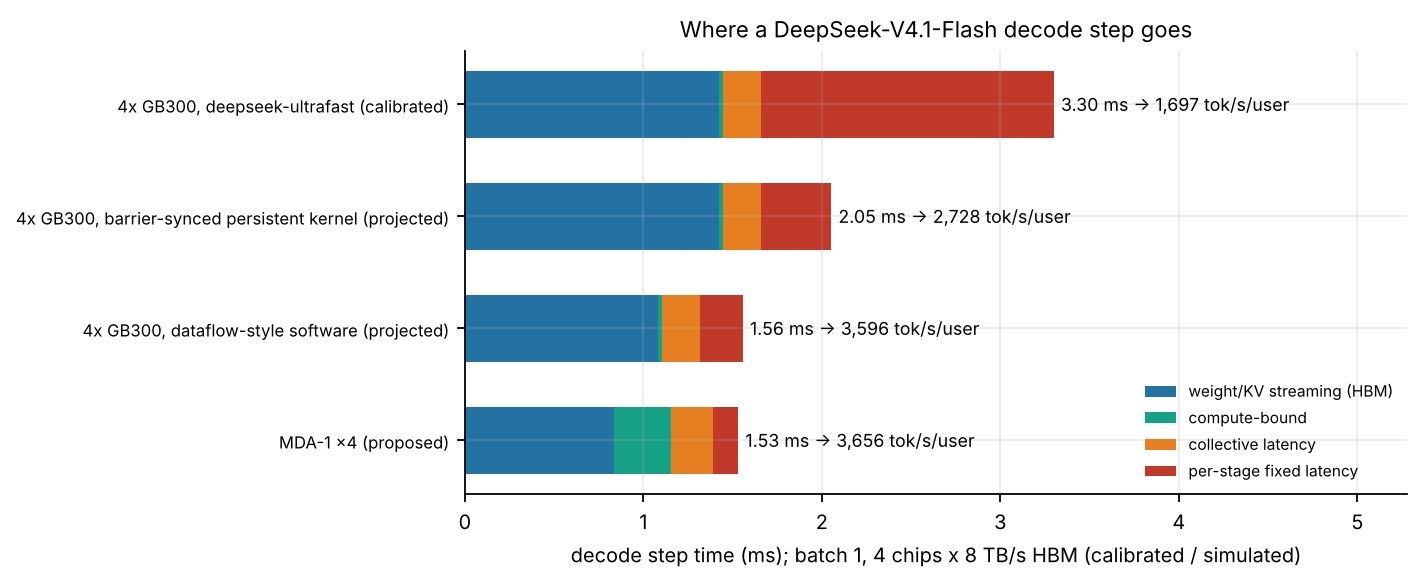
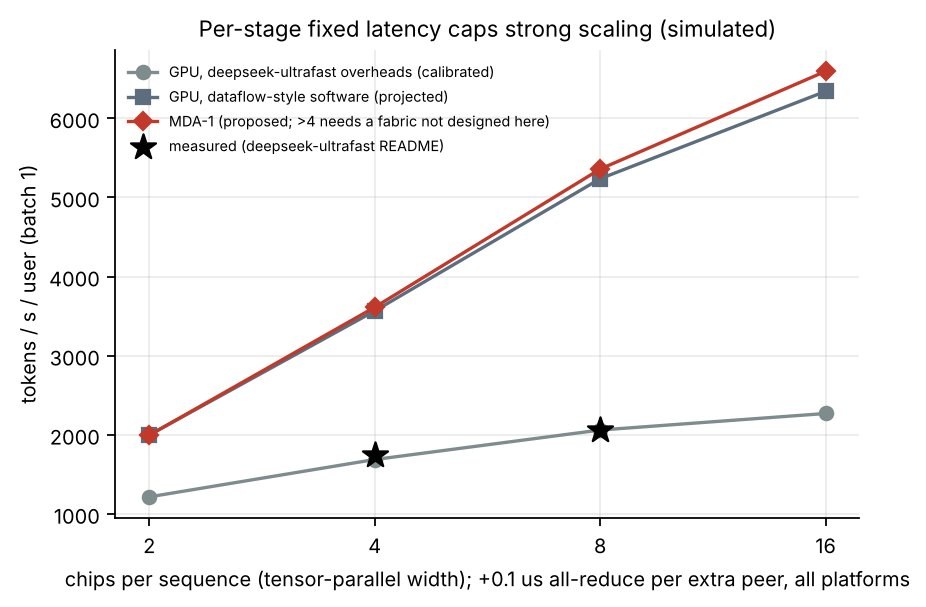
Read it with the source in mind: the author is proposing a decode ASIC, the projected bars are a simulator's, and the study's own reply to Baseten says "These are modeled, not measured." I include it because its calibrated bar and my arithmetic land in the same place from different directions, not because I believe the projections.
The million-token prefill
The prefill figure is the other one the replies liked. 1,000,000 tokens in 13.2 s on TP4 is 75,758 tokens a second (the README rounds to 76,000); 11.7 s on TP8 is 85,470. Doubling the GPUs buys 12% here, even less than decode.
The model does most of the work here. The prompt runs through the 20 encoder layers, about 7.89B
active parameters a token by the site's header count, and the decoder only needs its 128-token window:
docs/SERVER.md calls this "CED bounded SWA replay prefill". The global KV is 890 bytes a token, so a
million tokens of it is 0.89 GB. What stays expensive is the encoder's indexers, which score every
earlier compressed position for every new one, so that part grows with the square of the prompt. How much of the
13 seconds it is, I can't say without a profile.
Against what?
Neither the post, the thread nor the README compares this engine with anything. "From scratch" and the speeds invited the comparison, and one reply under Baseten's post was "RIP vLLM". There is no vLLM or SGLang number in the release at any setting, so there is nothing like for like to check.
What exists are other single-stream or high-interactivity numbers for the same model, each measured differently. These are mine to line up, from the site's earlier reads:
| Run | Tokens/s per user | What it is |
|---|---|---|
| deepseek-ultrafast, 8 x B300 | 2,060 | one request, Tetris, thinking off, 5.6 a step |
| deepseek-ultrafast, 4 x GB300 | 1,740 | the same |
| Fireworks Ultrafast demo | 1,521 | peak of one Tetris stream, 1,284 average, hardware not disclosed |
| DeepInfer, most interactive point | 325.2 | 8 requests per rank, 131,072 context, acceptance assumed |
| InferenceMAX, GB300 Dynamo vLLM | 196.5 | P90, concurrency 10,888, agentic trace |
The bottom rows are throughput systems running thousands of requests: the vLLM row makes 13,732 tokens a second per decode GPU at that speed, about 32 times what deepseek-ultrafast makes per GPU, and DeepInfer's 26,270 per GPU (at about 100 per user, with acceptance assumed) is about 60 times. The top rows are latency systems running one. They are different products. The fair comparison would be vLLM or SGLang at batch 1 on the same four GB300s with DSpark on, the same prompt and thinking off, and nobody has published that. The reply asking for "total throughput at 64 concurrent users" was asking for a number this server cannot produce: it would run the 64 requests one after another.
The closest thing to a speed comparison is Fireworks, also a Tetris demo with thinking off, and deepseek-ultrafast's four-GPU number is above its peak. Since Fireworks never said what hardware it used, that tells you little.
The demo clip
The README says the GIF is "Shown at real-time speed." It checks out. Reading the counters frame by frame, the token count goes from 82 at 0.4 s into the clip to 5,323 at 2.8 s: 5,241 tokens in 2.4 seconds of video, 2,184 a second, against the gauge's final 2,206 average. The clip is not sped up.
It is also not either headline. 2,206 is above the README's stated range for 8 x B300 (1,980 to 2,170) and far above the four-GPU range, and the page does not say which machine it ran on. A good run on the eight-GPU box would explain it. The 5,448 tokens are all output: with thinking off there is no reasoning to hide.
Agents, SGLang and "from scratch"
The thread is open about how this was built. "this was an experiment in how far you can get working mostly agent driven. our first attempt was from scratch with no reference and the agent struggled. so we started again and let the agents read from sglang, which allowed for some good bootstrapping." Then: "TP4 went from ~5ms to 3.5ms to 3.1ms per step in ~a day. stopped hill climbing around 2.6ms." The README's acknowledgment agrees: "The kernels were optimized by coding agents that could read the source of FlashInfer and SGLang while they worked."
So "from scratch" means no PyTorch and no SGLang at runtime, which is true: the engine links
cudarc, the Hugging Face tokenizers crate, DeepSeek's deepseek-recipe for prompt rendering,
cuDNN and cuBLAS for the vision encoder only, and NVIDIA's Velo for RDMA. Its MoE path is named sgl
throughout, and the thread says it pulled in "the best of some sglang work we have coming to OSS". It
does not mean written without reference to the open engines.
One number does not reconcile. The thread says hill climbing stopped "around 2.6ms" per step on TP4; the README's TP4 row is 3.30 ms, with 30 runs between 3.24 and 3.37. Perhaps the 2.6 ms was a different prompt, context or machine. As published, the README's figure is the one with a method behind it.
The variant files read like a search that kept every winner: names such as
variant_zzzzzzzzzzsds.cu sort after everything else, compile only for sm_103a and are picked by
name at runtime. That is fine for one model on one GPU generation, and it is why I'd expect a rewrite
rather than a port for Vera Rubin, which the thread already promises.
Open source, with a clause
The post says "It's open-source." The LICENSE file is the Elastic License 2.0, which is
source-available, not an OSI open-source licence. Its first limitation: "You may not provide the
software to third parties as a hosted or managed service, where the service provides users with access
to any substantial set of the features or functionality of the software." You can read it, run it for
yourself and modify it. You cannot start an API business on it, which is the business Baseten is in;
its own endpoint is DeepSeek-V4.1-Flash-Fast on Baseten Model APIs. That is a reasonable licence for a
company to choose. It is not what the word in the post means.
Good code, oversold numbers
The engineering is good and specific, and the repository is a better read than most serving code: one model, so every decision is visible. The design is right for the job it picked. At batch 1, slicing experts beats dispatching them, a push all-reduce beats a collective library, and keeping the draft-verify-accept loop inside one graph beats a host round trip. If you want to know what single stream decode on Blackwell looks like with the framework tax removed, this is the code to read.
The numbers are honest in the README and oversold in the post. 1,740 is one user on four GB300s, on a prompt that lets the drafter keep 4.6 of 6 guesses, with thinking off. It is also the box's whole output. Nothing here says it beats vLLM or SGLang, because nothing here was compared with them, and the comparison that matters for most deployments (tokens per GPU-hour at a target latency) is the one this engine does not try to win.
What I'd take from it is the 2.12 ms. More GPUs, more bandwidth and better FP4 kernels all go into the
part of the step that is already the smaller one. The next 2x for one stream on this model is in the
dependent-stage latency: a persistent kernel, fewer and earlier synchronisations, the weights for the
next layer in flight while this one's experts stream. Baseten says Rubin numbers are coming. I'd
rather see an nsys breakdown of a GB300 step through the tools/nsys_breakdown.py script they
already ship, which would settle where those 2.12 ms go.
What I read and what I ran: the post, the quoted thread and the replies through the fxtwitter mirror;
the repository at 76766a9; the checkpoint's config.json and inference/config.json from Hugging
Face; frames of the demo clip. Byte sizes come from the site's header-level read of the
checkpoint. I ran nothing on a GPU. Every tokens-per-second and
step-time figure is Baseten's; the per-step byte table, the fit and the per-GPU ratios are my
arithmetic.