2026-11-24 · 23 min · world-models · video-generation · diffusion-transformers · interpretability · benchmarks
A 2:00 narrated explainer, drawn in code. Every number and picture in it is this article's own; the sources are below.
› transcript
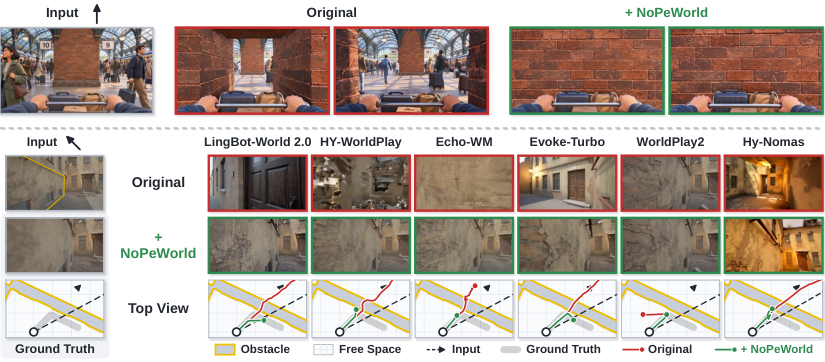
Hold W at a brick pillar in a video world model. The raw model walks straight through. The same input with NoPeWorld stops at the bricks. Hi, I'm Kerb. These models have no physics engine, so nothing says no. NoPeWorld adds the no, and leaves the generator alone. From above. The camera walks at an angled wall, and the raw model's path runs right through it. So at every chunk, score 34 candidate motions. Sweep a disc along each. Red would touch the wall, green keeps its margin. A game engine would slide along the wall. Pick the green one closest to that. And the camera slides, instead of passing through. There is no map at test time, and the generator stays frozen. But its hidden states carry the geometry, so the head reads a few middle and deep blocks. Each candidate is added to every token, and two cross-attention blocks read the grid. Out comes a safety and an intent score per candidate. An unsafe input gets swapped. Why the DiT? On decoded pixels the same head is close to a coin flip. On DiT states it separates safe from unsafe almost perfectly. NoPeBench places each generated video on the true map. The raw model goes through, or erases, the obstacle on 89 routes of 100. With the head in collision mode, 7 are left. Most of the rest are stops, and only 13 slides. A depth guard that halts on every chunk has fewer violations on average, about ten percent. NoPeWorld lands at sixteen, but it slides instead of freezing, and costs almost nothing. The model already knows where its walls are. A tiny head turns that into the motion you get. Thirty-four candidates, read from the DiT, and a camera that stops at the wall. Thanks for watching! Every source is in the full article. I'm Kerb. Bye!
Why read this
Solidtop 85%How a sub-2M head reads a frozen video DiT to stop the camera at walls, with the candidate rule and the benchmark's real tracks made interactive.
- Original analysis
- A lasting reference
- A new technique
Image & video generationNeeds datacenter GPUsMixed licencesResearch paper
How this was scored
- Is it new?
- 2 of 3: A real new idea, method or capability
- Can I trust it?
- 2 of 3: Measures key facts from files, code or configs
- Can I run it?
- 1 of 3: API-only, gated or restrictive licence
- Will I understand it?
- 2 of 3: Mechanism from first principles with figures
- Can I act on it?
- 1 of 3: General advice
- Will it last?
- 2 of 3: A reference for a year or more
- Does it affect many?
- 1 of 3: A specialist community
- Only here?
- 2 of 3: A teardown or measurement few others did
Score 59 of 100, ranked 519 of 780 rated articles. Each question is answered 0–3 by hand, and a 3 is rare. How articles are scored
Hold W in a video world model and walk at a wall. In most of them you go through it. The model was trained on video of people walking, and the training set almost never shows a command that gets refused, so it renders the walk you asked for and paints the other side of the wall as it goes. There is no physics engine to say no.
NoPeWorld, from Xingyi Yang's Learning & Generation Lab at The Hong Kong Polytechnic University, adds the "no" without adding a physics engine. It does not retrain the generator either. It reads the generator's own hidden states with a small head, asks "would this motion hit something?" for 34 candidate motions, and substitutes a safe one when your input would not be. Averaged over six open world models, the share of benchmark videos that pass through or erase an obstacle falls from 74% to 16%.
The X thread that brought it to my feed (@yxy2168, with @_akhaliq reposting the paper) sells it with GTA VI screenshots, and the project page has a GTA-themed version. Everything is released: code under Apache-2.0, the trained heads and the NoPeBench data.
The constraint, stated the way a game engine states it
Games solved this decades ago, and the paper borrows the two rules a game engine uses.
Swept clearance. A body may not overlap geometry anywhere along its motion, not only at the end of it. Testing only the end point lets a fast object tunnel through a thin wall. Write for the signed gap between the body and the nearest obstacle at a point along the path ; the constraint is .
Collide and slide. When the body touches a surface with normal , the commanded motion is projected onto the closest motion that does not push into it:
Head-on, that is a stop. At an angle, the component along the wall survives and you slide. This is the behaviour you expect when you hold W+A against a corridor wall in any first-person game.
A video world model generates video chunk by chunk, each chunk conditioned on the past frames and on the action. The paper frames the fix as choosing the executed action so that the chunk stays likely under the frozen model, the swept constraint holds, and stays as close as possible to . Freeze the generator and assume it renders whatever motion it is given inside the scene it has already shown, and the likelihood term stops separating the admissible actions. What is left is a pure action-selection problem over a candidate set :
with a collision disc of radius 0.25 m, a margin of 0.05 m, and the distance from the candidate's displacement to the slide response, its cross-slide part weighted by .
This is where it gets hard: the world model has no . There is no map. The geometry exists only as whatever the DiT has learned to represent internally.
34 ways to move, scored without a map
The candidate set is small and fixed. From nopeworld/head/candidates.py and Appendix S2.3: the input itself (KEEP), STOP, the input shortened to 75, 50, 25 and 12.5%, half-length turns of 30° and 60° each way, and 12 points per side on an "intent ellipse". The ellipse points deviate from the input by 8.8° to 88°, with a length that shrinks as the turn widens:
That is the step length that minimises the intent error in direction , so a wide turn is also a short one.
During training every candidate gets ground-truth labels from Unreal Engine. Sweep the disc along it on the level's occupancy map and you get its clearance , clipped to m. Compare its displacement with the simulator's collide-and-slide response and you get the intent error . Both are softened so the loss has a gradient:
is the standard normal CDF and . is a soft "safe", a soft "what you meant", and ranks candidates that are both.
At test time the rule (the paper's Eq. 6) is short. Calibrate the safety logits with a temperature , call a candidate safe if , keep the input if it is safe and no safe candidate beats its intent score by more than , otherwise run the safe candidate with the best intent score, and stop if nothing is safe. , and are fitted per generator on validation scenes; for LingBot-World 2.0's collision head the model card lists 0.82, 0.85 and 0.030.
The widget below runs that rule with exact labels from a straight wall, the labels a simulator would hand the head during training.
Two behaviours fall out. Head-on, nothing that moves forward is safe once the wall is within a step, so the best safe candidate is a short step or STOP. At 30-odd degrees, a turn along the wall scores almost as well on intent as the input did, because the engine's own answer to "W into an oblique wall" is a slide. That second case is why the paper scores against and not against : a stop at an oblique wall is safe, and still wrong.
Reading the answer out of a frozen DiT
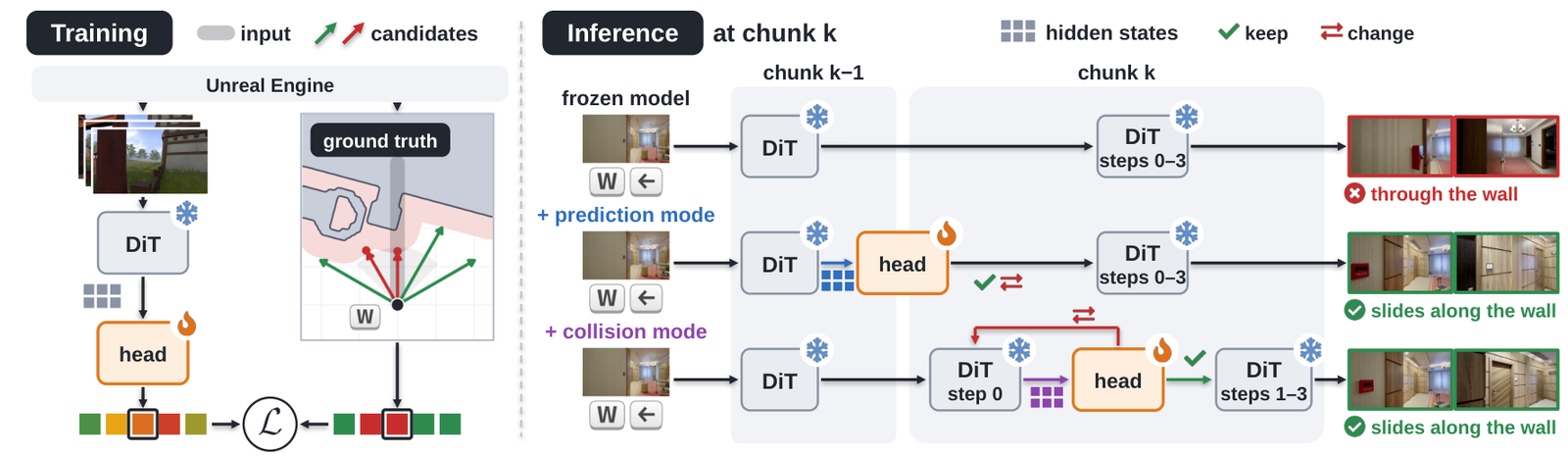
The head is small. Each world model has its own, between 0.70M and 1.74M parameters according to the model card's table. It takes the tokens of one or a few mid-to-deep DiT blocks, projects each token from the DiT's width to 128 with a learned per-token linear map and a LayerNorm, and does not pool them: on LingBot-World 2.0 the collision head attends over 13,572 tokens from blocks 30, 38 and 39. Each candidate is encoded by the generator's own frozen camera encoder, projected to the same 128 wide grid and added to the state tokens at the same frame, row and column. A learned query then reads that action-conditioned grid through two cross-attention blocks (4 heads, width 128) and outputs three numbers per candidate: a safety logit, a predicted clearance and an intent score.
Adding the candidate to every token before the readout is a deliberate choice, and Table S11 shows why. A variant that merges state and action only at the end keeps the AUC for "is the input unsafe" (.971) but loses same-state ranking of the alternatives (from .786 to .712) and its regret rises from .0554 to .0740. It can tell you the wall is there; it cannot tell you which way to go.
The loss trains all three outputs: binary cross-entropy on safety against the soft , a Huber term on clearance where saturates, cross-entropy on intent, and a listwise KL term that matches the head's ranking over the 34 candidates to the ranking by . Each head trains for 1,000 optimizer steps on 729 Unreal Engine videos from 44 UnrealZoo scenes, replayed through the frozen generator by teacher forcing. Chunk indices are reweighted so the unsafe rate is the same at every chunk, which stops the head from learning "late in the clip means wall".
Two places to tap
Collision mode enters chunk , runs the first denoising pass with your input, and reads those tokens. If it keeps the input, denoising continues from step 1 with nothing wasted. If it changes the input, it reruns step 0 once with the new action and carries on.
Prediction mode reads earlier. After chunk is denoised, these models run a noise-free "commit" pass to write it into their attention memory. The head reads that cached pass together with your incoming input and decides before chunk starts. It adds no DiT pass at all. Evoke-Turbo keeps no memory between chunks, so it has no commit pass and no prediction head.
The paper's Table 5 puts the cost on LingBot-World 2.0 at 0.09 s per decision for prediction mode against 2.11 s for collision mode (1.04 s when the input is kept), on a raw route time of 53.7 s. Over a route that is about 1% added for prediction mode, 18% for collision mode and 27% for the external-depth baseline. For scale, docs/INFERENCE.md says those 53.7 s produce one 5 s route. At LingBot's 16 fps that is 80 frames, about 1.5 frames per second on a 96 GB GPU, which is the real speed limit of this whole category and nothing NoPeWorld changes.
Why the DiT, and not the pixels
The paper's most interesting claim is in Section 5.1: the frozen DiT "knows before it draws". On LingBot-World 2.0's validation scenes the heads predict contact in the current chunk at .955 to .967 AUC, and one chunk (0.75 s) ahead, before those frames are denoised, at .831 to .838. The paper's training-rate lookup scores .59 and its stratum lookup .64. Two chunks ahead the heads fall to .636 to .673 and the stratum lookup catches up at .69. The signal is real for about one chunk of look-ahead.
The same head on other inputs does much worse. Table S11, LingBot-World 2.0 validation, block 39:
| Input to the head | AUC | Regret |
|---|---|---|
| DiT states, current chunk (collision) | .968 | .0554 |
| DiT states, previous commit (prediction) | .969 | .0561 |
| VAE latents of the preceding chunk | .847 | .1101 |
| Decoded pixels of the preceding chunk | .583 | .1129 |
| Always keep the input | n/a | .1128 |
Read as an AUC for spotting an unsafe input, that is 0.968 on DiT states, 0.847 on VAE latents and 0.583 on decoded pixels, close to a coin flip. On pixels the head's regret is no better than never intervening. The VAE latents carry some of it. The DiT's middle and deep blocks carry most of it, and Figure 6 says the choice of block is forgiving: from the tenth block on, the current-chunk head is equally good within the spread between seeds, and only the shallowest block, whose step-0 tokens are still close to noise, is clearly worse.
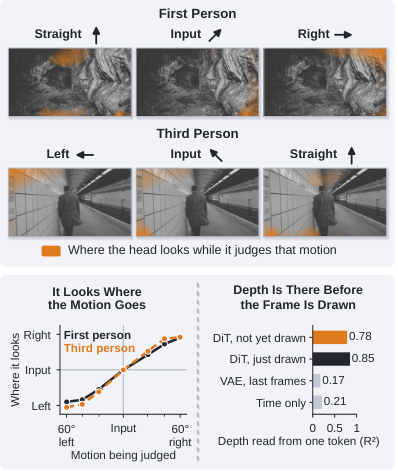
I find this the most useful part of the paper, more than the benchmark win. Probing papers usually stop at "the representation encodes depth". This one closes the loop: the representation encodes impending contact well enough to act on, and the action is chosen before the chunk that would have shown the violation is drawn. It also explains the zero-shot result below. The heads were trained only on first-person walks through static Unreal scenes, and still cut violations on open-domain images, third-person views and moving obstacles. If the head had learned Unreal's textures it would not transfer. A readout of the model's own geometry should.
How NoPeBench decides you went through a wall
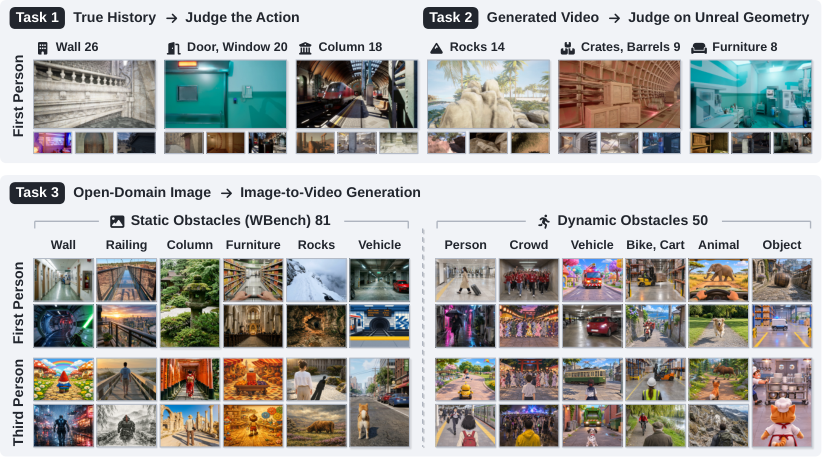
Existing world-model benchmarks mostly steer around obstacles. The authors count only 13 of 158 navigation cases in WBench that drive into a visible obstacle. NoPeBench drives every test route into one.
Routes. 100 collision routes in 32 UnrealZoo scenes that share no asset pack with the 44 training scenes: 66 walls and 34 objects, 84 different obstacles, on foot at 1.2 m/s, as a drone at 4 m/s and as a car at 5 m/s. Glass, thin poles and moving bodies are excluded. Each route plays the true history up to a hand-off before contact (about 1 s on 49 routes, 0.5 to 3 s on the other 51), then holds W, W+A or W+D for 5 s. 50 open routes with nothing in the way check that a method does not stop for no reason.
Task 1 isolates the decision. The generator replays the real Unreal continuation by teacher forcing and the method only has to say keep or change at each chunk, scored on the occupancy map: Missed (unsafe input kept), False (safe input changed) and a decision score of 100 × (1 − regret). On LingBot-World 2.0 the raw model's score is 56.3 and both heads reach about 88 to 89, missing 2.4 to 2.6% of unsafe inputs and changing 7.0 to 9.3% of safe ones. Hy-Nomas is the weak one: its collision head changes 49.4% of safe inputs.
Task 2 is the real test: the model generates 5 s in closed loop with the method in charge, and a geometric evaluator decides what the video shows. VGGT-Ω reconstructs camera poses and depth for the last 2 s of true history at 4 fps and the 5 s after the hand-off at 8 fps (49 frames) in one pass. One scale factor, the true history path length over the estimated one, is applied to everything. The path is placed through the true hand-off pose on the level's occupancy map with 5 cm cells, and SAM 2 tracks the obstacle from the true hand-off mask.
Then a rule table (Table S1), checked top to bottom, gives each video exactly one verdict. The violation rows, with thresholds I checked against nopebench/task2/rule.py:
- Penetration: the camera centre is deeper inside geometry than the video's own noise floor (its history error, clipped to 0.10 to 0.30 m) for at least 2 consecutive samples, or it is in free space that is reachable only by a path longer than 1.1 × its own path + 0.3 m, which means it went through a thin wall.
- Tunnelling: the depth ahead jumps within 0.125 s from at most 0.8 m to at least max(2 m, 3 × the previous depth), and at the extrapolated pose geometry still fills the window.
- Vanishing: the obstacle disappears on approach, by the same depth jump from further away, or by SAM 2 losing it while it is ahead, more than 0.6 m away and covering 1 to 50% of the frame, while the map still has geometry there.
- Walking on: the camera touched geometry and then got at least max(1.5 m, 0.375 s × speed) further along the wall's inward normal than the Unreal reference ever does.
Below the violations come the non-violating outcomes: no response, reversed, retreated, early stop, turned away, and the two correct ones, stopped and slid. The thresholds come from measurements, not taste: 0.10 m is the evaluator's position error near walls on renders with true poses, and 0.30 m its error on 214 Unreal reference executions. On 391 Unreal renders whose behaviour is known, the evaluator is right on 366, and on 3,350 generated videos it agrees with an independent reconstruction (DA3) at κ = 0.89.
The headline metric is the Safe-Intent Score, borrowed in spirit from NAVSIM's hard gating:
It is zero for any violation, and zero for a video that goes back, goes the wrong way, turns away or stands still. is how many chunks of travel the camera stops short of where the engine made contact, the share of the engine's slide it misses (on the 65 routes where the engine slides at least 0.5 m). Each unit of shortfall multiplies the score by . A method that stops dead in front of every wall is safe and scores poorly. That is the point.
Task 3 leaves Unreal: 131 open-domain start images, 81 from WBench with static obstacles and 50 generated ones with people, crowds, vehicles and animals moving, in first and third person. With no 3D ground truth, VLMs judge each video by the same rule. Against three human annotators on 269 majority-labelled videos, Claude Opus 5.5 has recall .91 and precision .78 on violations, GPT-6 Astra .81 and .92, and the two open judges are clearly worse (F1 .62 and .64), so the main table averages the two closed ones.
Eight real routes, from above
The repository ships test fixtures with the benchmark's stored verdicts and reconstructed camera tracks for LingBot-World 2.0 on all 100 Task 2 routes. That is enough to look at what the numbers are made of.
I counted the stored verdicts in that fixture myself, and the violations come out at Table 4's 89, 7 and 4 for LingBot-World 2.0. The raw model: 84 videos through the obstacle, 3 that walked on past contact and 2 where it vanished, which is 89 violations. Of the rest, 5 stopped, 1 slid and 5 went backwards. Collision mode: 60 stopped, 13 slid, 13 stopped early, and 7 violations (6 through, 1 vanished). Prediction mode: 58 stopped, 17 slid, 12 stopped early, and 4 violations.
Most of NoPeWorld's wins are stops, not slides, on a benchmark where the engine slides at least half a metre on 65 routes; the Slide column (19 and 30 for the two modes, against the engine's 100) says the same thing. A dozen "stopped early" videos per mode are the price of the margin: a head that is unsure stops a chunk before the wall, and SIS charges for it.
What the main table says, including the parts the abstract doesn't
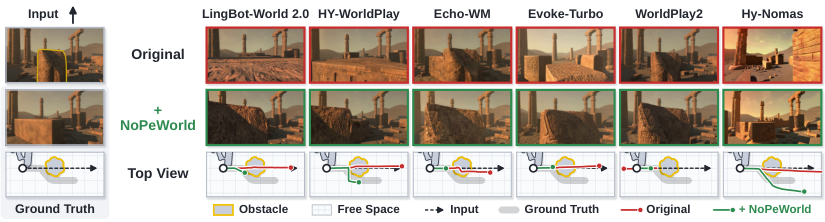
Table 4, Task 2, the violation rate and SIS per generator (collision mode unless marked):
| Generator | Raw viol. | External depth viol. | NoPeWorld viol. | Raw SIS | External depth SIS | NoPeWorld SIS |
|---|---|---|---|---|---|---|
| LingBot-World 2.0 | 89 | 2 | 7 (Pred 4) | 5 | 34 | 50 (Pred 56) |
| HY-WorldPlay | 86 | 0 | 15 (Pred 21) | 5 | 38 | 38 (Pred 43) |
| Echo-WM | 86 | 2 | 3 | 11 | 14 | 44 |
| Evoke-Turbo | 77 | 4 | 30 | 8 | 11 | 27 |
| WorldPlay2 | 11 | 1 | 1 | 36 | 31 | 25 |
| Hy-Nomas | 95 | 50 | 40 | 2 | 20 | 31 |
The text prompt baseline, which is told the obstacle's name, side and distance and asked to stop or slide, does almost nothing for the five camera-pose-driven models. A pose-conditioned model does not read your sentence as a command.
Now average the columns. NoPeWorld's collision mode goes from 74% to 16%, the abstract's number. The external-depth guard, which decodes every chunk, runs Depth Anything 3 on it and halts whenever the input is swept unsafe, averages about 10% by my arithmetic on the same table (2, 0, 2, 4, 1 and 50). On the violation rate alone, the baseline wins on four of the six generators and ties on a fifth. The case for NoPeWorld rests on the other columns: SIS, because a halt-only guard cannot slide and gives up the user's motion (its Slide column runs from 1 to 11, NoPeWorld's from 6 to 30 across its two modes); cost, 9.9 s or 0.7 s added per route against 14.7 s; and Task 3, where collision mode matches or beats external depth in 10 of 12 generator-and-setting pairs, including all six with moving obstacles. The paper says this plainly in Section 4.4 ("External depth has the fewest violations on four of them, but only by halting"), so this is not a hidden result. It is a reason to read the SIS column first.
A few rows deserve their own sentence:
- Hy-Nomas keeps 40% violations with the head, and 49.4% false interventions in Task 1. It is concurrent work run as released, and the head design that suits five models clearly suits it less. (The site's Hy-Nomas article covers how that model keeps its memory.)
- Evoke-Turbo has no memory between chunks, no prediction mode, and still 30% violations in collision mode.
- WorldPlay2 is the only keystroke-driven model, and the raw model already backs away from walls instead of entering them (11% violations). NoPeWorld removes almost all the rest, down to 1%, but its stops eat part of the native slide, so its SIS (25) ends up below the raw model's (36), the prompt's (43) and external depth's (31).
- On the 50 open routes, both modes neither stop early nor retreat in 92 to 100% of videos, so the head rarely brakes for nothing.
The GTA demo
The thread's hook is GTA VI: the authors fed screenshots to the world models and drove them with keys. These are not Unreal scenes and not benchmark cases, so treat them as a demonstration of the open-domain transfer, chosen by the authors.
The clips themselves are cut from Rockstar's GTA VI footage, so they aren't reproduced here; they are in the thread under @yxy2168's post. In them, Echo-WM held on W walks through a parked sports car while the NoPeWorld version stops at the bonnet, and HY-WorldPlay, Echo-WM and LingBot-World 2.0 do the same at a person, a staircase post and a wall.
Running it
You will not run this on a desktop card. The repository's docs/WORLD_MODELS.md asks for a GPU with at least 80 GB and recommends 96 GB. Peak memory ranges from 42.9 GiB (Evoke-Turbo) to 85.8 GiB (WorldPlay2), and the generators' weights alone are 56.7 to 86.1 GB each. The heads themselves are 2.8 to 7.0 MB files. I wanted to measure penetration with and without the head on a 24 GB RTX 3090, and the smallest configuration does not come close, so I didn't.
Non-penetrating World Models
- license
- Apache-2.0
- branch
- main
- forks
- 2
- open issues
- 0
- source
- 703.7 kB
- commit date
- 2026-11-23
GitHub REST API, 2026-11-24 — branch, commit, commitDate, createdAt, description, forks, homepage, languages, license, openIssues, pushedAt, stars, topics
- task
- image-to-video
- library
- pytorch
- license
- other
- largest file
- 7.0 MB
- files
- 29
- downloads
- 0
- likes
- 1
repo last modified 2026-11-23
Licences are a patchwork. The code is Apache-2.0, but each head follows its base model: LingBot-World 2.0 is CC BY-NC-SA 4.0, the two Tencent models carry a community licence that excludes the EU, UK and South Korea, and NoPeBench is released for research use.
Where I land
The method is simple enough to state in a sentence and the analysis is careful enough to believe: thresholds with their origin written next to them, an evaluator validated on known renders, VLM judges checked against people, and a fixture in the repository with the stored verdicts behind one row of the main table. That last part matters to me. I tallied that fixture's violations for LingBot-World 2.0 and got 89, 7 and 4, the paper's numbers.
The limits are also plain. The benchmark's best violation rate belongs to the dumb baseline, and NoPeWorld's real advantage is that it slides instead of freezing and costs almost nothing in prediction mode. Most of its successes are still stops. It handles solid static boundaries with a disc of fixed radius on a ground plane, which is the easy half of physics; the paper's own last line points at contact that pushes, carries and shatters. And all of it sits on generators that make about a frame and a half a second on a 96 GB card.
I would still take the idea home. In reality capture I work with explicit geometry, a splat or a mesh you can collide against, so this problem doesn't exist for me. Video world models made the opposite bet, and this paper shows the bet keeps more geometry inside the network than its output admits. A sub-2M head that reads it and moves the action, not the pixels, is a pattern I expect to see again for other constraints.
The site has more on video world models: AVM keeps a scene as a pool of posed views, SANA-WM looks at where a minute-long world keeps its memory, Matrix-Game 4.0 re-skins a game in real time, and NextLat trains a transformer on its own next hidden state. External depth here is Depth Anything 3; the streaming reconstruction article covers that family.