2026-11-09 · 16 min · benchmarks · agents · pricing
Why read this
Solidtop 85%Splits Muse Ember's 'a third of Haiku's cost' into tokens and cache price from AA's data, rebuilds its 36.02, and puts noise bars on Meta's table.
- Original analysis
- Widely used
- Concrete numbers to act on
Evals & benchmarksAPI onlyProprietaryPractitioner model
How this was scored
- Is it new?
- 1 of 3: An incremental tweak
- Can I trust it?
- 2 of 3: Measures key facts from files, code or configs
- Can I run it?
- 1 of 3: API-only, gated or restrictive licence
- Will I understand it?
- 2 of 3: Mechanism from first principles with figures
- Can I act on it?
- 2 of 3: A concrete recipe, numbers or comparison
- Will it last?
- 1 of 3: Relevant for months
- Does it affect many?
- 2 of 3: A widely used model, tool or lab release
- Only here?
- 2 of 3: A teardown or measurement few others did
Score 58 of 100, ranked 482 of 701 rated articles. Each question is answered 0–3 by hand, and a 3 is rare. How articles are scored
Meta Superintelligence Labs released Muse Ember today, November 9. The announcement on X calls it "our smallest and most efficient model, built for complex reasoning execution and everyday agent work", and lists what it is for: it "can carry workflows across apps, call tools in sequence, run tests and make targeted code fixes", with "a 1M-token context window and native understanding of text, images, audio and video". The reply under it carries the claim the launch is built on:
On the @ArtificialAnlys Intelligence Index, it achieves performance comparable to Claude Haiku 5.5 at roughly one-third of the cost per task, while scoring higher than GPT-6 Luna across all of Luna's reasoning settings.
The first reply from someone else was "release the weights please. otherwise nobody cares". The second asked "can i download it or just rent it". It is rent. That decides what this article can and cannot do, so it goes first.
What shipped
One model, behind an API. Meta's developer page lists it as muse-ember-1.0, on the Meta Model API and inside Muse Code, with text, image, video, audio and PDF in and text out, a context window of 1,048,576 tokens, up to 524,288 output tokens, and reasoning effort from minimal to max, with max the default. It speaks three request formats: Responses, Chat Completions and Messages. There is nothing on Hugging Face: the meta-models organisation holds Muse Glimmer and Muse Spark Open and nothing called Ember. There is no model card with a parameter count or architecture, and Artificial Analysis lists its size class as "medium", the same class as Haiku 5.5 and GPT-6 Luna, with parameters left blank.
So I could not read a config, count parameters from safetensors headers or run a tokenizer, the things the two open Muse articles were built on. Everything below is measured from published numbers: Meta's blog post and its four-page evaluation methodology, the per-evaluation scores and costs Artificial Analysis embeds in its model pages, Meta's price list, and Vals AI's independent run.
Two pieces of context from the blog are worth having. Ember "is the first trained using Muse Wonder Full", the model I took apart a month ago; Meta had said it would use Wonder to build smaller specialised models, and this is the first. The training recipe is not described beyond that sentence, so "distilled from Wonder Full" is a reasonable reading, not something Meta states. And "our smallest" needs a qualifier: one reply pointed out that Muse Glimmer, a 30B open model, is smaller. Read it as the smallest of the hosted reasoning models, which is where Meta's docs list it.
The cost claim, checked
Meta's blog leads with a scatter plot of index score against cost per index task, one point per reasoning-effort setting, "from the raw Artificial Analysis results". I pulled the same points from AA's model pages for every effort setting AA has run on the three models. The data behind the blog's chart is slightly older than AA's live board (Meta's chart has Ember at max on 35.8 and Haiku at max on 36.2; AA now shows 36.02 and 36.48), but the costs are the same to the cent.
The headline holds. Ember at max costs $0.136 per index task; Haiku 5.5 at max costs $0.411. That is a ratio of 0.33, "roughly one-third" exactly. Ember's xhigh point, at 34.11, also beats Luna's best, 27.86 at max, so the second half of the claim holds too. Among the 31 effort points I could load from AA's pages, no model scores higher than Ember at max for less per task, so it is on that frontier; I could not load the full leaderboard, so I can't confirm "the full Artificial Analysis leaderboard" myself.
What the chart does not say is what the cost is made of, and the price list makes that unusually easy to see. Muse Ember, Claude Haiku 5.5 and GPT-6 Luna all list $0.10 per million input tokens and $0.50 per million output tokens. "More intelligence per dollar" between three models with the same token prices is a statement about tokens, plus whichever prices do differ.
Two things differ.
Output tokens. AA records output tokens per index task. Ember at max spends 84,482; Haiku 5.5 at max spends 225,966, 2.67 times as many. Ember at max writes about as much as Haiku at high effort (88,064) and scores 36.02 to Haiku-high's 29.87. Luna at max writes 75,296 and scores 27.86.
The cache read price. Ember's cached input costs $0.004 per million tokens; Haiku's and Luna's cost $0.01. That looks like a footnote until you see how much of an agent benchmark is cache. AA's index run sent Ember 10.02 billion input tokens, and from the cache-read bill at $0.004 per million, 9.82 billion of them, 98%, were cache hits. Haiku's run was 97% cache hits. An agent re-sends its whole conversation every turn, so cached input is most of the input there is.
Re-price Ember's cache reads at $0.01 (the toggle above) and its max point moves from $0.136 to $0.236 per task, 0.57 of Haiku's cost instead of 0.33. Of the $0.275 per task between Haiku at max and Ember at max, $0.100, about 36%, is the cache price. The other 64% is Ember spending fewer tokens. Both are real savings to someone paying the bill; they are different kinds of advantage. The token count belongs to the model. The cache price belongs to Meta's pricing desk and can change in a press release.
One more cost line from the blog: Muse Spark 1.3 at max scores 37 on Meta's comparison table and costs $2.39 per index task, against Ember's 36 and $0.14. A reply put it as "17x cheaper than Muse Spark 1.3 (max) for nearly same intelligence", which is the right ratio. Spark 1.3 lists $1.25 and $4.25 per million input and output tokens, so most of that 17 is price, not tokens.
"Comparable" is a rounding
Meta's results table prints the Artificial Analysis Index as 36 for Ember and 36 for Haiku 5.5, and shades both as the best result. AA's unrounded figures are 36.02 and 36.48. Haiku leads by 0.46 points. That is small, but Meta's own scatter plot has Haiku's max point above Ember's, so the rounding is doing the work "matches" needs.
The index has nine evaluations in v5.0.1, four categories at 25% each. I rebuilt it from AA's per-evaluation scores with the published weights and got 36.02 for Ember at max, AA's figure to the second decimal, and within 0.08 for every other point here (AA freezes an Elo when a model is added, so older entries drift slightly). The ledger below splits the gap into its evaluations.
Against Haiku 5.5 at max, Ember's wins are concentrated. AutomationBench-AA, a run of Zapier's 657 business workflows through simulated SaaS APIs, gives Ember 68.1% partial credit against Haiku's 35.4%, worth 1.63 index points even at a 5% weight. Terminal-Bench 4.0 gives it 40.9% against 32.8%, worth 0.81. And AA-Omniscience pays it 0.84 points for its hallucination rate, 17.4% against Haiku's 34.2%: when Ember does not know a fact, it more often says so.
Its losses are knowledge and hard reasoning. Omniscience accuracy, 3,000 closed-book fact questions, is 21.1% for Ember, 34.7% for Haiku and 39.6% for Luna, costing Ember 1.36 points against Haiku. FrontierCode 2.0, Cognition's merge-quality coding benchmark, costs it 1.16 (27.2% against 34.9%). CritPt and HLE-Diamond cost 0.45 each, Briefcase 0.40.
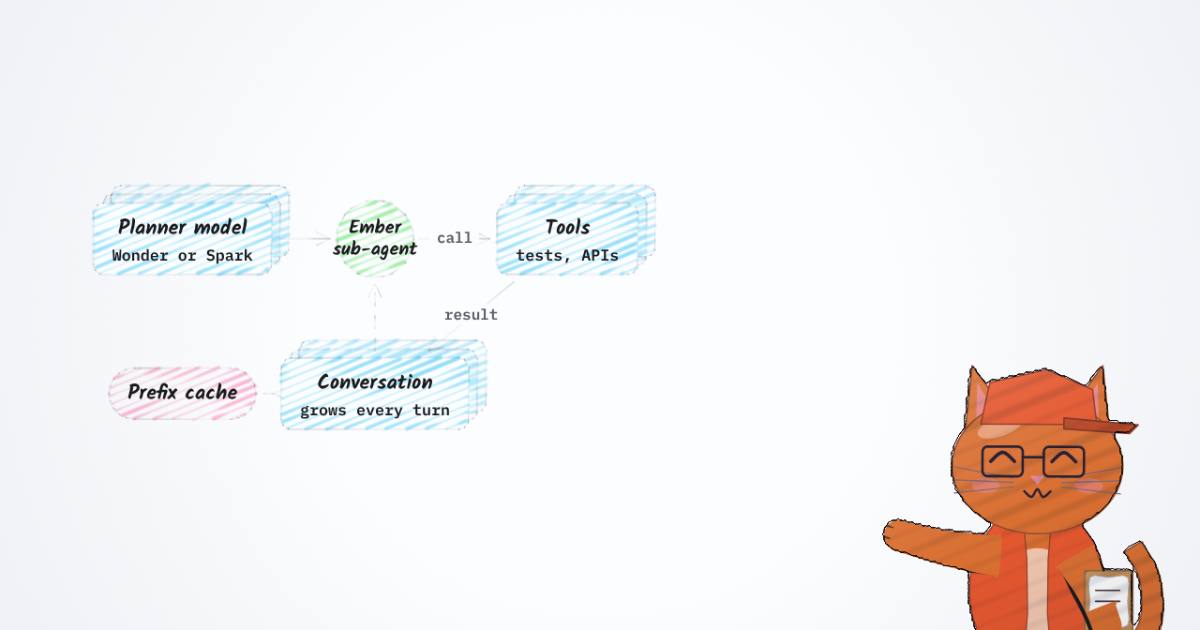
That is the profile I'd expect from a small model distilled for agent work, and it is a reading, not something I can prove from outside: it recalls fewer facts than models in its own price class, declines to guess when it doesn't know, and is strongest on the benchmark closest to "call tools in sequence and update systems across apps". The recall gap matters if you planned to use it as a cheap question-answering model. It matters much less if it is a sub-agent with a search tool, which is the job Meta's docs describe: "run the sub-agent tasks, tool calls, and routing inside larger agent workflows."
Meta's table, with noise bars
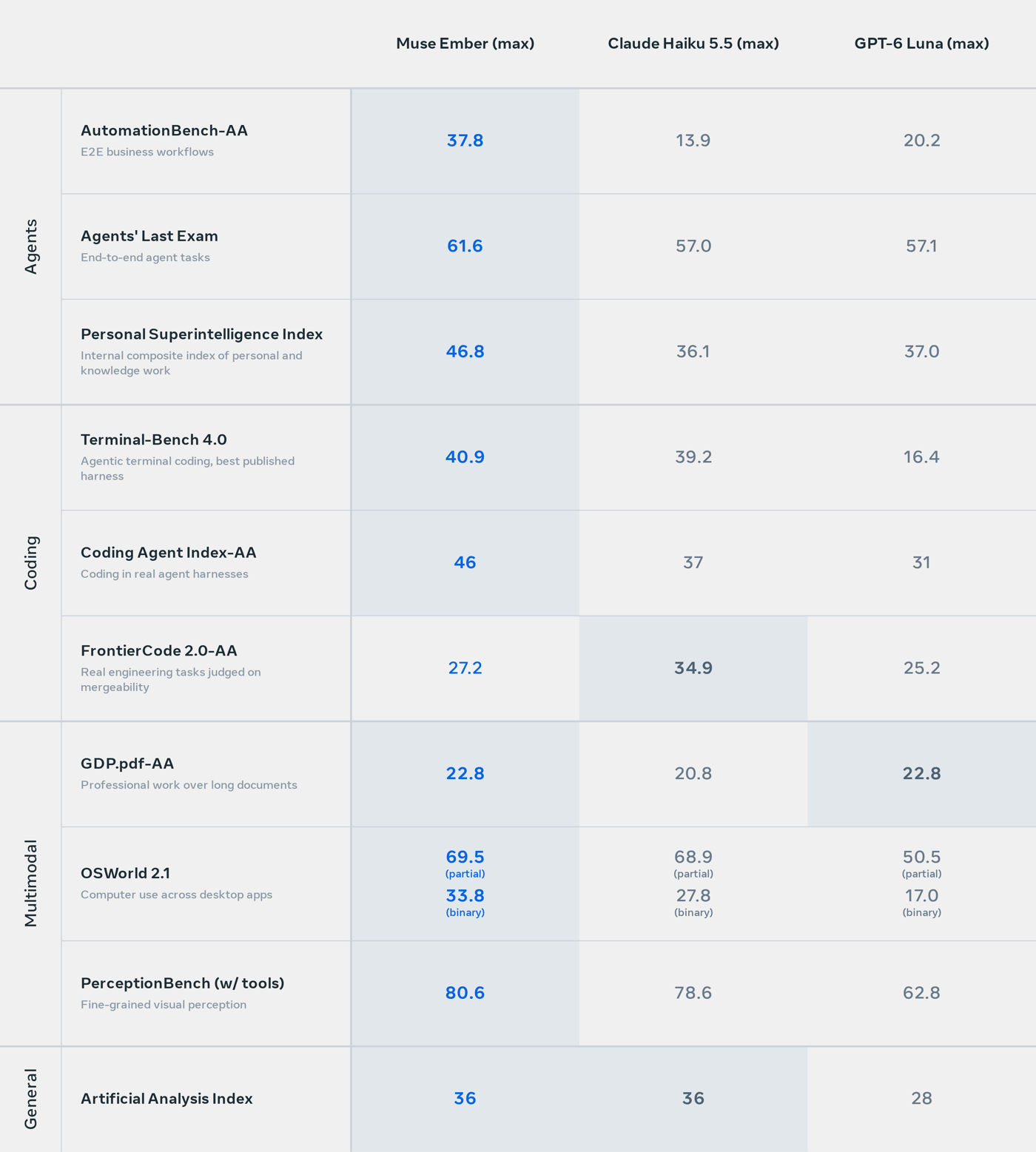
The methodology PDF is careful about where each number came from, and it gives the test-set sizes, which lets me ask a question the table does not: how big would a gap have to be to be more than sampling noise? For each row I took the test-set size and computed a rough 95% half-width for the difference between two scores, treating each task as one pass-or-fail draw and the two models as independent. That is my arithmetic, not Meta's, and it is crude in both directions: repeats make it tighter, partial credit makes per-task variance smaller, and two models answering the same tasks are correlated, which also tightens it. Treat it as an order of magnitude.
| Row | Tasks | Ember vs nearest rival | Gap | Rough 95% half-width |
|---|---|---|---|---|
| AutomationBench-AA (strict) | 657 | 37.8 vs 20.2 (Luna) | +17.6 | ±4.8 |
| Agents' Last Exam | 100 | 61.6 vs 57.1 (Luna) | +4.5 | ±13.6 |
| Terminal-Bench 4.0, Meta's table | 66 | 40.9 vs 39.2 (Haiku) | +1.7 | ±16.7 |
| Terminal-Bench 4.0, AA's one harness | 66 | 40.9 vs 32.8 (Haiku) | +8.1 | ±16.4 |
| FrontierCode 2.0 | 132 | 27.2 vs 34.9 (Haiku) | −7.7 | ±11.1 |
| GDP.pdf | 100 | 22.8 vs 22.8 (Luna) | 0.0 | ±11.6 |
| OSWorld 2.1, partial | 108 | 69.5 vs 68.9 (Haiku) | +0.6 | ±12.3 |
| OSWorld 2.1, binary | 108 | 33.8 vs 27.8 (Haiku) | +6.0 | ±12.3 |
| PerceptionBench (with tools) | 3,000 | 80.6 vs 78.6 (Haiku) | +2.0 | ±2.0 |
One row is unambiguous: AutomationBench, where Ember's lead is several times the noise and AA's partial-credit version of the same benchmark agrees. PerceptionBench is borderline. Everything else in the table is a gap a different random seed could plausibly erase, in either direction. The two rows I could not put a bar on are the ones with the widest Ember leads: the Personal Superintelligence Index, "an internal composite of eight personal and knowledge-work evaluations" of which two, FocusBench and VBT, are Meta's own internal benchmarks, and the Coding Agent Index-AA, a composite.
The Terminal-Bench row deserves a second look for a reason that cuts in Meta's favour. The PDF says Ember's 40.9 is AA's run in the mini-swe-agent harness, Haiku's 39.2 is "Anthropic's self-reported Claude Code result", and Luna's 16.4 is the Codex result on the public leaderboard. Three harnesses in one row. AA ran all three models in its own single harness, and there Haiku scores 32.8% and Luna 12.6%. Meta printed the competitors' higher, self-reported numbers, which shrinks its own lead from 8.1 points to 1.7. Ember's 40.9% is also exactly 81 of 198 task attempts, 66 tasks three times over, and Vals AI's independent run of the same benchmark gives 39.39% ± 2.31, so the number itself reproduces.
OSWorld is the other row to read twice. The headline is partial credit, "the mean credit per task"; "the strict pass rate, the share of tasks with full credit, is reported second." On partial credit, Ember and Haiku are 0.6 points apart. On whether the task actually got finished, Ember completes about a third of 108 desktop workflows. A computer-use agent that finishes a third of its jobs is a component, not a product, and that is true of all three columns.
A second evaluator
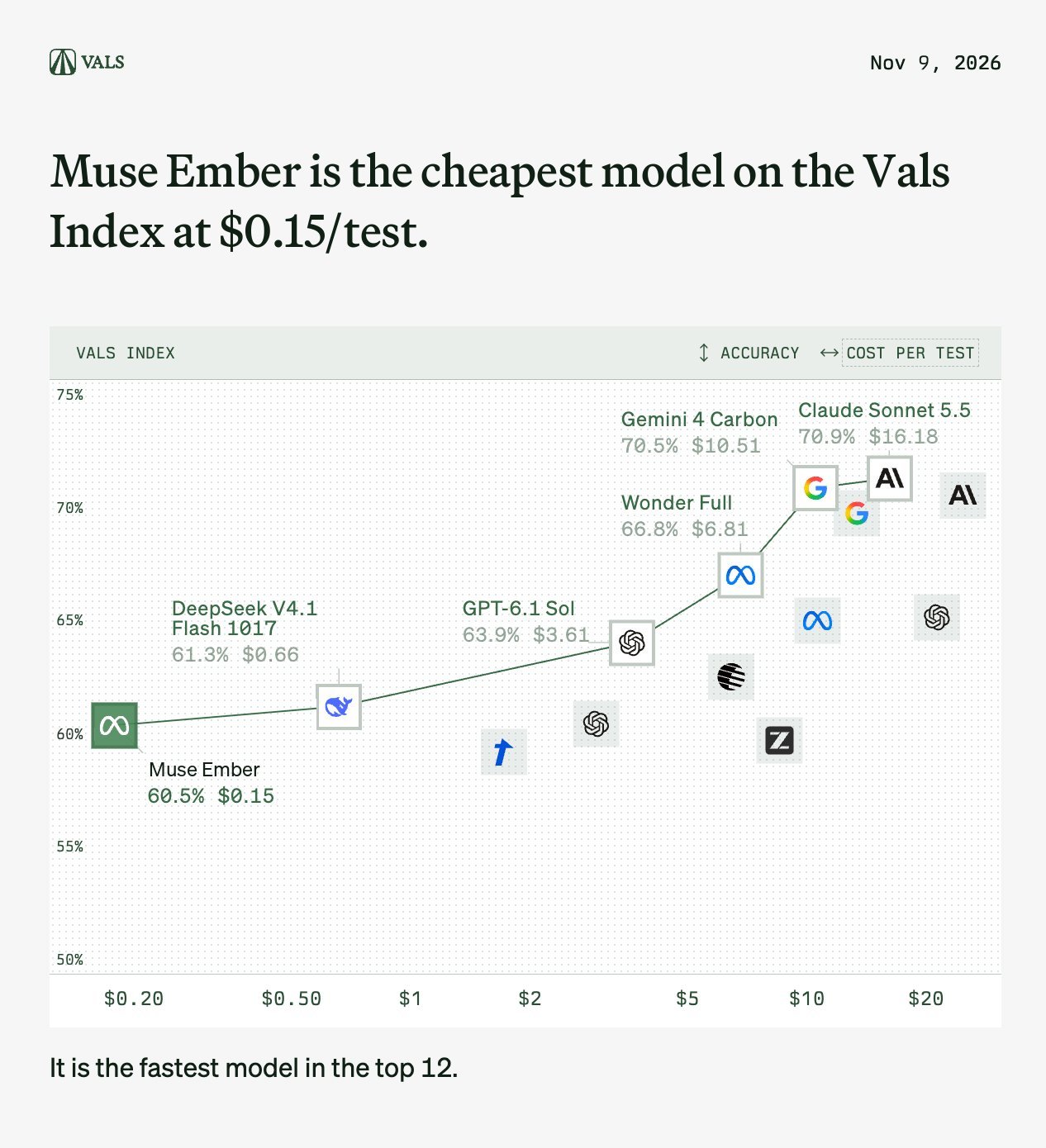
Vals AI ran its own index on launch day and lands in the same place from a different direction. Ember scores 60.48% ± 1.07 on the Vals Index at $0.153 per test, with tests finishing in 15 minutes 2 seconds. On the same index, Claude Haiku 5.5 scores 58.73% ± 1.28 at $3.175 per test and 49 minutes 57 seconds, and GPT-6 Luna 52.32% ± 1.12 at $0.450. Ember's lead over Haiku there is 1.75 points with error bars that nearly touch; its cost advantage on Vals' harness is far larger than on AA's. I don't know what reasoning effort Vals used for Haiku, so I would not lean on the size of that cost ratio, only on its direction. Vals' best single result for Ember is the Harvey legal benchmark, HLAB-Vals-1.1, at 25.00%, tied for second. Meta's models have done unusually well on that benchmark since Muse Spark 1.2.
Vals also lists Ember's video input as "not supported", and AA's model record has video and speech input set to false, while Meta's developer page lists "Text, image, video, audio, and PDF". The likeliest reading is that the evaluators record what their harnesses send, not what the API accepts. I could not call the API to find out.
The 200K line
The price card has a second tier that the launch post mentions only in a footnote. Up to 200K input tokens, Ember costs $0.004, $0.10 and $0.50 per million cached input, input and output tokens. Over 200K, $0.012, $0.30 and $1.50. Meta's pricing page is explicit about how the line is drawn: "the input tokens in your API request set the tier, cached tokens included", and a request with more "is billed at the long-context rates in full, not only for the tokens past 200K."
For a single request that is a cliff: 200,000 fresh input tokens cost $0.020, and one more token makes the request $0.060. For an agent, which is what Ember is for, it is worse, because an agent's context only grows. The widget runs a simple loop on the price list.
With the defaults, the context passes 200K at turn 26 and that turn costs 3.04 times the one before it, every turn after it too. Sixty turns cost $0.344. The same loop compacted back to its starting size whenever it would cross the line costs about $0.114, a third as much, before counting the cost of writing the summaries. Muse Wonder and Muse Spark have no long-context premium; the page says so in as many words. So the 1M-token window on Ember is real, and you pay three times the rate for every request that uses more than a fifth of it.
None of this is unusual, and Claude Haiku 5.5 has its own split at 100K, which I took apart when it launched. The practical point is that an agent harness running Ember as a sub-agent should keep each sub-agent's context under 200K, which is also what a sub-agent is supposed to look like.
What I'd do with it
If you run an agent harness and pay per token, Ember is a credible sub-agent model, and the case for it is better stated than Meta stated it. It is not "Haiku's intelligence at a third of the cost". It is a model that scores within half an index point of Haiku 5.5 at max while writing under 40% of its output tokens, priced at a cache rate 60% below Haiku's, and clearly ahead on the one agent benchmark with enough tasks to be sure: AutomationBench. Its weaknesses are closed-book recall and the harder coding and exam rows, which are the jobs Meta's own docs send to Muse Spark and Muse Wonder.
Keep its contexts under 200K. Check cached_tokens in the usage object to see whether your harness is getting the cache hits AA's run got, because the cost advantage depends on them. And if you wanted it on your own hardware, the open Muse models are Muse Glimmer, a 30B model sized for a 24 GB GPU, and Muse Spark Open. Ember is not one of them, and Meta has said nothing about releasing it.
How I checked
Everything was fetched on November 9, 2026, launch day. The post and its replies were read through the fxtwitter mirror; the two images in it are Meta's benchmark table (reproduced above) and a title card. Meta's blog post supplied the cost scatter's underlying values, the table, the pricing footnotes and the Wonder Full sentence; the methodology PDF, four pages read in full, supplied every test-set size and harness. The developer page and pricing page supplied the model ID, modalities, limits and both price tiers. Artificial Analysis's methodology page gave the v5.0.1 weights; the per-evaluation scores, costs per task (with their cache-read split), token counts and cache prices came from the model objects embedded in AA's pages for each effort setting of the three models, and my rebuild of the index from them reproduces AA's 36.02. The cache share is AA's cache-read cost divided by the cache price, over AA's input token count. The Vals figures are from Vals' Muse Ember, Claude Haiku 5.5 and GPT-6 Luna model pages and its post on X. The noise half-widths and the agent-loop bill are my own arithmetic on those published numbers.
What I could not check: anything about the model's size, architecture, tokenizer or training; any of Meta's internal benchmarks (the Personal Superintelligence Index, FocusBench, VBT, Meta's runs of Agents' Last Exam, OSWorld 2.1 and PerceptionBench); AutomationBench-AA's strict pass@1 figures, which are not in AA's page data; the full AA leaderboard behind the frontier claim; and how the API behaves with audio and video, because I have no key and called nothing.