2026-11-12 · 27 min · linear-attention · quantization · kernels · inference · vllm · state-space-models
A 5:01 narrated explainer, drawn in code. Every number and picture in it is this article's own; the sources are below.
› transcript
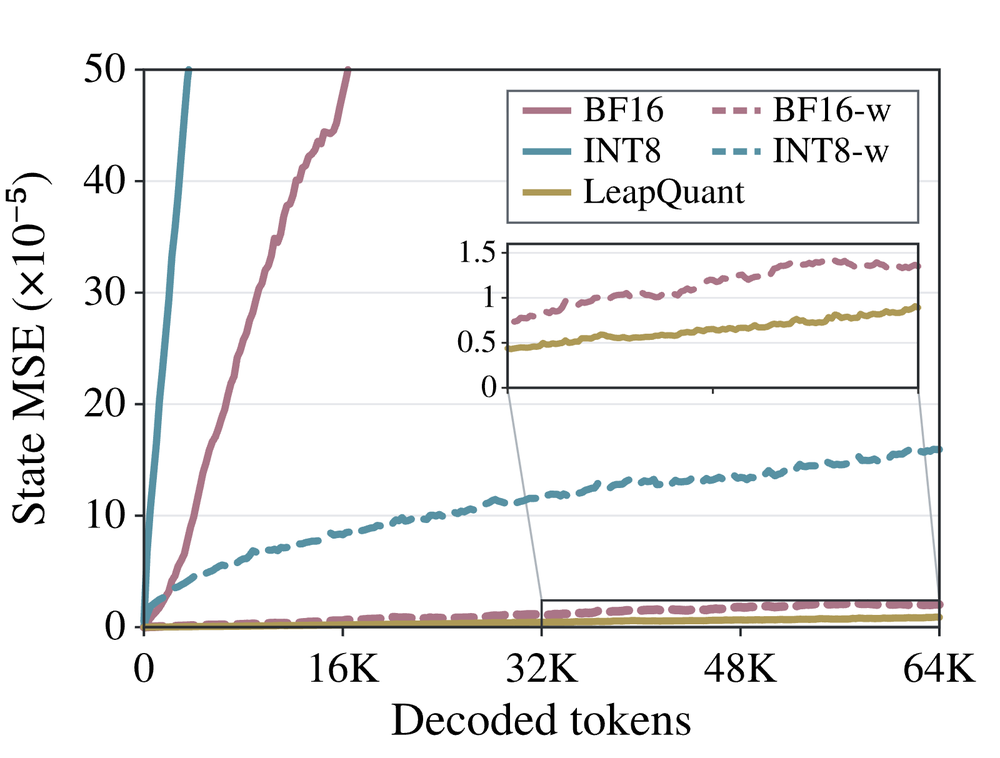
Store a linear attention state in BF16, and Qwen three point five, nine B, falls from eighty-seven point nine to seventy-two point one on a math benchmark. Why? Hi, I'm Ludo! LeapQuant stores this state in eight bits and keeps full precision accuracy. Here is how. Chapter one. A state read every token. Each Gated DeltaNet head keeps one matrix, a hundred and twenty-eight square. A new token brings a key, a correction and a decay. The update decays the matrix, then adds one rank-one write: the key, times what the memory got wrong about that key. That is the delta rule. Then the whole matrix goes back to memory. Every token, every head, every layer. On Qwen three point eight, twenty-seven B, that is a hundred and forty-four mebibytes per stream. Halve the bytes and you halve the bill. Here is the formula. First the decay. A slow head forgets a tiny fraction per token. Then one rank-one write. Each write is small next to the state it lands on. Chapter two. Why rounding piles up. Follow one entry of the state as it slowly decays. The faint lines are the only values a low-bit format can store. Round it after every token. Each change is smaller than half a level, so it rounds straight back, and the stored value never moves. In BF16, a decay of zero point nine nine nine is erased completely. LeapQuant holds the stored state fixed, buffers sixteen tokens of updates in higher precision, and applies them exactly. It rounds once, at the window's end. A few roundings instead of one per token, and nothing small is thrown away. The paper measured this on Qwen three point five over sixty-four thousand tokens. Rounded every token, INT8 and BF16 both drift away. Rounded once per window, the error stays near the floor, and LeapQuant's line is lowest of all. Chapter three. Lift the outliers, smooth the rest. Here is one value channel. Its scale is set by its largest entry, so two outlier rows leave ordinary entries on a grid far too coarse. LeapQuant subtracts the strongest rank-one pieces. Each has the shape of a token's write, so it rides in the window buffer, kept in FP16. Smoothing then divides each key row by the square root of its mean size, and multiplies back when it reads. On one real Qwen three point five head, the peak falls from a hundred and seventy-six times the median, to forty-seven, to five point three. The authors animate the same idea. Outlier rows and columns lift out as Compensator Tokens, and the rest is rescaled row by row until it is flat. The paper's picture of a window: residual, plus Compensator Tokens, plus buffered real tokens, add up to the full state. The compensators sit in the same list as real tokens, so the kernel needs no second path. A window starts from the stored state: an INT8 residual, its scales and four FP16 tokens. One point one nine bytes per value, against four. Each decode step reads that state and the buffer, and appends its own key and correction. It writes no state. After sixteen tokens, the kernel rebuilds the full state. It fits four new Compensator Tokens, subtracts them, and smooths the rows. Then it rounds once, and the next window begins. Chapter four. Does it hold up? The paper's ablation. INT8 rounded every token scores seven point one. The window lifts it to eighty-two point four, compensators to eighty-six point six, and smoothing to full precision's eighty-seven point nine. Kernel throughput for one layer. At batch five hundred and twelve, Gated DeltaNet runs two point six eight times faster on a B200. And four point two five times on an RTX fifty ninety, the best cell. End to end, the paper averages one point five seven times. The open code is narrower than the paper. It is eight-bit only. It writes the low-bit state inside the full precision slot, so it saves traffic, not memory. It refuses prefix caching, which is where the paper measured its memory savings. And its kernels use copy engines that arrived with Hopper, so an RTX thirty ninety is out. A low-bit recurrent state works, if you round it rarely, and make each rounding small. Round rarely, lift the outliers, smooth the rest. See you next time! Every source is in the full article. I'm Ludo. Bye!
Why read this
Hightop 30%Delta rule and rounding-error recurrence from first principles, a simulator of all three fixes, and a code read separating what ships from what was measured.
- Interactive explanations
- Original analysis
- Widely used
Quantization & compressionRuns on a consumer GPUApache-2.0Practitioner paper
How this was scored
- Is it new?
- 2 of 3: A real new idea, method or capability
- Can I trust it?
- 2 of 3: Measures key facts from files, code or configs
- Can I run it?
- 1 of 3: API-only, gated or restrictive licence
- Will I understand it?
- 3 of 3: Mechanism carried by interactives built from real code or data
- Can I act on it?
- 2 of 3: A concrete recipe, numbers or comparison
- Will it last?
- 2 of 3: A reference for a year or more
- Does it affect many?
- 2 of 3: A widely used model, tool or lab release
- Only here?
- 2 of 3: A teardown or measurement few others did
Score 71 of 100, ranked 118 of 740 rated articles. Each question is answered 0–3 by hand, and a 3 is rare. How articles are scored
Earlier today I worked out why Qwen3.8-27B serves only so many streams on a 3090. The answer was not the KV cache. Each stream carries 48 Gated DeltaNet layers of recurrent state, 144 MiB of it in the FP32 the config asks for, allocated before the first token and read and rewritten on every decode step. Halve the precision and you halve the bill. Nobody halves it, because the models get worse when you do.
LeapQuant (Yi Pan, Haocheng Xi and eleven co-authors from UC Berkeley, UW, MIT, Perplexity and NVIDIA; I read v2 of 10 November) is about that last sentence. Its claim, from Yi Pan's thread: 8-bit recurrent states that match FP32 accuracy across Qwen, Kimi and GLM models, linear-attention kernels up to 4.25x faster, up to 2x inference throughput and up to 56% less memory, all without training or calibration data. The code is at github.com/leapquant/leapquant under Apache-2.0, and there is a project page at leapquant.github.io.
The thread's 34-second animation explains the method well, and three clips from it appear below.
The state, from the update rule up
Softmax attention keeps every key and value and pays for it with a cache that grows with the context. Linear attention keeps one matrix per head (the linear-attention roundup reads that matrix as an online regressor; here it is enough to read it as a memory). With keys and values , the plainest version adds each pair into a state and reads it with the query:
Read as an associative memory: query it with a stored key and you get that key's value plus crosstalk from everything else. Nothing is ever removed, so the crosstalk grows. The delta rule (Schlag et al., the "fast weight programmers" paper) fixes that by first asking the memory what it currently returns for , and writing only the difference:
is a learned write strength. With and a unit-norm key, the old association along is erased and replaced. The Gated DeltaNet paper writes the second form in the transposed orientation, as . Same thing. I use the paper's orientation throughout, where keys index rows and values index columns.
Gated DeltaNet (GDN, used by Qwen3.5 and Qwen3.8-Flash-Next) adds a forgetting gate, a scalar decay per head per token. Kimi Delta Attention (KDA, used by Kimi Linear and GLM-5.3-Flash) makes the decay a vector, one factor per key channel, which gives each channel its own half-life. The LeapQuant paper writes both as one update, its equation 1:
Expand KDA's and you get exactly this (the paper's Appendix A does it for both). The form that matters for everything below is its equation 3. Call the bracketed term the correction, , and every token's update is a decay followed by one rank-one write:
A token is three small vectors, . The state is a matrix per head. Hold that asymmetry in mind.
Why a decode step is a memory copy
At decode, every linear-attention head does this per token: load from HBM, compute with one matrix-vector product, apply the decay and the rank-one write, compute with another matrix-vector product, store . For a FP32 head that is 64 KiB in and 64 KiB out for roughly four multiply-adds per element, about one FLOP per byte. The ReplaySSM piece does the tighter count, 0.63 FLOP per byte, against the roughly 20 an H100 needs to keep its FP32 cores busy. Batching does not help, because every sequence brings its own state. The recurrence is a bandwidth problem with a little arithmetic attached.
The paper's Figure 1 puts a size on it. On GLM-5.3-Flash in NVFP4 at batch 256 on a B200, linear attention is about a third of decode time, and that share does not shrink as the context grows, because the state does not grow with the context. The right panel is the other half of the bill: with prefix caching, a serving engine keeps one copy of the state per cached prefix block, and on Qwen3.5-9B that overtakes the KV cache.
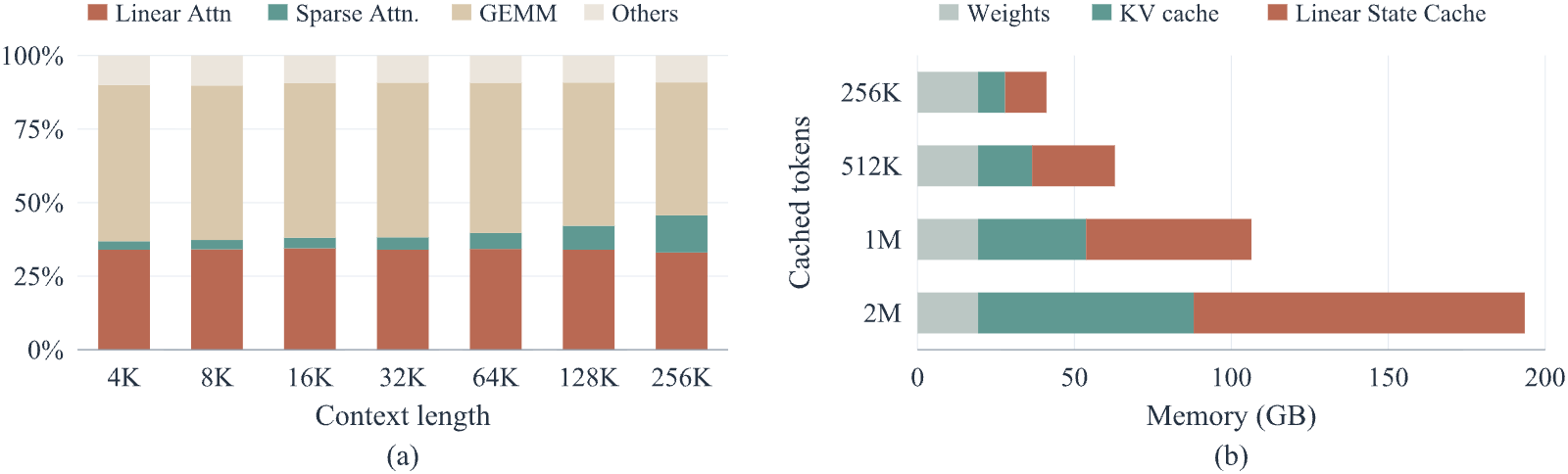
So the fix is obvious: store in fewer bits. vLLM and SGLang already let you pick BF16 instead of FP32. The paper's Table 1 shows what that costs.
Rounding every token
The naive scheme stores the state in a low-bit format and, after every decode step, computes the new state from the stored one and stores it again (the paper's equation 2):
Run an exact FP32 trajectory beside it, on the same inputs, and call the gap . Subtract the two updates and cancels. Appendix B.1 gets the error recurrence, its equation 9:
with , , and the rounding error of step . Two readings of this. First, the error is not amplified: the decay and the delta-rule erase both shrink it, so it does not blow up exponentially. Second, nothing removes it either. Each is carried forward by exactly the dynamics that carry a memory written at step . A head whose decay is close to 1 remembers for thousands of tokens, and it remembers its rounding errors for just as long. The error settles where the rate at which rounding adds it balances the rate at which forgetting removes it. Round every token and that equilibrium sits high.
That would be tolerable if the per-step errors were independent noise. They are not, and BF16 shows why with no model involved. BF16 has 8 significant bits, so two neighbouring values are between 0.39% and 0.78% apart. Multiply a stored value by a decay of 0.999 and it moves by 0.1%, less than half the gap, so it rounds straight back to where it was. I checked this exhaustively over values from 0.01 to 10 with the simulator's BF16 rounding: with , 100% of stored values never decay at all. At 0.998 it is 96%, at 0.997 37%. A head that the model trained to forget slowly, stored in BF16 and re-rounded each step, does not forget. The same logic eats any part of a write smaller than half a step. That is the paper's point in B.1: "each update is small relative to the state", so per-step rounding throws away part of it every time, in the same direction, and the errors add up coherently instead of averaging out. FP16, with three more mantissa bits, has the same cliff further out: my count puts 0.9995 safe and 0.9999 frozen.
Table 1 is what that does to reasoning. Over AIME 2026, BeyondAIME, GPQA-Diamond and LiveCodeBench v6 on three models, the FP32 state averages 84.0 and a BF16 state 72.5, the 11.5-point drop the thread quotes. On Qwen3.5-9B alone, AIME falls from 87.9 to 72.1 in BF16, to 3.9 in INT8 and to 0.0 in FP8. Its AIME traces run to tens of thousands of tokens, so there is a lot of time to drift. The collapse is model-specific: GLM-5.3-Flash keeps 87.4 on AIME with a per-step INT8 state, and Qwen3.8-Flash-Next is between the two. The paper's summary is that every 8-bit baseline still loses more than 10 points on at least one task of the two less sensitive models.
Figure 3 measures the drift directly, as state error against the FP32 trajectory over 64K decoded tokens of PG-19 on Qwen3.5-9B. INT8 per-step leaves the chart almost at once. BF16 per-step climbs steadily. The paper also tried stochastic rounding, the textbook cure for coherent rounding bias: it lowers the BF16 error at 64K by 3x and makes INT8 diverge.
Fix one: leap over a window
The error recurrence says the problem is how often you round, so round less often. That needs a way to compute outputs from a state you do not rewrite. Equation 3 gives it. Start a window at a quantized state , apply tokens, and unroll (the paper's equation 4, with the product of the decays from step to step ):
The state at any point in the window is the fixed boundary state, decayed, plus the window's rank-one writes, decayed. You never need itself, only for a query or a key. Transpose and multiply (Appendix B.2, equation 10):
The first term is one pass over the stored low-bit matrix. Each buffered token adds one dot product and one scaled vector, . The decays are diagonal and accumulate incrementally. So a decode step inside the window reads , reads the buffer, appends its own to the buffer, and writes no state at all. Only at the end of the window does the kernel materialize and quantize it once, into the next window's . Rounding happens times less often, and because what gets rounded is the accumulated update rather than sixteen separate small ones, the sub-half-step writes are no longer thrown away.
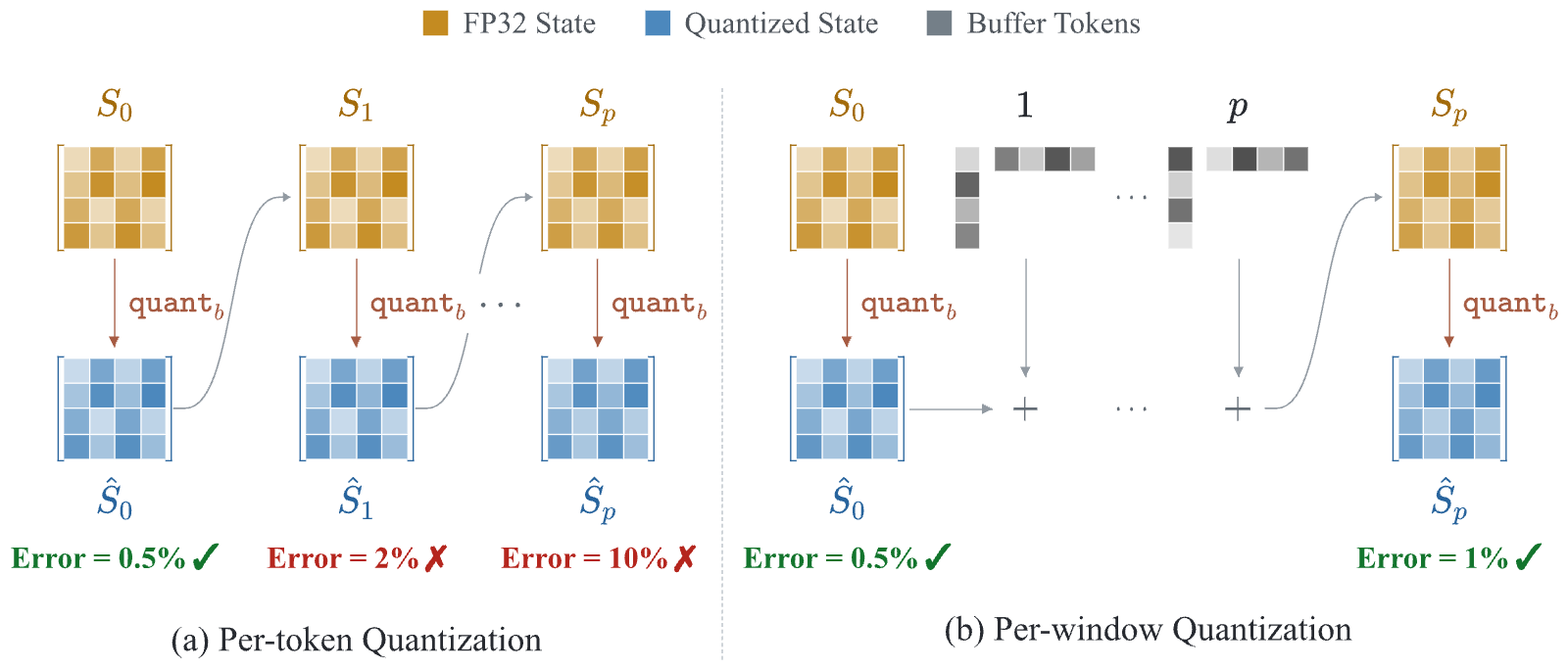
This is the same identity as ReplaySSM, from Tri Dao's lab and NVIDIA, which this site covered in October and which LeapQuant cites. ReplaySSM also writes its state once per 16 tokens, to save the write traffic, and keeps the checkpoint at high precision. LeapQuant keeps only the low-bit copy and pays for it with one rounding per window, the "one checkpoint, rounded once per window" case that the ReplaySSM piece measured on a toy as better than per-step but far from free. That is why LeapQuant needs the next two fixes and ReplaySSM does not.
The ablation in Table 2 shows the window alone does most of the work. On Qwen3.5-9B, an INT8 state rounded every step scores 7.1 on AIME and 9.2 on LiveCodeBench; per-window INT8 scores 82.4 and 60.6. Per-window BF16 scores 87.8 on AIME, against FP32's 87.9. Note that Table 2's per-step INT8 run is not the one in Table 1, which reports 3.9 and 10.7 for the same cells; both are near zero. Table 3 varies the window: accuracy improves up to 16 tokens and stops, and the kernel is fastest at 16 too (2.52x over FP32 at batch 256 on a B200, against 1.59x at 4 tokens and 2.20x at 32), because a longer window means a longer buffer to read every step.
Here is all of this on a toy head you can drive. It is one GDN head with a state, L2-normalised keys with two biased channels and four wide ones, two large biased value channels, decays just under 1 and write strengths of 0.05 to 0.15, run 4,096 steps exactly and again with a quantized state. The grey line stores every step with nothing else. The orange line uses your settings.
With the defaults (INT8, long memory), storing every step ends at 15% relative state error after 4,096 quantizations. A 16-token window with no other fix brings that to 4.3% with 256 quantizations. Four Compensator Tokens and smoothing bring it to 1.0%. At INT4 the difference is starker: per-step INT4 diverges, its error past 1000% by the end, while the window with four Compensator Tokens and smoothing holds near 21%. The toy saturates where Figure 3 keeps climbing, because my longest decay is shorter than a real model's; the order of the curves carries over, not their values.
Fix two: pull the outliers out as tokens
The window decides how often the state is rounded. The second fix decides how much each rounding costs. The paper's Figure 6 shows one Qwen3.5-9B head (layer 13, head 16) at 8K tokens of context, its entries divided by the median magnitude. The largest is 176 times the median, and the big ones sit in a few rows and columns.
With symmetric INT8 and one scale per value channel, which is what the code does, a column's step is its largest entry divided by 127. A column containing a 176x outlier quantizes every ordinary entry in it on a grid sized for the outlier: a median-sized entry gets less than one level. That is the source of the per-quantization error.
The structure is also low-rank. Figure 5 in the paper shows a few singular values carry most of the state's energy, and a value that is large along a row and a column at once is what a rank-one outer product looks like. So before quantizing , fit the best rank-one approximation and subtract it (equation 5):
By Eckart and Young the minimiser is the top singular pair, and with of them it is the top . Only the residual is quantized; the pairs are kept in FP16.
The name comes from the shape. is exactly the form of a token's write , so
at the start of the next window the Compensator Tokens go into the window's buffer ahead of the real tokens, with a
decay of 1. The readout in equation 10 already handles buffered rank-one writes, so the decode kernel processes them
on the same path at the cost of extra records. The kernel docstring in kernels.py says it plainly: "the
Compensator Tokens are handled exactly like R extra buffer entries with weight 1." No model-specific code, no second
state.
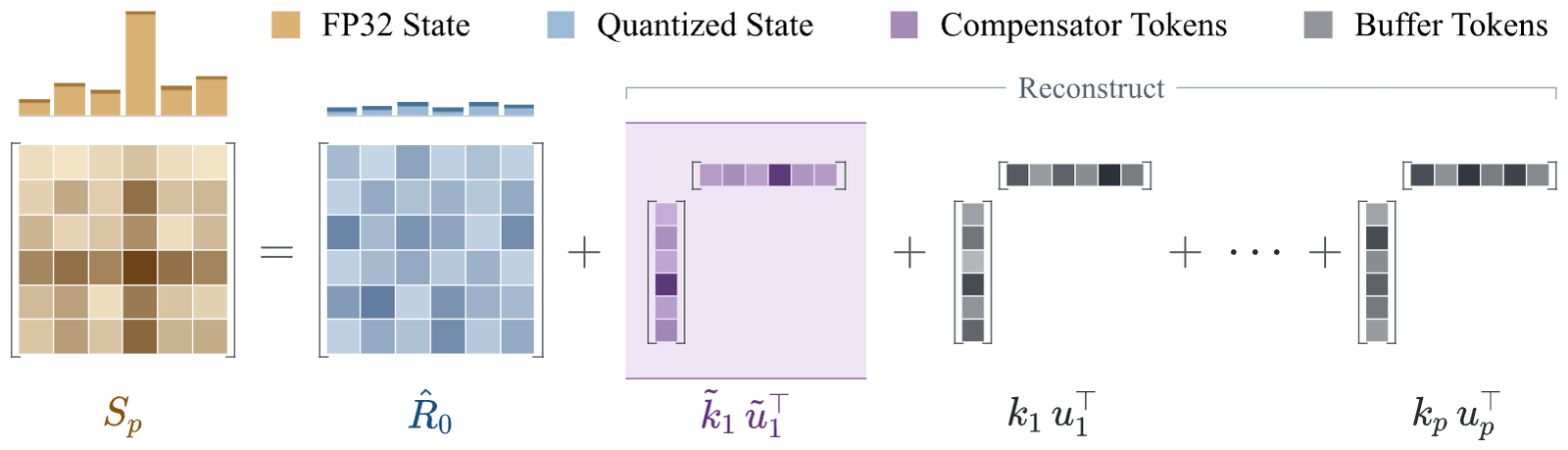
The paper uses at 8 bits and at 6 and 4 bits. Table 3 sweeps it at 8 bits: two tokens give 85.7 on AIME, four give 87.9, eight 88.1, and sixteen give 87.9 with the kernel at 0.74x, slower than FP32. Up to four are hidden behind the state read on a B200; more become visible. In the ablation, adding four Compensator Tokens to per-window INT8 lifts AIME from 82.4 to 86.6 and LiveCodeBench from 60.6 to 61.5.
How the fit is computed in the shipped kernel is cheaper than the argmin suggests. The paper says power iteration.
make_flush runs ITERS=1 round of subspace iteration from a fixed random start (Q0, seeded with 0),
orthogonalises with CholeskyQR2 on the tensor cores, and carries the previous window's factors algebraically instead
of rebuilding them into the dense state. One iteration from a random start does not find the exact top-four
subspace. It finds a subspace that holds most of a spectrum this concentrated, and what it misses lands in the
residual, which is quantized anyway. That is a sound trade, and the accuracy tables are measured with it.
Fix three: smooth what is left
After the Compensator Tokens the residual is flatter, but not flat. In Figure 6 the peak drops from 176x the median to 47x; a few key rows still stand out. Per-value-channel scales do nothing about a row that is large across every column. So the third fix rescales rows. For each key row of the residual, take as the square root of the row's mean absolute value, divide the row by it, and quantize (equation 7):
The square root splits the difference between doing nothing and fully normalising, the same move SmoothQuant makes between activations and weights. The scales are FP32, fixed within a window and recomputed at each boundary. Undoing it costs nothing at read time. Appendix B.3 writes the dequantized INT8 payload as , with the per-value-channel scales, so
and folds into the vector before it meets the integer matrix. The kernel multiplies a 128-long vector
by one more diagonal. The code computes exactly the paper's rule, sk = torch.sqrt(res.abs().mean(-2)).clamp_min(1e-12)
in the KDA path and s_k[c] = sqrt(mean_v |E[v, c]|) in the flush kernel's docstring.
In Figure 6 smoothing takes the peak from 47x to 5.3x the median. In the ablation it takes per-window INT8 with Compensator Tokens from 86.6 to 87.9 on AIME and from 61.5 to 64.1 on LiveCodeBench, both equal to FP32, at a kernel speedup of 2.52x.
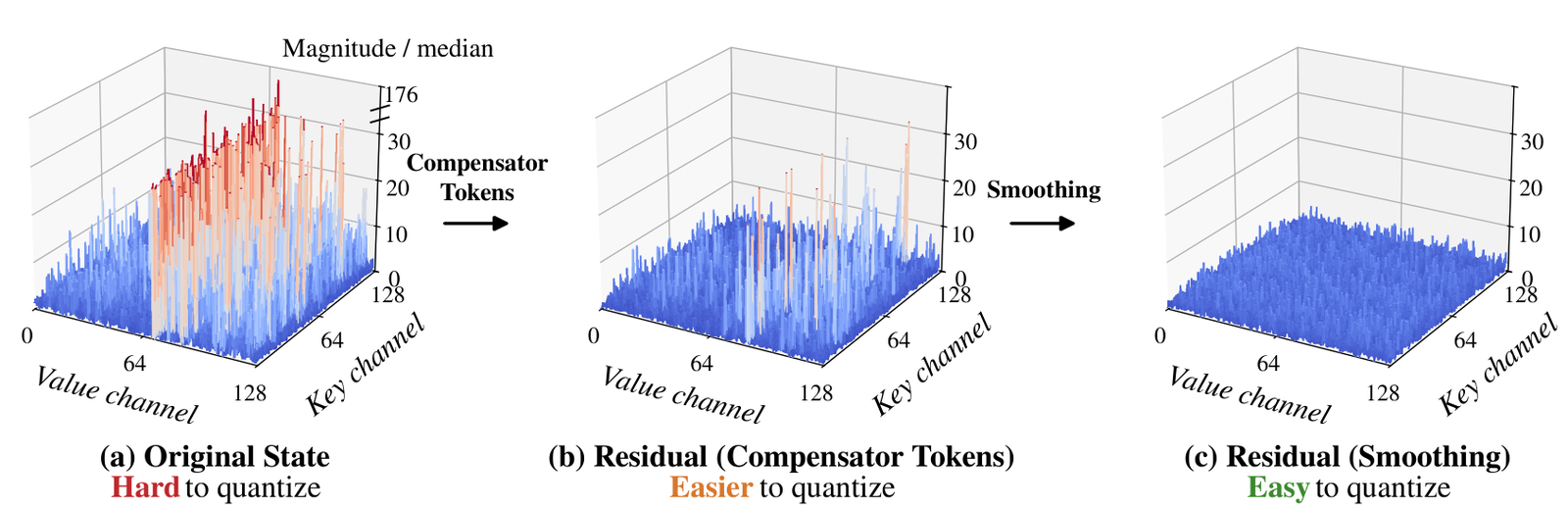
In my toy the order is the same and the proportions are not. The exact state's peak is 48x its median, four Compensator Tokens take the residual to 5.3x, and smoothing to 5.1x. My outlier rows are mostly rank-one, so the Compensator Tokens remove them and leave smoothing little to do. Turn the Compensator Tokens off in the simulator and smoothing alone is worth something: per-window INT8 goes from 4.3% to 3.0%. The paper's head has row structure that four rank-one terms do not capture, which is why smoothing earns its 2.6 points on LiveCodeBench there.
What 1.19 bytes buys, and what it costs to carry
The paper says each window-boundary state takes 1.19 bytes per element instead of 4, a 3.4x reduction. The layout
comment in state.py gives the pieces, and the arithmetic per head is mine: 16,384 bytes of INT8
residual, 128 FP32 smoothing scales for the key rows and 128 FP32 quantization scales for the value channels
(1,024 bytes), and four Compensator Tokens of 128 + 128 FP16 values (2,048 bytes). That is 19,456 bytes, 1.1875 bytes per element. It checks.
That figure is for a state at rest, a checkpoint. A request that is decoding also carries its window buffer: 16
tokens of key and correction, 8 KiB per head, which matches the paper's "around 8 KiB per head per layer" (the
paper says FP16; the code's Kbuf and Ubuf are BF16, the same size). That
adds half a byte per element, so an active GDN stream holds 1.69 bytes per element. KDA's buffer also keeps a
per-channel FP16 decay for each buffered token (the Gbuf tensor), another 4 KiB per head, so an active KDA stream
holds 1.94, barely under BF16's 2. The memory win on a live request is modest. The big one is on cached checkpoints,
which carry no buffer, and that is where the paper measures it.
Traffic is the better story. An FP32 state moves 8 bytes per element per step, 4 in and 4 out. On my reading of the kernels, a LeapQuant step reads the 1.19-byte checkpoint and the buffer (half full on average), appends one record, and writes a checkpoint once every 16 steps, about 1.5 bytes per element per step for GDN. That is roughly 5x less than FP32 and 2.6x less than BF16, which is in the range of the kernel speedups the paper measures. This is an estimate from the layout, not a measurement.
For the Qwen3.8-27B case that started this, 48 layers of 48 heads, the state per stream would go from 144 MiB in FP32 to 60.75 MiB active or 42.75 MiB as a cached checkpoint. The 3090 article inferred a pool of five to six GiB from HyperQwen's logs, where 37 FP32 streams actually ran. Taking 5.5 GiB as the midpoint, that is 39 FP32 streams, 78 in BF16 and 92 with LeapQuant's layout. The last number is what the paper's design would give. The next section is about why the released code does not give it yet, and why it would not run on a 3090 anyway.
The speed numbers, cell by cell
Figure 7 is one linear-attention layer (32 heads, ) against the FP32 kernel in FLA. The 4.25x in the thread is one cell: GDN on an RTX 5090 at batch 512. At batch 512, GDN is 2.68x, 3.95x and 4.25x faster on the B200, RTX PRO 6000 and RTX 5090, and KDA 2.41x, 3.38x and 3.64x. The abstract's "2.05-3.70x" is the average per GPU. The gains are larger on the two workstation cards, which the paper reads as state traffic being a stronger bottleneck there.
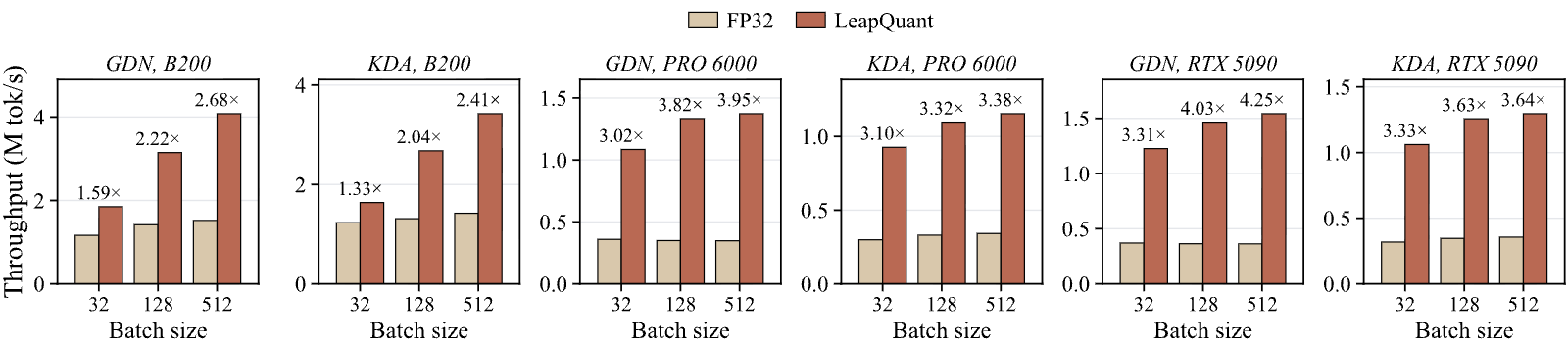
A layer kernel is not a model. In pure decode steps through vLLM at 4K context, the gain is 1.22-1.29x at the largest batch on a B200 and 1.22-1.57x on the RTX PRO 6000, growing with batch size as linear attention takes more of each step. Appendix C has the gain still at 1.18x for Kimi-Linear-48B-A3B at 8K context.
End to end (Figure 9), the paper reports 1.19-2.98x output throughput on the B200 and 1.31-1.65x on the RTX PRO 6000, and 1.57x on average. The top of that range is GPQA, whose long outputs make the state checkpoints dominate memory: concurrency rises from 10 to 23 requests per GPU on GLM-5.3-Flash and from 32 to 61 on Qwen3.8-Flash-Next. The thread's "up to 2x" undersells the paper's own maximum and oversells its average. Those end-to-end runs keep a state checkpoint every 1K cached tokens, which the paper calls the vLLM and SGLang default with prefix caching on, and that is also the setting for the memory figure: 41%, 51% and 56% less end-to-end memory on Qwen3.5-9B, Qwen3.5-35B-A3B and Kimi-Linear-48B-A3B. The spacing matters, because the saving scales with how many checkpoints are kept. The FlashState paper found vLLM checkpointing GLM-5.3-Flash only at 4,352-token block boundaries and SGLang on a 256-token grid, so real engines sit on both sides of the paper's 1K.
The accuracy side holds up at 8 bits. LeapQuant averages 84.4 over the twelve model-task pairs against FP32's 84.0 and stays within 2.5 points of FP32 on every pair. At 6 bits it also averages 84.4. At 4 bits it averages 80.6 against TurboQuant's 45.0 and MXFP4's 16.7, within 3.2 points on Qwen3.5-9B and 1.3 on Qwen3.8-Flash-Next, but GLM-5.3-Flash loses 6.5 points on AIME and 11.7 on BeyondAIME. "Matches FP32" is an 8-bit and 6-bit claim.
What the released code does
I cloned the repository at commit 61434a9 (11 November) and read state.py, the two vLLM hooks and the parts of
kernels.py (2,332 lines of TileLang) I cite: the docstrings, the step kernel's load stage and the flush kernel's
fit and residual. I did not run it: there is no Hopper or Blackwell GPU here. What the code says:
- It is 8-bit only.
kernels.pyopens with "TileLang kernels of LeapQuant's 8-bit recurrent state (rank-4 Compensator Tokens + smoothed INT8 residual, window L = 16)". There is no 6-bit or 4-bit path, andmake_flushasserts , or for 128 x 128 GDN heads only, so the paper's low-bit configuration cannot be built. - It keeps the FP32 allocation. The
state.pydocstring: "the 8-bit checkpoint lives inside vLLM's fp32 state slot". The INT8 payload, the scales and the factors are views aliasing the FP32 tensor, and the window buffers are allocated beside it. Per active request the plugin holds more memory than plain vLLM, not less. What it saves is traffic, which is where the speedup comes from. - It refuses prefix caching.
get_stateraises unless the engine runs with--no-enable-prefix-caching, andserve.shpasses that flag. The paper's 41-56% memory reductions and its largest end-to-end gains were measured with a checkpoint per 1K cached tokens. The open code cannot reproduce that setting. - Speculative decoding falls back to per-step rounding. In
vllm/gdn.py, a step with speculative tokens takes a "round trip every slot" path: dequantize, run vLLM's own kernel, quantize again, reset the window.vllm/glm.pydoes the same for KDA. That is a quantization per verification step, the regime the paper shows failing. The paper does not evaluate speculative decoding, so I cannot say how much it matters with a few accepted tokens per step. - It needs TMA. The step kernel's producer warp streams the INT8 tile, the scales, the factors and the buffer
with
T.tma_copy. TMA arrived with Hopper. The paper's three GPUs are Blackwell parts, and I found no fallback. An RTX 3090 is out. - It covers two model classes. The plugin hooks vLLM's Qwen GDN layer and GLM-5.3's KDA layer, and the GLM path asserts "LeapQuant supports the bounded KDA gate only". Kimi-Linear, which the paper evaluates at 8 bits, is not wired in.
- It is pinned to
vllm==0.30.0andtilelang==0.1.12, with head shapes 128 x 128, 64 x 128 and 64 x 64.
One comment in the flush kernel is the kind you only write after a bad night: a floor on the cumulative decay because "a fully decayed head has a denormal product (2e-41 seen on 9B layer 11) and 1/pn = inf", which poisoned the residual into NaN outputs. Carrying a product of 16 decays and dividing by it is exactly where a real model's gates will find the edge of FP32.
Worth running on Blackwell, not yet on a 3090
The analysis is the best part. Equation 9 plus the observation that per-step rounding is biased, not noisy, explains both the BF16 drop and why stochastic rounding barely helps, and the fix follows from it: round less often, and make each rounding cheaper. The window is the big lever, worth about 75 AIME points over per-step INT8 on Qwen3.5-9B by itself; Compensator Tokens and smoothing take the last five. Reusing the token path for the outlier factors is the kind of design where the kernel gets simpler instead of harder.
For an engine that serves GDN or KDA models on Blackwell, at large batch, without prefix caching, the released plugin is worth trying today: the kernel speedups come from traffic and the plugin keeps that. Everyone else should read the paper for the method and wait for the port. The memory story, which is the one the 3090 case needed, is in the paper and not yet in the code. And if you are on a consumer card doing what HyperQwen did, storing the state at 16 bits and re-rounding it every token, the BF16 arithmetic above is a reason to prefer FP16 over BF16: FP16's mantissa still moves a 0.9995 decay that BF16 cannot represent. That last point is my reasoning from the number formats; the paper tests BF16 and not FP16.
The step I would watch for next is the one ReplaySSM already took: keep the boundary state in high precision for the recurrence and use the low-bit copy only for reads. That takes most of the rounding out of the loop, though not all: the high-precision copy is itself rounded at each flush unless it stays in FP32, and on GDN the corrections computed from the low-bit copy carry its error through the rest of a window. It also costs the memory LeapQuant is trying to save. LeapQuant's answer is that with three fixes, one rounding per 16 tokens is small enough. On its tables, at 8 bits, it is.
How I checked. Read: the paper (v2), its appendices and all six figures I reproduce; the thread and its video;
state.py, vllm/gdn.py, vllm/glm.py, serve.sh and pyproject.toml in full and the cited parts of kernels.py,
at commit 61434a9. Computed: the 1.1875 bytes per element and 8 KiB buffer from the layout, the per-stream sizes from the
Qwen3.8-27B and GLM-5.3-Flash shapes, the traffic estimate, and the BF16 and FP16 decay counts. Ran: the toy
simulator above, whose code is components/articles/leapquant/sim.ts. Not run: LeapQuant itself.