2026-11-09 · 13 min · hunyuan · mixture-of-experts · benchmarks · vision-language-models · computer-use
Why read this
Solidtop 85%No weights shipped, so this counts Tencent's own numbers three ways, runs the preview tokenizer, and measures the one endpoint.
- Original analysis
- Widely used
- Concrete numbers to act on
LLM architectureAPI onlyProprietaryPractitioner model
How this was scored
- Is it new?
- 1 of 3: An incremental tweak
- Can I trust it?
- 2 of 3: Measures key facts from files, code or configs
- Can I run it?
- 1 of 3: API-only, gated or restrictive licence
- Will I understand it?
- 1 of 3: Partial mechanism
- Can I act on it?
- 2 of 3: A concrete recipe, numbers or comparison
- Will it last?
- 1 of 3: Relevant for months
- Does it affect many?
- 2 of 3: A widely used model, tool or lab release
- Only here?
- 2 of 3: A teardown or measurement few others did
Score 54 of 100, ranked 536 of 701 rated articles. Each question is answered 0–3 by hand, and a 3 is rare. How articles are scored
On November 4, Tencent's Hy team posted "Hy4 is here, new with vision. Firmly among the leading open models." Ten weeks earlier the same team shipped Hy4 preview: a 770B-parameter, 49B-active mixture-of-experts with an Apache-2.0 licence, 131 weight shards and a model card I could check down to the tensor. The full release is a different kind of object. It has a launch post, a promotional film, a research page that answered my fetches with a security block, a 12-panel chart and a comparison table. It has no weights.
So this is the shorter article: what changed from the preview, which claims can be checked from outside, and which cannot. Every claim carries a label. Measured means I ran it or fetched it. Reported means Tencent or a third party said it and I have not reproduced it. Reasoned means I derived it from measured or reported facts.
| Model | Hy4 (Tencent Hy team), the full release of Hy4 preview |
| New since the preview | image input and computer use (reported); text+image->text on OpenRouter (measured) |
| Size | 770B total, about 49B active, 1M context (reported in coverage; no config to read) |
| Weights | none published: tencent/Hy4 absent from Hugging Face and ModelScope on 2026-11-10 (measured) |
| Licence | none published; the preview is Apache-2.0 (measured) |
| Where it runs | Tencent's own endpoint, tagged fp4 on OpenRouter (measured) |
| Price | $0.834 in / $2.501 out per million tokens list, half that until December 31 (measured on OpenRouter; discount window reported) |
| Checked | Hy4 ahead of DeepSeek-V4.1-Flash on 12 of 12 chart panels; ahead of the best of three open rivals on 6 of 12, four of them internal; ahead of all five on 0 (counted from Tencent's chart) |
What shipped, and what did not
No weights (measured). The Hugging Face API lists two Hy4 repositories under tencent: Hy4-preview and Hy4-preview-FP8, both created on 2026-08-27. A request for tencent/Hy4 returns 401, which on Hugging Face is what a missing repository returns. ModelScope's API answers Tencent-Hunyuan/Hy4-preview with the model's record and Tencent-Hunyuan/Hy4 with "获取模型失败" (failed to get the model). OpenRouter's catalogue entry for tencent/hy4 carries hugging_face_id: tencent/Hy4, a pointer to a repository that does not exist yet. Coverage of the launch reports that Tencent describes the weights as planned for open release, with a system card, and gives no date. I could not reach Tencent's own page to confirm the wording: hy.tencent.ai/research/hy4 returned a Tencent Cloud EdgeOne "Restricted Access" page to every fetch I made, and I did not try to get around it.
No licence (measured). There is nothing to quote, because there is no LICENSE file. The history matters, because Tencent's licences have changed. The preview's LICENSE opens "Tencent Hy4 preview is licensed under the Apache-2.0," and so does Hy3's. A year earlier, Hunyuan-A13B shipped under the Tencent Hunyuan Community License, whose first line is: "THIS LICENSE AGREEMENT DOES NOT APPLY IN THE EUROPEAN UNION, UNITED KINGDOM AND SOUTH KOREA AND IS EXPRESSLY LIMITED TO THE TERRITORY, AS DEFINED BELOW." Its definition: "'Territory' shall mean the worldwide territory, excluding the territory of the European Union, United Kingdom and South Korea." The last two flagships dropped that clause. Whether Hy4 keeps it dropped is unknown until the weights land. Reading "Firmly among the leading open models" as a licence promise would be reading too much into a launch post.
A hosted model, served at fp4 (measured). OpenRouter's endpoint listing for tencent/hy4-20261104 has exactly one provider, Tencent, with quantization: fp4. Context is 1,048,576 tokens, the same as the preview; the completion cap rose from 64,000 to 65,536. Input modalities are text and image; the preview's are text alone. The supported-parameter list shrank. The preview endpoint accepts top_p, top_k, min_p, seed, logprobs, top_logprobs, logit_bias and three penalty knobs; the Hy4 endpoint accepts none of them, only temperature, stop, reasoning controls, tools and structured output. If your harness pins seed or reads logprobs, it will not carry over. The preview's own model card recommends top_p=1.0, so dropping top_p costs less than it sounds.
The price is the preview's price, halved for now (measured). OpenRouter lists Hy4 at $0.417 input and $1.2505 output per million tokens, with discount: 0.5 on the endpoint. Undo the discount and you get $0.834 and $2.501, the figures in the third-party post that announced the release, and exactly the preview's list price on the same site. Coverage reports Tencent's renminbi list as 6 in and 18 out per million, and a 50% TokenHub discount through December 31, 2026 (reported). The dollar figures are those renminbi figures at about 7.2 to the dollar (reasoned).
Vision was already in the vocabulary
There is no Hy4 tokenizer to run, so I ran the preview's. I loaded tokenizer.json from tencent/Hy4-preview with tokenizers 0.23.3 and listed every added token (measured). The base BPE vocabulary has 120,000 entries. On top of it sit 832 added slots, ids 120000 to 120831, which is exactly the vocab_size of 120,832 in config.json. Thirty-five have names. The other 797 are reserved placeholders, <|hy_place▁holder▁no▁N|>.
The names were the surprise. Eight are control tokens (begin, middle, end, pad, end-of-turn and three fill-in-the-middle markers), and thirteen are for reasoning and tool calls (<think>, <tool_call>, <arg_key> and their closers). The other fourteen are visual grounding: <box>, <quad>, <ref>, <point>, <det>, <mask> and <pFig>, each with a closing tag. A model served as text->text, whose card describes no image input, shipped a tokenizer that could already write a bounding box.
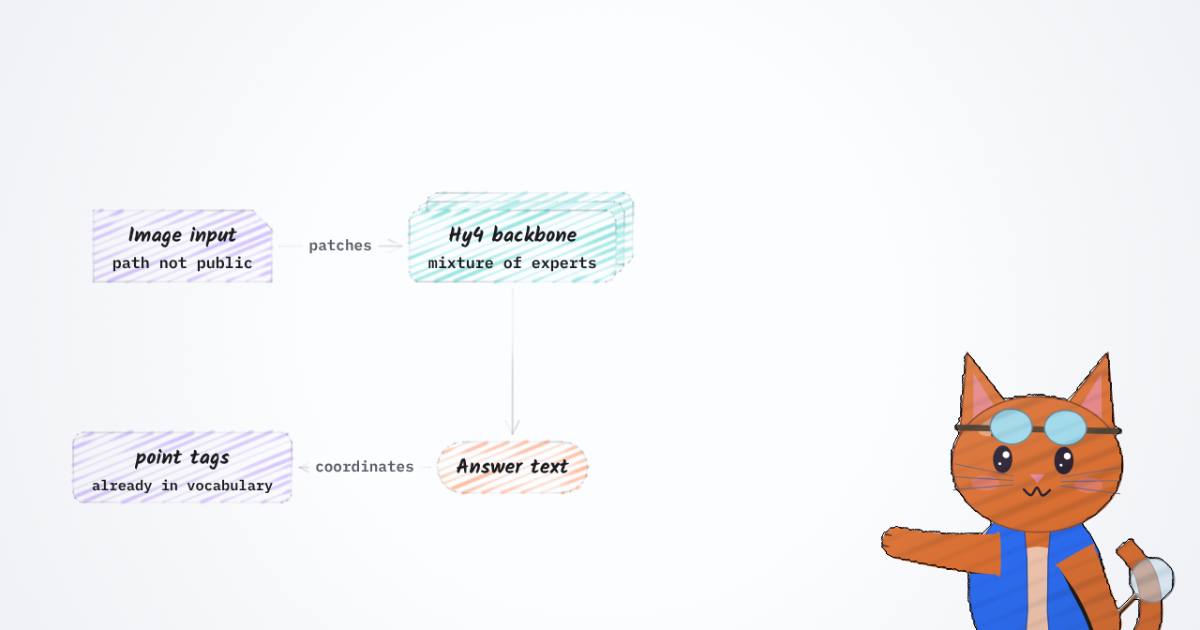
Grounding tokens frame output, not input. A coordinate is ordinary text between the tags: <point:opensource>(512,384)</point:opensource> encodes to 7 ids, the two tags as single tokens and (, 512, ,, 384, ) as plain BPE pieces (measured). This is the convention several vision-language models use for pointing and boxing: the model names a region in characters rather than through a detection head. What the preview's vocabulary does not contain is an image-input token. The string <image> splits into <, image, > (measured). Whatever carries image patches into Hy4, a new token, a placeholder slot repurposed, or embeddings spliced in without a token, is not visible from the preview. With 797 free slots, Tencent did not need to resize the embedding table to add one (reasoned).
Two readings of those fourteen tokens fit the evidence. Vision was planned when the tokenizer was built, and the preview shipped with the output half of the interface already reserved. Or Hy's tokenizer is shared across Tencent's model family and the grounding tokens came along with it. I cannot tell them apart from one file. Either way, the release's claim that vision is new is a claim about the model, not the vocabulary.
The same run gives a feel for what a token buys at Hy4's prices (measured on the preview tokenizer, which Hy4 may not share): this site's brand-crew/brand/voice.md is 4,986 characters and 1,276 tokens, 3.91 characters a token; a 9,363-character TSX component is 3,245 tokens, 2.89 a token; a 77-character Chinese paragraph is 41 tokens, 1.88 a token.
The chart counts Tencent's own runs
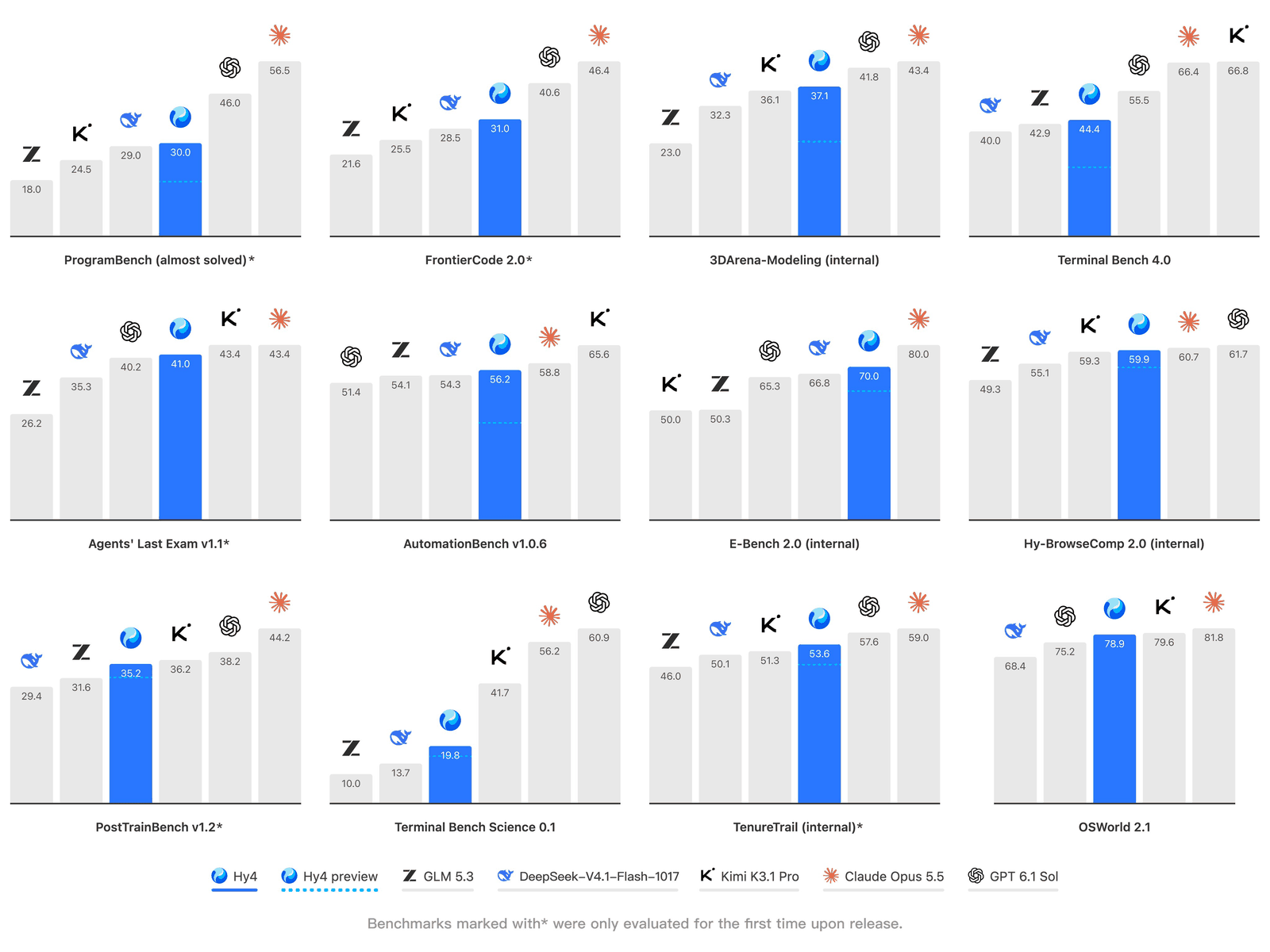
The launch post carries one image: 12 benchmark panels, Hy4 against GLM 5.3, DeepSeek-V4.1-Flash-1017, Kimi K3.1 Pro, Claude Opus 5.5 and GPT 6.1 Sol, with a dashed line marking Hy4 preview where it was scored.
A second image, Tencent's "Agentic Coding" table, circulated in a third-party post the same day. It has 13 rows and a Hy4 preview column, which makes it the best record of what changed.
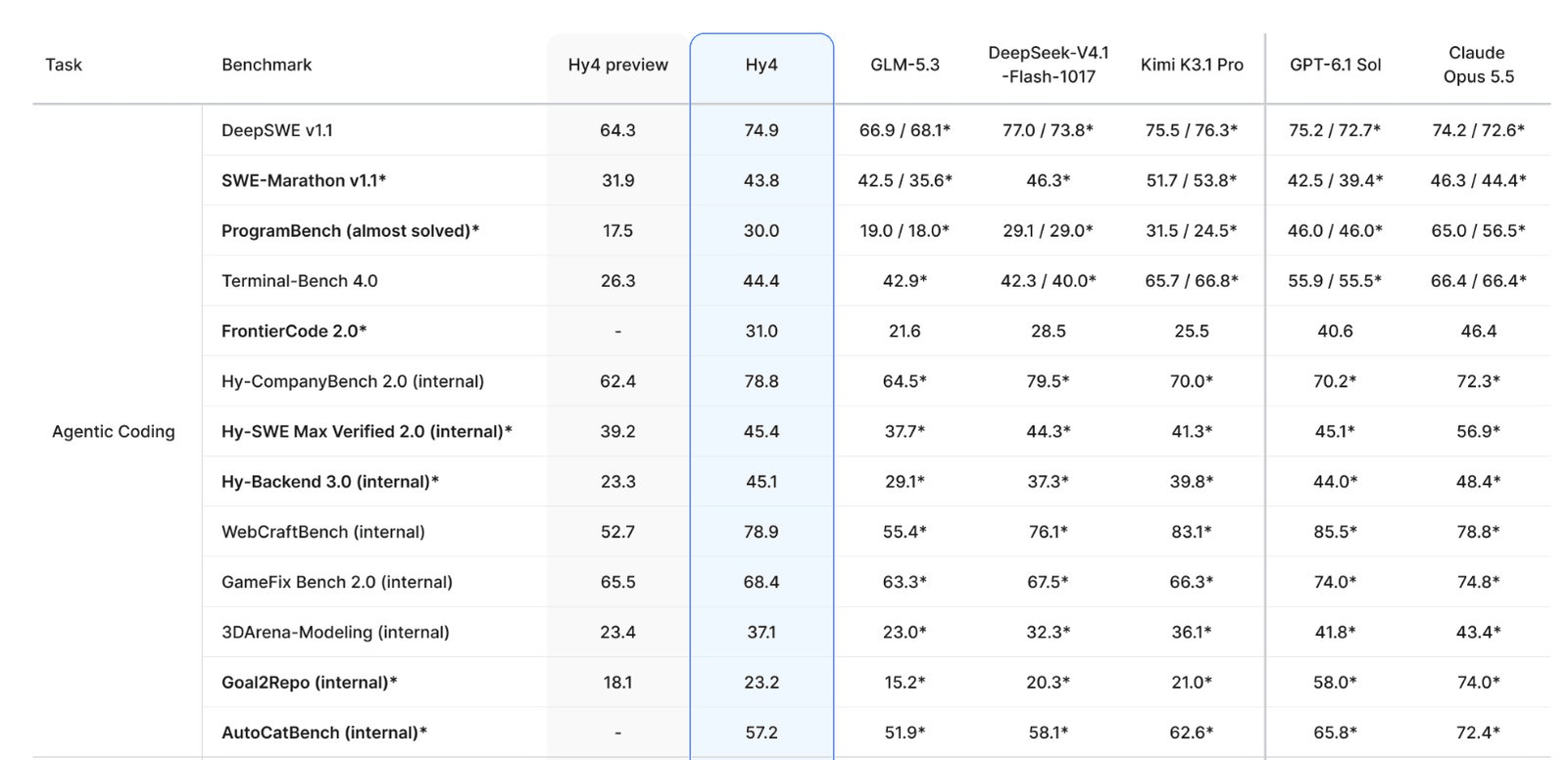
The preview's model card used the asterisk for "our own testing." The new table uses the same mark in the same place, and on every row the chart shares with it, the chart's bar is the asterisked figure (measured, by reading both images). I read the unstarred figure as a number published elsewhere, most likely by the competitor itself (reasoned; the table's own legend was not in the image). The two disagree often. On 18 cells that carry both figures, Tencent's run is lower on 12, higher on 4 and equal on 2, by 1.85 points on average (counted). Three of those gaps flip the comparison with Hy4. On ProgramBench, Kimi K3.1 Pro is 31.5 one way and 24.5 in Tencent's run, either side of Hy4's 30.0. On DeepSWE v1.1, DeepSeek-V4.1-Flash is 77.0 or 73.8 against Hy4's 74.9, and GPT-6.1 Sol 75.2 or 72.7. A re-run under one harness is the right way to compare models. It also means every margin below depends on Tencent's harness.
The counts, from Tencent's numbers only:
- Against DeepSeek-V4.1-Flash Hy4 is ahead on all 12 chart panels. In the coding table it is ahead on 10 of 13 with Tencent's runs and 9 of 13 with the other figure, losing on SWE-Marathon v1.1 (43.8 against 46.3), Hy-CompanyBench 2.0 (78.8 against 79.5) and AutoCatBench (57.2 against 58.1). The margin on ProgramBench is 30.0 against 29.0. "Beats DeepSeek V4.1 Flash" holds on Tencent's chart.
- Against the best of the three open models Hy4 is ahead on 6 of 12 panels: ProgramBench, FrontierCode 2.0, 3DArena-Modeling, E-Bench 2.0, Hy-BrowseComp 2.0 and TenureTrail. Four of the six are labelled internal. On the eight public panels it leads two. Kimi K3.1 Pro beats it on the other six, by 22.4 points on Terminal Bench 4.0 and 21.9 on Terminal Bench Science 0.1.
- Against all five Hy4 leads no panel and no table row. Its best chart placing is second, on E-Bench 2.0, an internal benchmark, at 70.0 against Claude Opus 5.5's 80.0. In the table, with Tencent's runs, it is second on four rows: DeepSWE v1.1 (74.9 against Kimi K3.1 Pro's 76.3) and three internal ones, Hy-CompanyBench 2.0, Hy-SWE Max Verified 2.0 and Hy-Backend 3.0.
"Firmly among the leading open models" is a fair summary of that: ahead of one open rival everywhere, level with the strongest open rival, behind both closed models. On computer use, the new capability, OSWorld 2.1 puts Hy4 at 78.9, ahead of DeepSeek-V4.1-Flash at 68.4 and GPT 6.1 Sol at 75.2, behind Kimi K3.1 Pro at 79.6 and Claude Opus 5.5 at 81.8 (reported). GLM 5.3 has no bar there. Finance, the other claim in the third-party post, rests on a crowdsourced test reported in coverage, 213 experts and 579 tasks scoring Hy4 3.04 against DeepSeek-V4.1-Flash's 2.97 on a four-point scale (reported, secondary; I could not reach Tencent's own write-up).
What changed from the preview
The table's preview column is the cleanest evidence of the update, because it is one vendor scoring two of its own checkpoints under the same harness. Two values carry over from the preview's own model card: ProgramBench 17.5 and DeepSWE 64.3 (measured, against the card read for the earlier article). That is a small check that the preview column is not re-scored to flatter the gap.
Across the 11 rows with a preview score, Hy4 gains a median of 12.5 points (counted). The largest are WebCraftBench (52.7 to 78.9), Hy-Backend 3.0 (23.3 to 45.1) and Terminal-Bench 4.0 (26.3 to 44.4); the smallest are GameFix Bench 2.0 (65.5 to 68.4) and Goal2Repo (18.1 to 23.2). Internal and public rows gain about the same, 13.2 and 13.3 points on average. Coverage relays two more Tencent figures: hallucination on an internal search set falling from 15.76% to 5.45%, and "guessing errors" from 23.1% to 5.6% (reported, benchmark unnamed).
Two cautions. Terminal-Bench moved versions between releases: the preview's card scored it on 2.1 (85.4) and the new table on 4.0 (26.3 for the same preview checkpoint). Comparing headline numbers across the two launches without that note would read as a collapse. And the size line has not changed in coverage, 770B total and about 49B active (reported). Whether the full release kept the preview's 78-layer backbone, its gated sparse attention and its IndexCache layout, and how large a vision tower it added, nobody outside Tencent can say until there is a config.json to read.
What holding it would cost
If the backbone is unchanged (reasoned, not known), the preview's files bound the problem. I summed the safetensors sizes from the Hugging Face API (measured): the BF16 repository is 1,559.98 GB over 131 shards, 2.0 bytes a parameter for 779.96B parameters including the next-token-prediction layer; the FP8 repository is 813.77 GB over 130 shards, 1.04 bytes a parameter. Tencent serves Hy4 at fp4. If that means the 753.77B routed-expert parameters at NVFP4's 4.5 bits a weight and the remaining 26.19B at one byte, the checkpoint is about 450 GB before any vision tower (reasoned).
The KV cache is small for a 1M window because of the preview's attention design (reasoned from its config.json). Multi-latent attention stores 576 values a layer a token, 512 latent and 64 rotary, over 78 layers. IndexCache gives only 21 layers their own 128-dimension indexer key. In BF16 that is 92,544 bytes a token, 97.0 GB for one full 1,048,576-token sequence; FP8 latents bring it to 49.9 GB. Without IndexCache the indexer keys alone would take 10.5 GB at 1M instead of 2.8 GB.
So a single 1M-token stream at fp4 weights wants about 547 GB, five 141 GB accelerators at 90% use, or eight 80 GB ones (reasoned). The hosted price makes the comparison plain: an agent task with 2M input tokens and 40K output costs about $1.77 at list and $0.88 at the discount, with no cache hits (reasoned from the measured rates).
The ledger
What holds (measured): no Hy4 weights on either registry the preview used; one provider, Tencent, at fp4; image input on the endpoint; a sampling-parameter list cut to temperature and stop; a list price equal to the preview's, discounted by half. The preview's tokenizer reserved 14 grounding tokens and 797 empty slots, and no image-input token.
What holds on Tencent's own numbers (counted, not reproduced): Hy4 is ahead of DeepSeek-V4.1-Flash on 12 of 12 chart panels and 10 of 13 coding rows; ahead of the best open rival on 6 of 12 panels, 4 of them internal; ahead of all five on none. The preview-to-Hy4 gains are real and large, a median 12.5 points over 11 rows.
What cannot be checked yet: parameter counts, architecture, the vision encoder, the licence and its territory, and every benchmark. Of the chart's 12 panels, 4 are internal by name and others are new versions with no public leaderboard I could cross-check. The preview article could confirm "770B / 49B" to four decimal places from 131 shard headers. This one can confirm that the number was said again. When tencent/Hy4 appears, the first things to read are config.json for the vision tower, LICENSE for the word "Territory", and the model card's appendix for what the asterisk means this time.
Related on this site: Hy4 preview for the architecture checked from its weights; Hunyuan Hy3 and Hunyuan-A13B for the family and its licence history; DeepSeek-V4.1-Flash-1017, Kimi K3.1 Pro and GLM-5.3 for the three open models on Tencent's chart; NVFP4 KV cache for the 4-bit format the fp4 estimate assumes.