2026-11-13 · 28 min · speech · voice-agents · realtime · audio · flow-matching · hybrid-attention
A 4:59 narrated explainer, drawn in code. Every number and picture in it is this article's own; the sources are below.
› transcript
You say mm-hm while a voice assistant is talking. Does it stop mid-sentence, or keep going, the way a person would? Hi, I'm Pippa! Haru is an open full-duplex speech model from a Japanese startup. Let's see how one model listens and talks at once. Chapter one. Why voice pipelines wait. Most voice assistants are a relay of four models. First, a detector waits until you have been quiet long enough to be sure you finished. Then speech recognition writes down what you said. Your laugh and your tone stay behind. A text model writes the answer. And a speech synthesiser reads it out. Every stage waits for the one before. In a relay, only one side holds the floor, and a polite mm-hm looks exactly like an interruption. A full-duplex model drops the floor. It hears and speaks every frame, and overlap is just more data. Chapter two. Three streams, one clock. Here's the idea. Every frame, add your audio, the model's own audio, and its text into a single position of one language model. Time runs in frames of a hundred and thirty-three milliseconds. You ask. The model writes padding, then an end-of-padding token, and starts to speak. Take one frame. Your audio, its own audio and its text token are added into one position. The output predicts the next text token and the next audio. Now you say mm-hm while it talks. That is just sound on your row. Trained on real overlapping speech, it keeps going. Interrupt it properly, and it should trail off a couple of frames in, the way people do in the recordings it learned from. Summing matters. Six frames interleaved would take eighteen positions. Summed, they take six. The company's own figure. Interleaving puts user audio, text and model audio in separate positions, one after another. Haru stacks them. Three tokens share one position per frame, and the next text and audio come out together. Chapter three. Audio as one vector. Every frame, three thousand two hundred samples of your voice go through the codec encoder and come out as sixty-four numbers. No codebook. Those numbers are added to the model's last text token and its own last audio latent. The sum is one position in the backbone, a four billion parameter language model. Its output branches. A text head picks the next token. A small MeanFlow head turns noise into the next audio latent in one step. Compare Moshi-style codes. Each eighty millisecond frame is eight discrete codes, generated one after another by a second transformer. Haru's frame is a single latent, and the flow head runs once. Fewer frames per second, and one pass each. The head learns a mean flow, so one jump lands on the sample. Start from random noise, sixty-four numbers. Add the average velocity over the whole interval, which MeanFlow learns. One step is enough. It is conditioned on the backbone's hidden state for this frame. And guidance is an input, so it costs no second pass. Chapter four. How fast, and how true? Say your last syllable. It lands somewhere inside a frame. The model can't hear it until the frame completes. That's up to a hundred and thirty-three milliseconds, before any compute. Then one model step. On an M one Max with int8 weights, the company measures thirty-four point two milliseconds. With microphone, socket, output margin and headphones, the pipeline is sixty-five point two milliseconds. That's the headline. Add the framing back, and the worst case is about a hundred and ninety-eight. Level with Moshi's two hundred, not ahead. There is no turn-taking benchmark, but the demo videos keep each speaker on its own channel. Measured there, Haru takes the floor a fifth of a second after you stop. Here is the Japanese demo. Watch the playhead cross the mark for aizuchi, the short listening noises. Then a stretch of overlapping talk. Both lanes busy at once, and neither one stops. The article found three soft spots. There is no benchmark at all. No error rate, no turn-taking test, no comparison with Moshi. The two-sided training audio was separated from single-track recordings, and separation is weakest exactly where people overlap. And the sixty-five milliseconds leaves out the frame you wait for. Sum both voices and the words into one position every frame, and listening becomes predicting your own silence. Three streams, one position, one step per frame. Thanks for watching! Every source is in the full article. I'm Pippa. Bye!
Why read this
Hightop 30%Full-duplex speech from first principles, Haru's code and header against its claims, latency and cache arithmetic, and turn timing from its demo tracks.
- Original analysis
- Runs on a consumer GPU
- A lasting reference
Speech & audioApache-2.0Practitioner model
How this was scored
- Is it new?
- 2 of 3: A real new idea, method or capability
- Can I trust it?
- 2 of 3: Measures key facts from files, code or configs
- Can I run it?
- 2 of 3: Open code or weights with real limits
- Will I understand it?
- 2 of 3: Mechanism from first principles with figures
- Can I act on it?
- 2 of 3: A concrete recipe, numbers or comparison
- Will it last?
- 2 of 3: A reference for a year or more
- Does it affect many?
- 1 of 3: A specialist community
- Only here?
- 2 of 3: A teardown or measurement few others did
Score 68 of 100, ranked 204 of 740 rated articles. Each question is answered 0–3 by hand, and a 3 is rare. How articles are scored
On 13 November the Japanese startup Higurashi posted that it had open-sourced "our 4B full-duplex speech model under Apache 2.0", trained "on 40M hours" and using "continuous tokens". The Japanese post it quoted leads with the part people actually notice when they listen: 自然に笑い、相槌を打つ, it laughs naturally and does aizuchi, the short "un", "sou sou", "mm-hm" a Japanese listener drops into the other person's sentence to show they are following.
There is a lot to like about the release. Weights on Hugging Face, inference code in three flavours on GitHub (PyTorch, MLX with a native Mac app, a vLLM-Omni plugin), a technical blog that names its references, and a project page with four demo conversations. There is no paper, no training code, and, which matters more, no evaluation: not a word error rate, not a turn-taking benchmark, not a comparison with Moshi.
So this is a teardown of the design, from the files. I read the code at commit 7fe6b76, read config.json, and pulled the safetensors header with two HTTP range requests to count what is in the 10.5 GB file. I did not run the model. What I could measure without running it is the timing in Higurashi's own demo recordings, whose two speakers sit on separate stereo channels.
- architecture
- HaruForConditionalGeneration
- task
- audio-to-audio
- license
- apache-2.0
- safetensors
- 1 shard
- largest file
- 10.54 GB
- files
- 7
- downloads
- 0
- likes
- 55
- languages
- en, es, pt, de, fr, zh
repo last modified 2026-11-13
A voice pipeline spends most of its time waiting
Most voice assistants you can call today are a relay. A voice activity detector (VAD) listens for you to stop. Then a speech recogniser (ASR) turns your audio into text, a text LLM writes a reply, and a text-to-speech model (TTS) reads it out. The trouble is the joins, and the first is the worst. The VAD cannot know you have finished a sentence until you have been silent for a while, and "a while" is a setting: too short and it cuts you off when you pause to think, too long and every reply starts late. Only after that wait does ASR finalise, the LLM start, and TTS produce its first audio. The gaps add. Higurashi's own diagram of the cascade puts "~2-3 sec" under that stack and labels it "Illustrative latency", which is fair: it depends entirely on the parts you pick and how you stream between them. Hugging Face's speech-to-speech pipeline spends real engineering on shaving them.
The second problem is what the relay throws away. Text is the only thing that crosses from ASR to the LLM, so your tone, your laugh and the fact that you said "yeah" while it was talking never reach the model that decides what to say. And the relay has one floor: either you speak or it does. A backchannel looks to a VAD exactly like an interruption. Turn barge-in on and a polite "mm-hm" stops the reply mid-sentence; turn it off and the system talks straight over a real interruption. You can only choose which mistake to make, and how long a sound has to last before it counts.
A full-duplex model throws out the floor. It hears and speaks every frame, all the time, and "being quiet" is just the model predicting that its next frame of audio is silence. The widget plays one scripted exchange both ways. Set the cascade's stage times to whatever you believe your stack does; the full-duplex lane uses only the frame length and Higurashi's measured per-frame pipeline time.
Try the backchannel with barge-in on and a 200 ms threshold: the cascade stops for a 300 ms "mm-hm" and then pays a full new turn to recover. Raise the threshold to 400 ms and the mm-hm survives, but now any real interruption is caught 200 ms later. The full-duplex lane has no threshold to tune. It has a different problem: its timing is learned, and Higurashi has not measured it. Further down I measure what its own demo recordings show.
Three streams, one position, every 133 ms
Think of a grid. Time runs left to right in fixed frames, and each frame has a slot for the user's audio, the model's audio and the model's text. The microphone fills the user's slot; the model fills its own two, one frame ahead.
Moshi, Kyutai's 2024 model and the first open one that really listens while it talks, set the template. Its frames are 80 ms (12.5 Hz), and each frame of audio is eight discrete codes from its Mimi codec, so one column of Moshi's grid holds 17 tokens: one text token, eight for its own voice, eight for yours. A 7B "temporal" transformer sums the embeddings of a whole column into one vector and takes one step per frame; a small "depth" transformer then generates the model's text token and eight codes one after another inside the frame. Predicting the text first is Kyutai's Inner Monologue. I took that architecture apart in PersonaPlex, NVIDIA's fine-tune of Moshi.
Haru keeps the summed column and drops the rest. Higurashi's figure lays out the options in four rows.
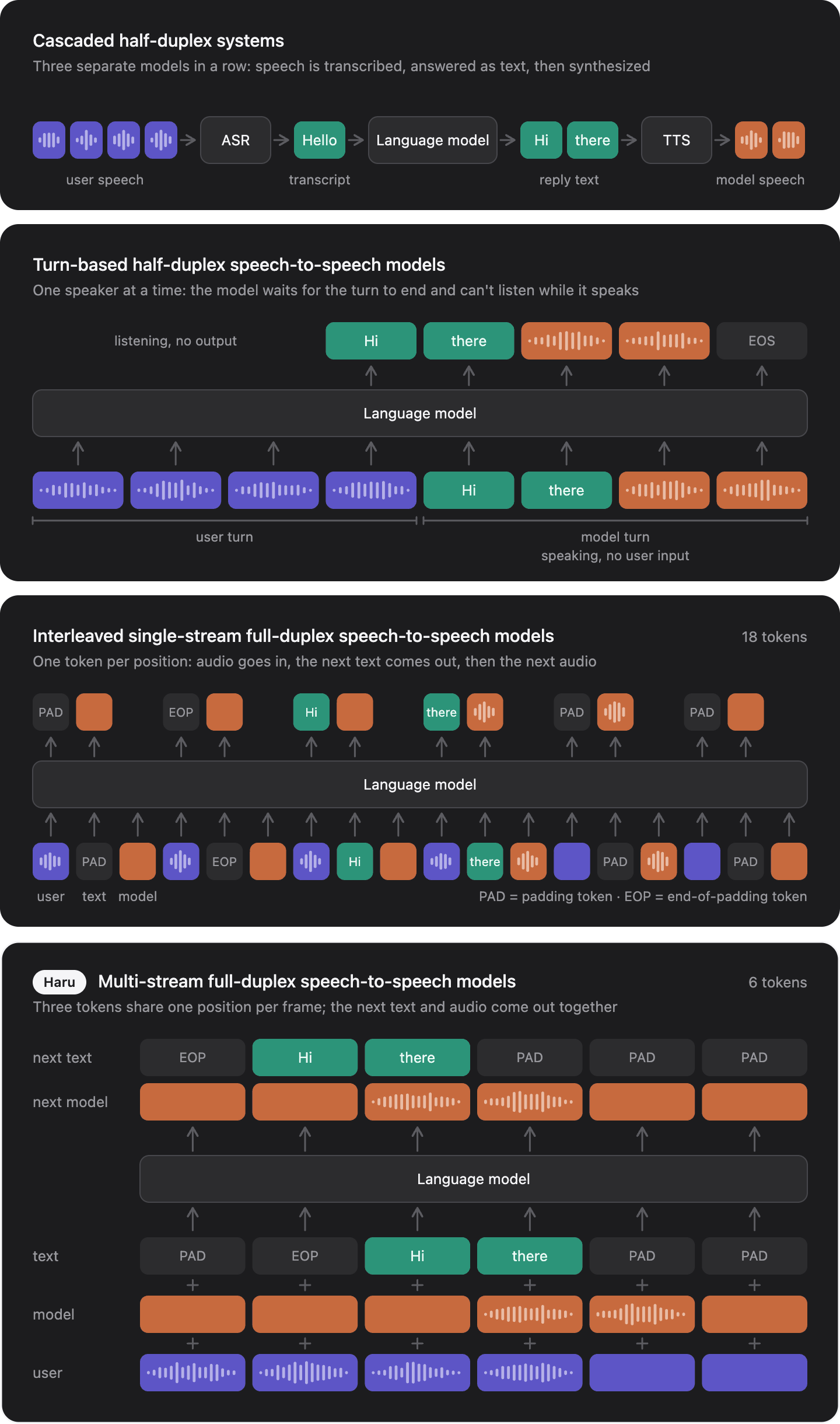
The summing is one function in haru/haru/models/haru.py:
# higurashi-ai/Haru @ 7fe6b76, haru/haru/models/haru.py (abridged)
def embed(self, tokens, model_latents=None, user_latents=None, model_mask=None, user_mask=None):
    x = self.lm.embed_tokens(tokens)
    for proj, latents, mask in (
        (self.model_audio_proj, model_latents, model_mask),
        (self.user_audio_proj, user_latents, user_mask),
    ):
        if latents is None:
            continue
        y = proj(self.scale_latents(latents).to(x.dtype))
        if mask is not None:
            y = y * mask[..., None].to(y.dtype)
        x = x + y
    return x
A text token's embedding, plus the model's own last audio latent through a small projector, plus the user's audio latent through another. One vector, one position. The two projectors are each a 64-to-2,560 linear layer, an RMSNorm and a 2,560-square linear layer: 6,725,120 parameters apiece in the header.
The hidden state at that position then has to produce two things for the next frame: a text token and an audio latent. The text token comes from the tied output embedding, the usual LM head. The audio latent comes from a separate head, and that head is where Haru differs most from Moshi.
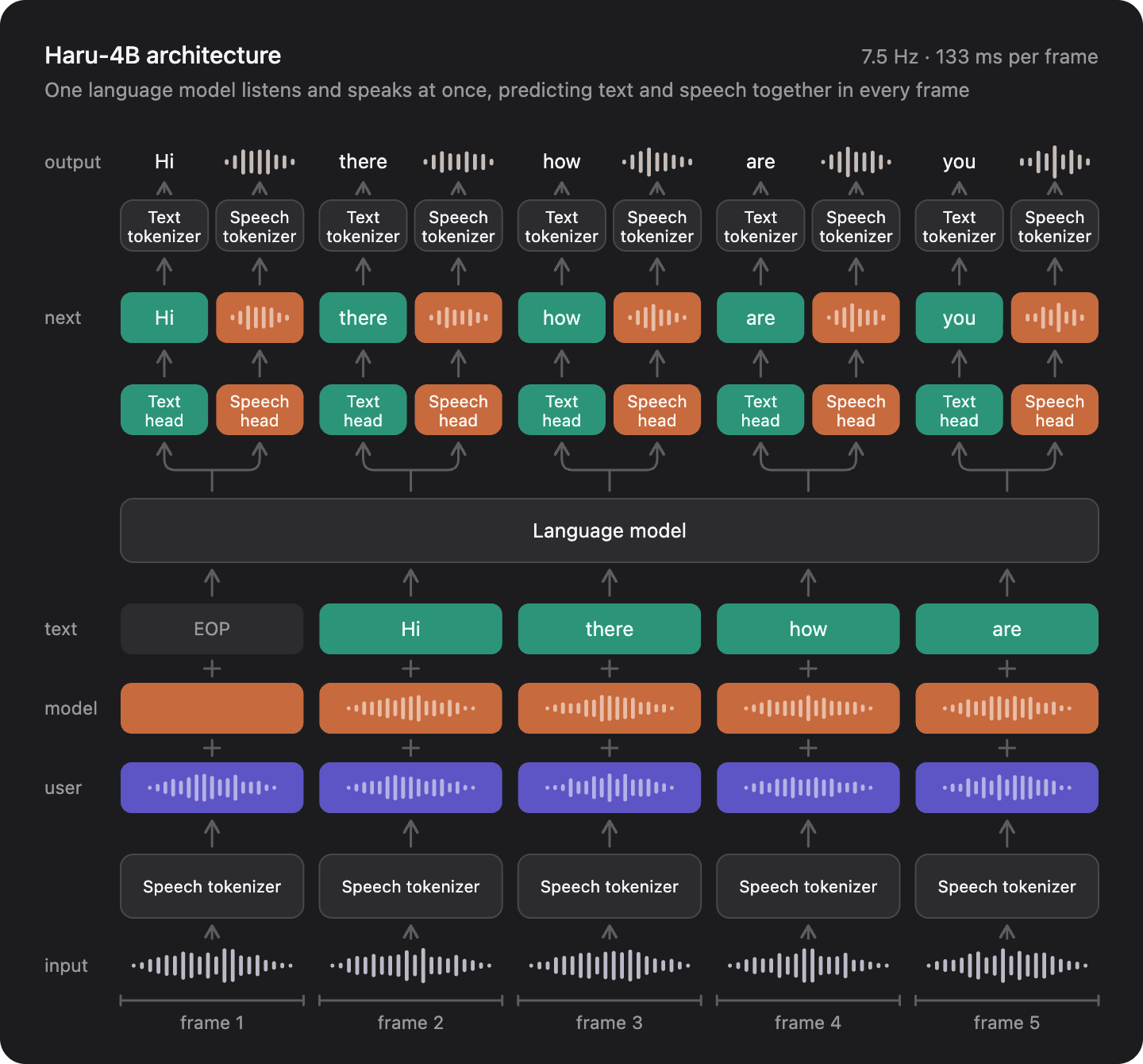
What "continuous tokens" means here
Moshi's audio is discrete. Mimi encodes each 80 ms of 24 kHz audio to a vector and then quantises it with a residual vector quantiser: pick the nearest of 2,048 codebook entries, subtract it, quantise the remainder with the next codebook, eight times. Eight codes of 11 bits, 12.5 times a second, is the 1.1 kbps the Moshi paper quotes. Discrete codes suit a softmax, and cost twice: quantisation throws information away, and a frame becomes eight tokens generated one after another. The Moshi paper does the sum itself: flattening the codes "would require a sequence length of 100 steps per second of audio", which is why it needs the depth transformer.
Haru's audio is a 64-dimensional real-valued vector per frame. The codec is the acoustic tokenizer from Microsoft's VibeVoice, a causal convolutional VAE whose strides in config.json are 8, 5, 5, 4, 2 and 2. Their product is 3,200, so one latent covers 3,200 samples at 24 kHz, which is 133.3 ms, which is 7.5 frames a second. That one number sets everything else in the model: the frame, the context length, the latency floor. In the header the codec is 687,392,001 parameters, split almost exactly in half between encoder (343,696,032) and decoder (343,695,969).
"Continuous" does not mean lossless. The latent is a VAE code, not the waveform, and the codec is the fidelity ceiling; the decoder has to invent whatever 64 numbers per 133 ms could not hold. On the input side the code even adds noise on purpose: codec.sample() draws the user's latent around the encoder's mean with a random scale, the σ-VAE noise VibeVoice trains its tokenizer with, applied at inference too. What continuous buys is that nothing is snapped to a codebook, and that one frame is one vector, so there is no second axis to generate along.
The price is that you cannot sample a 64-dimensional real vector with a softmax. Haru generates it with a small diffusion-style head conditioned on the LM's hidden state, the "next-token diffusion" recipe from MAR, LatentLM and VibeVoice, and the one Kyutai's CALM used for speech. Higurashi trained the head with flow matching and then distilled it with MeanFlow, which learns the average velocity over an interval instead of the instantaneous one. If you know the average velocity from noise to data over the whole interval, one step lands on the sample. I covered a sibling idea, drifting, in Kyutai's Pocket TTS.
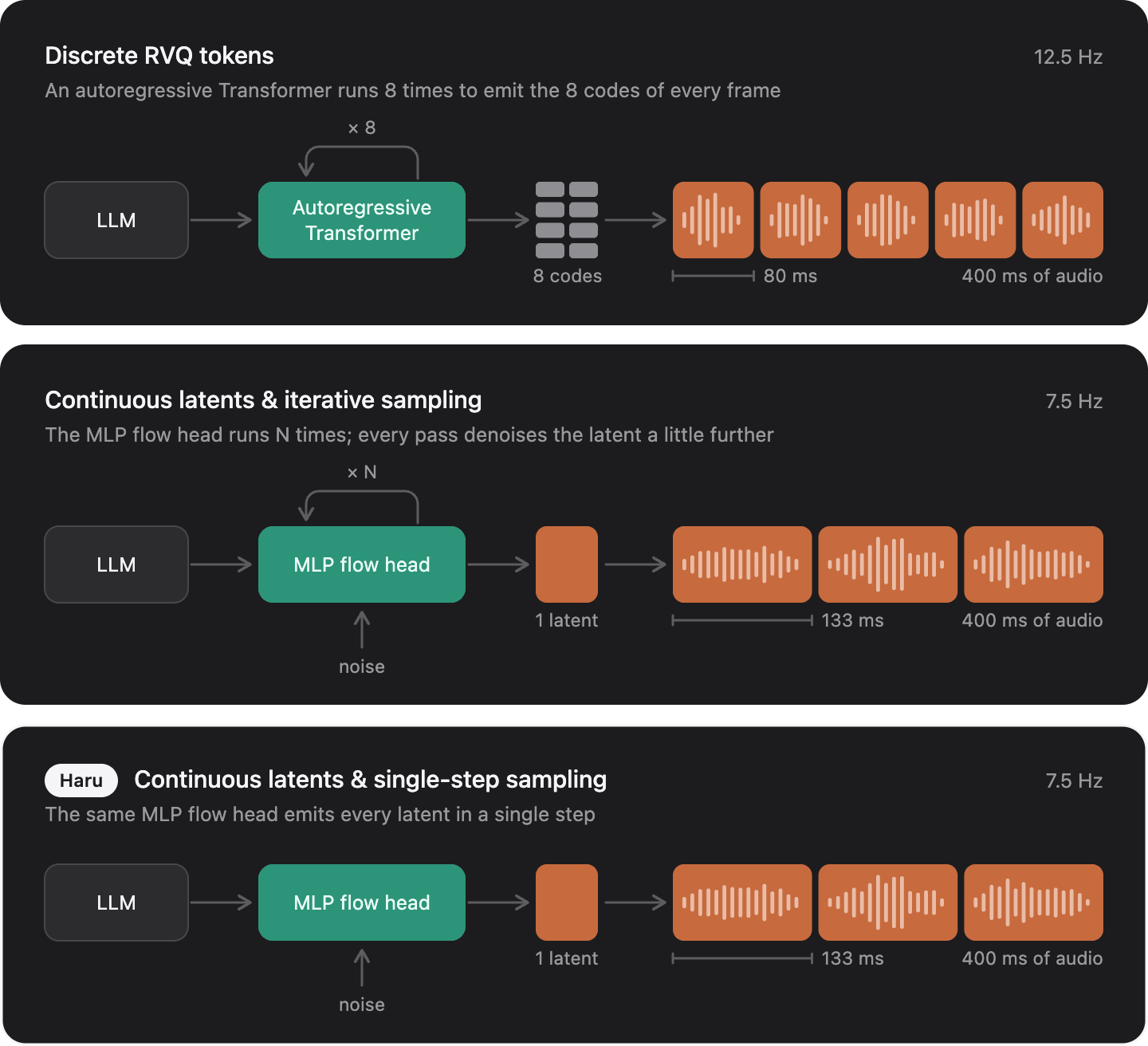
The sampler in meanflow_head.py is short enough to quote:
# higurashi-ai/Haru @ 7fe6b76, haru/haru/models/meanflow_head.py (abridged)
cond = self.cond_proj(hidden.to(noise.dtype))
z, h = noise, 1.0 / steps
for i in range(steps):
    z = z + h * self.velocity(z, cond, i * h, h, guidance)
return z
With num_steps: 1 in the config, that loop runs once: start at Gaussian noise, add the predicted mean velocity, done. Two details in velocity() are worth knowing. The interval and the time each get their own sinusoidal embedding, as MeanFlow requires. And the classifier-free guidance scale is an input (omega_embed of 1 - 1/w), the Improved MeanFlow trick, so guidance costs no second forward pass. The default is 1.5, in a trained range of 1 to 2.
The blog calls this head "a lightweight MLP". It is four adaLN residual MLP blocks of width 2,560 with a 7,680-wide gated FFN, and the header puts it at 363,407,360 parameters. That is light next to a 4B backbone and an extra transformer, and it is still 6.9% of the file. The file holds 5,270,000,899 parameters in 1,022 BF16 tensors: 4,205,751,296 in the language model, 687,392,001 in the codec, 363,407,360 in the head and 13,450,240 in the two projectors. "4B" is the backbone's name.
The text runs ahead in chunks
Haru keeps an inner monologue, but a looser one than Moshi's. Moshi aligns each word to the frame where its audio starts. Haru writes a phrase as one unbroken run of text tokens and then pads while the audio catches up.
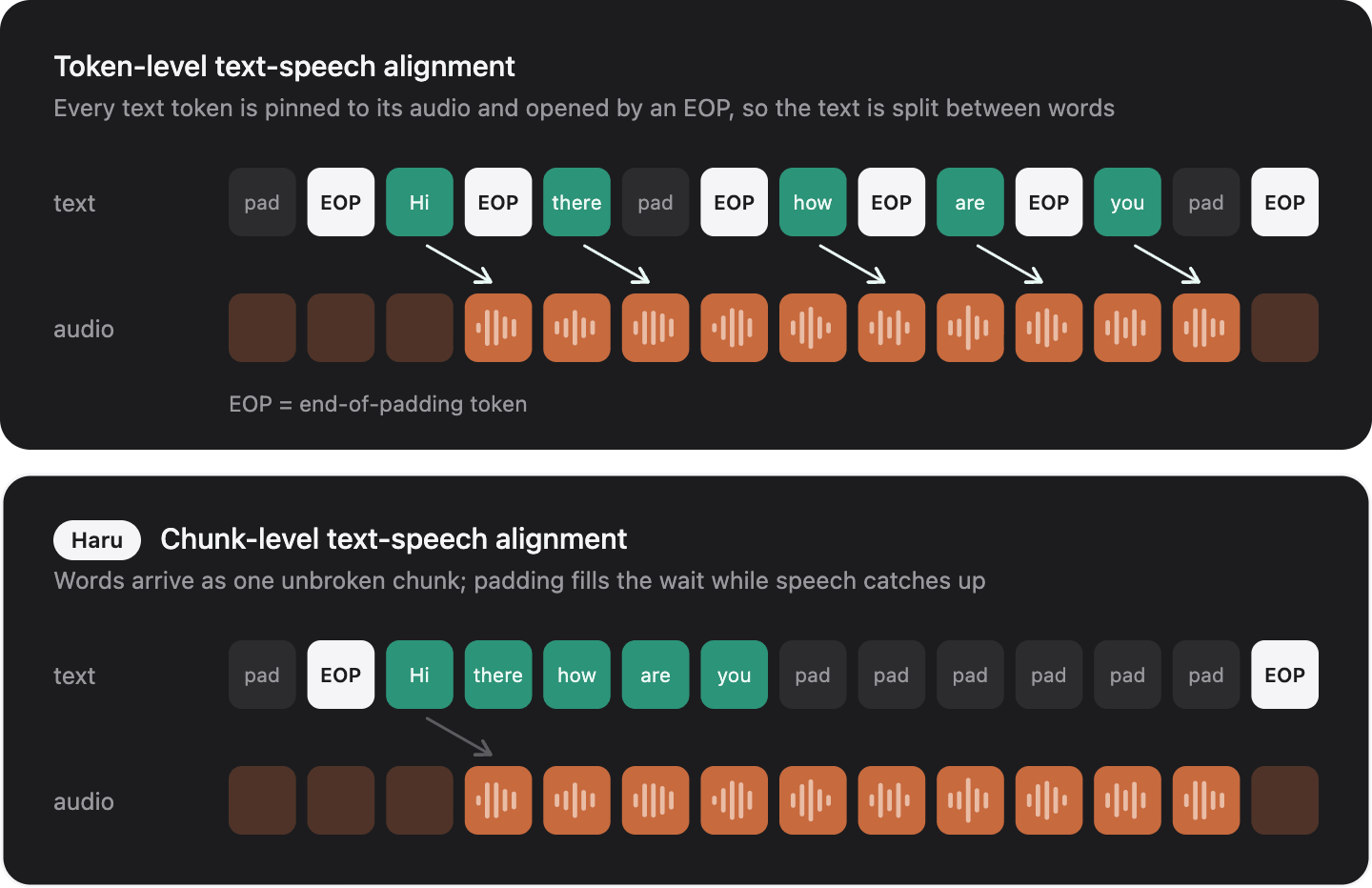
Two special tokens do the bookkeeping. In the tokenizer, id 248076 is <|audio_pad|>, the PAD written on frames with no new text, and id 248071 is <|audio_end|>, which Higurashi calls EOP (end of padding). EOP is sampled on the frame before the model starts a new stretch of speech, so it is the closest thing Haru has to a "my turn" decision. The blog gives two reasons for chunks: text and audio run at different rates, and keeping the text contiguous helps the backbone stay a language model ("mitigating catastrophic forgetting"). I find the second one plausible and unproven; there is no ablation.
The EOP decision is fragile enough that the code treats it specially. In session.py the logits of PAD and EOP are recomputed in float32 because, in the code's words, "the PAD / EOP decision (stay silent or start speaking) is often closer than the resolution of bfloat16 at the magnitude of those logits." And there is an eop_bias setting, "added to the EOP logit: > 0 makes the model start speaking sooner". So the turn-taking policy is learned, but not entirely knob-free: you get one scalar to make it more or less eager, and the character card has a backchannel field with three settings that read as sparse, moderate and frequent. One thing EOP does not do is gate the audio. The head produces an audio latent every frame whatever the text says; a silent frame is a latent that decodes to silence.
The prompt uses the same grid. prompt.py lays it out: the character card is a ChatML system turn with no audio, then the voice reference (3 seconds to 3 minutes of one speaker) is written onto the model's audio stream with PAD on every frame and EOP on the last, then the live conversation starts. The model's voice is whatever it has "been saying" in the reference. That is the same trick PersonaPlex uses.
The latency arithmetic
The session loop runs one position per frame and stays exactly one frame ahead. The docstring states it: "Frame 0 comes from the end of the prompt, so the model stays exactly one frame ahead and the frame length (133 ms) is the only structural latency." When your frame t arrives, the model runs the position for t and emits its own frame t + 1. There is no acoustic delay to wait out, because a frame's audio is one latent from one head pass, not eight codes in a hierarchy.
Higurashi's latency claim is "about 65 ms end-to-end latency on a MacBook", and the blog's table is careful about what that covers. It is an M1 Max running a native Swift app with custom Metal kernels and int8 weights, measured from the last sample of a user frame at the microphone to the first sample of the answering model frame at the headphones:
| Stage (M1 Max, int8) | Latency |
|---|---|
| Input (microphone to app) | 5.3 ± 0.0 ms |
| One model step | 34.2 ± 0.5 ms |
| Socket and handoff | 4.1 ± 0.3 ms |
| Output wait (15 ms margin and slack) | 13.3 ± 1.5 ms |
| Output (app to headphones) | 8.1 ± 0.2 ms |
| Total (p50) | 65.2 ± 1.5 ms |
The rows sum to 65.0 ms against a stated 65.2, which is what you expect when each row is its own median. The blog then adds the sentence that the headline drops: "With a 7.5 Hz token rate, audio framing introduces up to 133 ms of additional algorithmic latency." A sound you make at the start of a frame cannot be heard until the frame ends. So the time from a sound to the first sample that could react to it is 65.2 ms plus somewhere between 0 and 133 ms, about 132 ms on average and about 198 ms at worst.
That puts Haru right beside Moshi on Moshi's own definition. The Moshi paper reports "a theoretical latency of 160ms, 200ms in practice": one 80 ms frame to hear, plus 80 ms of acoustic delay, plus compute. Haru's structural floor on that definition is one 133 ms frame and no acoustic delay. Haru trades a longer frame for a single-pass head, and the two land in the same place. That is respectable for a 4B model on a laptop, not "ultra-low latency" next to Moshi, and the project page's own diagram of a full-duplex exchange, which shows "~0.32 sec", carries the same "Illustrative latency" label as the cascade's.
The compute side checks out on the back of an envelope. At batch size one, a forward pass reads essentially every weight. Haru's language model, head and projectors are 4.58 billion parameters, 9.17 GB in BF16, read 7.5 times a second: about 69 GB/s of memory traffic, before the codec. Moshiko, by the header count in my PersonaPlex piece, is 7,687,729,152 parameters, 15.4 GB read 12.5 times a second: about 192 GB/s. Smaller model, fewer frames, no depth transformer: under half the bandwidth. An M1 Max's memory system is rated at 400 GB/s, so a 34.2 ms int8 step in a 133 ms frame leaves room. On a datacenter GPU the blog reports about 15 ms for encode, decode and one LM step on a B300, which is what lets the vLLM-Omni plugin batch many conversations per GPU. The README asks for "about 12 GB" of GPU memory, which fits the 10.5 GB of BF16 weights plus cache; a 16 GB consumer card should run it.
None of these numbers is the one a user feels most, which is how long the model waits after you stop before it chooses to speak. In a full-duplex model that is behaviour, not plumbing: the number of silent frames before it samples EOP. On real speech that gap is learned from the data, varies by context, and is exactly what turn-taking benchmarks such as Full-Duplex-Bench measure. Higurashi publishes no such measurement. So I took one from its own demos.
What the demo tracks show
The four demo videos on the project page carry stereo audio, and the two channels are the two speakers: in all four, the left channel's envelope matches the person's lane drawn in the video and the right channel's matches the model's, and over the whole English demo the two correlate at 0.002. That matches the Mac app's own export ("you on the left, the model on the right, as heard"). So the timing can be measured the way I measured Block's Dessa, with the same detector: 10 ms frames, voiced when 18 dB above the channel's 10th-percentile floor and never below -50 dBFS, pauses under 180 ms bridged, bursts under 90 ms dropped. A floor switch is a talkspurt that follows one of the other speaker's, unless it starts and ends inside it (that is a backchannel); its offset is its start minus the end of the other's last talkspurt, negative when it starts in overlap.
| Demo | Length | Model takes the floor | Its median offset | The person's median offset |
|---|---|---|---|---|
| Economy (JA) | 104.4 s | 18 times | -0.115 s | +0.16 s |
| Movies (EN) | 67.2 s | 7 times | -0.17 s | +0.26 s |
| Parenting (JA) | 212.5 s | 32 times | +0.37 s | +0.055 s |
| Investment advice (EN) | 95.4 s | 6 times | +0.965 s | -0.085 s |
| All four | 8.0 min | 63 times | +0.20 s | +0.065 s |
Across all four the model takes the floor with a median gap of +0.20 s, and 38% of its starts are in overlap; the middle half of its offsets runs from -0.155 s to +0.765 s. That is conversational timing, not cascade timing, and it is close to what Dessa's tracks gave (+0.24 s, 29.5% in overlap). The people here were quicker than the model, +0.065 s at the median. It backchannels less than they do: 14 short bursts that start and end inside the person's talkspurt, 1.75 a minute with a median length of 0.395 s, against the people's 24. Both speak at once for 10.2% of all speech time, and the model does 52% of the talking.
The numbers move with the detector more than Dessa's did. With the absolute floor at -40 or -60 dBFS instead of -50, the model's median offset lands between +0.05 s and +0.27 s. And the sample is small and selected: eight minutes, four conversations Higurashi chose to publish, AAC audio inside a video. The investment demo, where the model shifts into a careful advisory tone, is much slower at +0.965 s, from only six switches. What it does show is gaps spread the way human gaps are, overlaps included. What it cannot show is how often the model is wrong about when to speak, which needs a benchmark with ground truth.
Sixty minutes of memory
The other thing a 7.5 Hz frame buys is a short sequence. An hour is 27,000 positions, which is the max_frames default in DuplexConfig ("60 minutes"), and the blog says training samples run up to 60 minutes long. Interleaving the same three streams would be 81,000 positions; Moshi's 12.5 Hz would be 45,000.
The backbone makes the hour affordable. Qwen3.5-4B is a hybrid: layer_types in the config lists 24 linear_attention layers (Gated DeltaNet) and 8 full_attention layers, one in every four. Only the full-attention layers keep a growing key-value cache. Each has 4 KV heads of 256 dimensions, so a position costs 8 × 2 × 4 × 256 BF16 values, 32,768 bytes. Sixty minutes is 27,000 × 32,768 bytes, about 885 MB. The DeltaNet layers carry a fixed recurrent state instead, 32 value heads of 128 × 128 per layer; at the float32 the config names that is about 50 MB, the same at minute one and minute sixty. With every layer on full attention the hour would need about 3.54 GB of cache instead.
For comparison, Moshi's loader config gives its temporal transformer a ring cache of 3,000 steps, which at 12.5 Hz is 240 seconds; past four minutes the oldest frames, including the prompt, fall out. Haru's DynamicCache just grows. I have not run an hour-long call to see whether the model's behaviour holds up across it, and neither the blog nor the card shows one.
Forty million hours, and the thirteen that teach turn-taking
The data claim is the least documented. The blog says Haru was pretrained on "over 40 million hours of speech", over 160 languages, nine of them primary (English, Spanish, Portuguese, German, French, Chinese, Japanese, Russian, Korean), with LLM-generated dialogues and TTS-synthesised speech deliberately excluded. It does not say where the audio came from.
Training ran in two stages. Stage one adapts Qwen3.5-4B to speech with a mix of ASR, speech and text continuation, and text-only rehearsal to keep the language model's knowledge. Most of the audio was first cleaned with Sidon, a speech restoration model for which Higurashi released Triton kernels. Stage two is the full-duplex part, and it has a problem every lab in this space has: two-sided conversation with each speaker on their own channel is rare. Most recordings are a single mixed track.
Higurashi's answer is FastDialogueSidon, a joint separation and restoration model that splits mixed conversations into two time-aligned streams. Over 13 million hours of separated dialogue went into stage two. The blog's demo section is explicit that this is all of it: "Without training on any natively recorded two-channel conversations, our model pretrained only on separated speech achieves natural conversation, including backchannels and overlapping speech."
That is a big bet, and a reply under the launch post put the objection well: "full-duplex is learned in the overlaps, and that's exactly where 13M hours separated from mono is the separator's guess, not what the speakers did." Separation is hardest exactly when two people talk at once, which is the behaviour the model is supposed to learn from it. Higurashi concedes the point in its future-work section ("separation errors and noise can remain, especially in overlapping speech") and says it is now fine-tuning on native two-channel recordings. Moshi took a similar route with diarization-simulated streams over its 7 million hours of audio, and then got its full-duplex behaviour from Fisher, 2,000 hours of telephone calls with each side recorded separately. Haru's separated dialogue alone is almost twice Moshi's entire 7 million hours of audio, and it has none of the native kind.
The compute claim, at least, is self-consistent. The blog says 256 NVIDIA B200 GPUs for about 8 days, 49,152 GPU-hours. One pass over 40 million hours at 7.5 Hz is 1.08 trillion positions. At the usual 6 × parameters × tokens with the 4.2B backbone, that is about 2.7 × 10²² FLOPs. Taking 2.25 PFLOPS as a B200's dense BF16 peak, 256 of them for 8 days supply about 4 × 10²³, so one pass would need roughly 7% utilisation. It is a plausibility check, not a reconstruction: the blog does not say how many epochs, what fraction of the hours each stage saw, or how the text mix was weighted.
One more, a different conversation from the project page, chosen for its overlaps.
What you can run, and what it is not
The quick start is three lines with an NVIDIA GPU: pip install -e ./haru, then python -m haru.server --hf-repo higurashi-ai/Haru-4B, then open localhost:8998, pick a character card, give it a voice clip, and talk. Wired headphones matter; the README warns that Bluetooth adds 100 ms or more, which on this model is most of a frame. The Mac path builds a native app from haru_mlx/swift, and the vLLM-Omni plugin speaks the OpenAI Realtime event protocol, one 3,200-sample frame per input_audio_buffer.append.
Licensing is clean for a release like this. Code and weights are Apache 2.0. The backbone, Qwen3.5-4B, is Apache 2.0 on its own card. THIRD_PARTY_NOTICES.md lists the codec parameters as Microsoft's MIT-licensed VibeVoice tokenizer and the web client as derived from Moshi's MIT client. Haru ships with no voice clips, so you bring one. The README's line, "Only use voices you have the right to use", is the whole safety story for a model that clones a voice from three seconds.
This is a pretrained base model, not an assistant. The card says it "is not a reliable source of facts and does not follow instructions the way an assistant does", and the blog says the small backbone "limits its response quality". There is no tool calling, which one reply asked about. If you want a phone agent that books appointments, this is a foundation to fine-tune, not a product.
Where I land
The architecture is a sensible set of choices more than a new idea. Summing streams is Moshi's. Next-latent diffusion for speech is VibeVoice's and CALM's. One-step heads are MeanFlow's. What Higurashi did is put them together in the order that removes work: a 7.5 Hz continuous codec so a frame is one vector, a one-pass head so there is no depth transformer, chunked text so the LM stays a language model, and a hybrid backbone so an hour of context is 885 MB. The model code is 589 lines across four files, and it is clean.
The claims need the qualifiers the blog itself supplies. The 65 ms is a per-frame pipeline time with up to 133 ms of framing on top, which puts it level with Moshi rather than ahead. The 40 million hours are undocumented in source and mix, and the 13 million that teach overlap were reconstructed by a separator from single-track audio. And Higurashi has measured nothing about the conversation: no turn-taking benchmark, no interruption handling, no WER, no comparison. Its own demo tracks give a median floor-taking gap of +0.20 s with plenty of overlap, which is the right shape, from eight minutes the company chose.
I would download it if you work on voice agents, because an Apache-2.0 full-duplex base model that fits in 12 GB and has a Mac app is rare, and because it is the cleanest open reference I have seen for continuous-latent dialogue. I would not trust its turn-taking past "the demos have human-shaped gaps" until someone runs Full-Duplex-Bench on it, or records a few hours against people who were not chosen by Higurashi. The 100B-parameter version Higurashi says it is now pretraining will need that even more.
Haru: a low-latency, multilingual, full-duplex spoken dialogue model
- license
- Apache-2.0
- branch
- main
- forks
- 3
- open issues
- 0
- source
- 745.6 kB
- commit date
- 2026-11-13
GitHub REST API, 2026-11-13 — branch, commit, commitDate, createdAt, description, forks, homepage, languages, license, openIssues, pushedAt, stars
What I read and what I computed
I read the Haru repository at 7fe6b76 (models/haru.py, models/meanflow_head.py, models/vibevoice_codec.py, session.py, prompt.py, sampling.py, the READMEs and THIRD_PARTY_NOTICES.md), the Hugging Face card, config.json and tokenizer.json, the English blog and the project page (and the Japanese blog, searched for an evaluation section it does not have), the Moshi paper, and the replies to the launch post. The demo timing is measured from the stereo audio of the four project-page videos (the X videos are two of them), with the energy detector described above, in a short numpy script. The parameter counts come from the model.safetensors header, fetched by HTTP range request; no weights were downloaded. The cache, bandwidth, sequence-length and compute figures are my arithmetic on the config and header, with the M1 Max bandwidth and B200 peak taken from Apple's and NVIDIA's specifications. I did not run the model. The latency table, the training scale and the data figures are Higurashi's. The figures were rendered from the SVGs on Higurashi's blog and project page, and the three clips are cut from its demo videos with the audio removed.