2026-11-09 · 21 min · robotics · agents · reinforcement-learning · code-as-policy · libero
Why read this
Hightop 30%Re-implements CaPtain's IK and critic credit on CPU to show where credit lands, and checks the 4B claims against the code, config and weights.
- Interactive explanations
- Original analysis
- A lasting reference
Robotics & embodiedNeeds a workstation GPUMixed licencesPractitioner paper
How this was scored
- Is it new?
- 2 of 3: A real new idea, method or capability
- Can I trust it?
- 2 of 3: Measures key facts from files, code or configs
- Can I run it?
- 2 of 3: Open code or weights with real limits
- Will I understand it?
- 3 of 3: Mechanism carried by interactives built from real code or data
- Can I act on it?
- 2 of 3: A concrete recipe, numbers or comparison
- Will it last?
- 2 of 3: A reference for a year or more
- Does it affect many?
- 1 of 3: A specialist community
- Only here?
- 2 of 3: A teardown or measurement few others did
Score 71 of 100, ranked 111 of 701 rated articles. Each question is answered 0–3 by hand, and a 3 is rare. How articles are scored
A post from @robotsdigest asked a good
question: "Can a 4B model write code that drives a robot arm using only low-level IK?" The answer it
pointed to is CaPtain, from MMLab at CUHK and NovaXBot: a paper
(arXiv 2610.40799, 29 October 2026), MIT-licensed code in
waltstephen/CaPtain with the execution environment in
waltstephen/CaPtain-Harness, and Apache-2.0
weights at YijiaFan/CaPtain-4B. The headline:
held-out LIBERO success goes from 0.0% for base Qwen3.5-4B to 55.4% after supervised fine-tuning and
73.8% after multi-turn RL.
I wanted to know three things. What exactly does the model get to call, and how low is "low-level"? How does the RL decide which of forty requests in an episode deserved the credit? And do the paper, the code and the weights agree with each other? I read all three, ran what I could on a CPU, and re-implemented two pieces where the sandbox would not let me execute the repository's own code.
Every claim below is labelled measured (I ran it), reported (the paper, README or a config says so) or reasoned (my inference).
- license
- MIT
- branch
- main
- tests
- 32 files
- source
- 1.2 MB
- commit date
- 2026-11-03
by size of tracked source at this commit, file counts in brackets; docs, data and vendored trees excluded
local clone, 2026-11-10 at a6b799b — branch, commit, commitDate, fileCount, hasTests, languages, license, licenseFile, shallow, testFileCount
shallow clone: counts describe the pinned tree, not the history
What code-as-policy means here
A vision-language-action model (VLA) maps pixels to motor commands with one network. A code-as-policy agent does something else: a language model looks at camera images, writes a program against a robot API, runs it, reads what happened and writes the next program. The idea goes back to Code as Policies and VoxPoser. What changed in 2026 is that frontier models got good at it. The paper cites GPT-6 Astra solving 94.0% of LIBERO-PRO episodes with a coding setup, and this site has watched MiMo-V2.6 drive a Panda in LIBERO-Spatial one delta-pose action per turn.
The catch is that most of these agents either prompt a closed frontier model at every episode, or
give the code a grasp() or place() skill backed by a VLA trained on the benchmark's own
demonstrations. In the second case the code chooses which skill to call, but the skill decides how
to grasp. RL on the code can then only learn to sequence the skill (reported, Section 1).
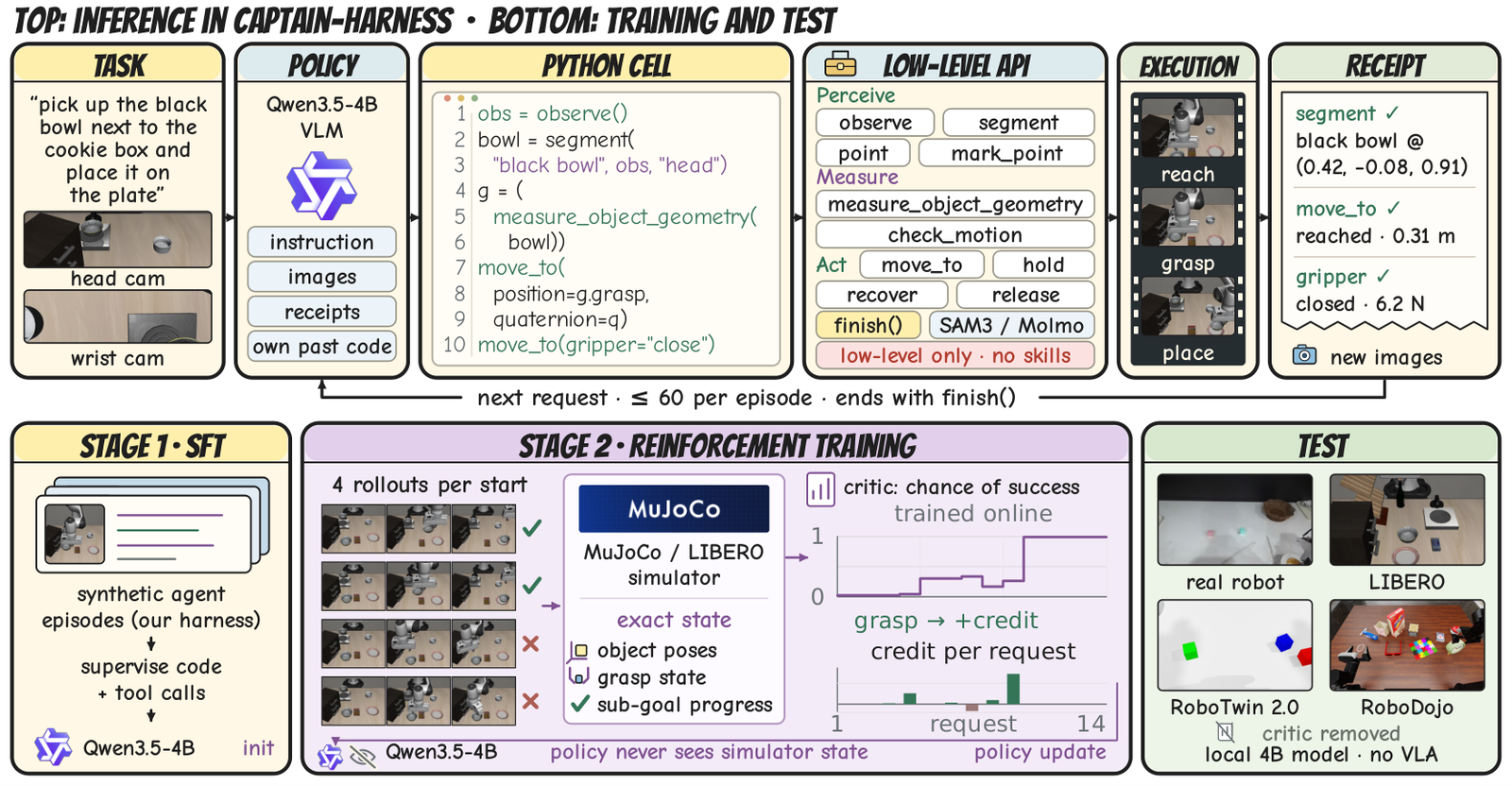
CaPtain removes both crutches. The policy is a 4B open model. The API has no grasp skill. The model must choose where the jaws go, from which direction they approach, and when they close.
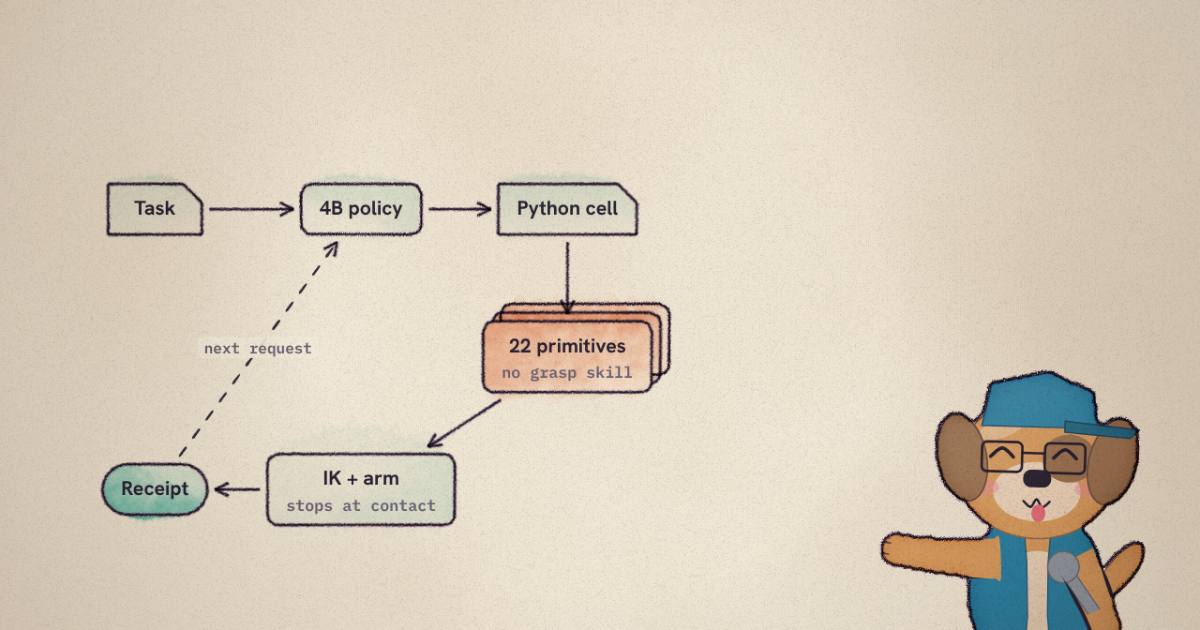
The loop: one request, one Python cell
An episode is a sequence of at most 60 requests. Each request is one chat completion of up to
4,096 tokens: the model thinks, then emits one or more calls to its only tool, python. That tool is
a persistent, sandboxed Python 3.11 session with numpy, scipy, Pillow and a pre-imported robot
module. Variables survive between requests, so a detection found in request 3 can be reused in
request 9 (reported, Appendix A.1; the client is server/robot.py, which I read).
Two design choices make this workable for a small model:
- Robot calls never raise. Every capability returns a plain dict,
{success, executed, failure_category, message, value, diagnostics, budget}. The model writes ordinaryif/for/retry logic around calls instead of crashing a cell (reported, and that is what the client's docstring says). - Every call leaves a receipt. The client appends one line of at most 300 characters per robot
call to the cell's output, capped at 20 lines per cell (measured:
_CELL_LIMIT = 20andstr(line)[:300]inrobot.py). A motion receipt reports the stop reason, the distance actually travelled, the peak force and the jaw opening before and after. The model learns from text what happened, not only from pixels.
The episode budget is 60 requests, 150 physical actions and 1,080 s of wall time. The context window is 65,536 tokens; past 60k the history is compacted turn by turn, but the Python variables are not in the prompt, so they survive compaction (reported, Appendix A.1).
One detail I did not expect. The request template the policy is trained and evaluated with,
react/prompts/captain.request.json, opens with a 21,261-character developer message that begins
"You are Codex, an agent based on GPT-6" (measured). The 4B model is wearing the system prompt of
the coding agent whose trajectories it was distilled from. That is consistent with the paper's
point that SFT, RL and test share one input format, and it is a reminder of where the behaviour came
from (reasoned).
How low is "low-level"?
The API is 22 capabilities plus finish() (paper, Table 4): perception (observe, segment with
SAM 3, point with Molmo2-8B, mark_point that back-projects a pixel the model chose,
track_target), measurement (measure_object_geometry, contact and release geometry checks),
motion (move_to, hold, recover, release), read-only planning checks, and pose arithmetic.
Only motions count against the action budget.
move_to takes an absolute end-effector pose or a single jaw command. Under it, the environment
turns the request into a straight Cartesian sweep, solves inverse kinematics, checks self-collision,
and monitors force at every control substep, stopping at first contact unless the model asks for a
manipulation mode that tolerates load (reported, Section 3.1).
So "only low-level IK" is accurate about the interface and generous about the machinery. There
is no grasp(), but measure_object_geometry hands back a symmetry-completed centre, extents, yaw
and the offset to the destination, and guarded motion protects the model from crashing into the
table. The policy-facing surface is small; what sits under it is not. The environment's src/ is
45,198 lines of Python across 182 files; the shared tool layer every backend imports, adapters/capx/backend.py, is 10,033 lines on its own
(measured with wc -l at commit de38d6d, which is the commit the main repo pins). That is not a
criticism. It is where the engineering went, and it is why the same API runs on LIBERO, RoboTwin
2.0, RoboDojo, SimplerEnv, CaP-Bench and a real arm.
- license
- MIT
- branch
- main
- tests
- 138 files
- source
- 3.4 MB
- commit date
- 2026-10-30
by size of tracked source at this commit, file counts in brackets; docs, data and vendored trees excluded
local clone, 2026-11-10 at de38d6d — branch, commit, commitDate, fileCount, hasTests, languages, license, licenseFile, shallow, testFileCount
shallow clone: counts describe the pinned tree, not the history
The IK under move_to, re-run on a CPU
The IK lives in RobotCollisionModel.solve_ik (adapters/robotics/model.py). It is damped least
squares:
where is the Jacobian, the target position and rotation, and stacks the position error with the rotation error as a rotation vector. Each step is scaled so no joint moves more than 0.12 rad, joints are clipped to their limits, and a solve succeeds when the error is under 2 mm and 0.02 rad within 180 iterations. If the measured configuration fails as a seed, it restarts from four more: the centre of the joint ranges and three offsets from it.
The sandbox refused to execute the repository's code, so I re-implemented exactly that loop in numpy (same constants, same five seeds) on a Panda built from Franka's published DH table, and ran it (measured, numpy 2.5.4 and scipy 1.18.1, one CPU thread):
| Variant | Solved from the first seed | Solved within 5 seeds | Mean iterations |
|---|---|---|---|
| As released: damping 0.0025, step cap 0.12 rad | 86.7% | 99.25% | 72.7 |
| Damping removed | 86.75% | 99.2% | 71.7 |
| Step cap removed | 79.65% | 98.4% | 81.0 |
That is 2,000 random reachable poses, each the forward kinematics of a random configuration inside the middle 80% of every joint's range, solved starting from the Panda's home configuration. Two things fall out. The restarts are what take success from about 87% to over 99%. And on targets that are reachable, the damping term changes nothing; the step cap does the work. Damping matters near singularities, which random reachable targets rarely hit (reasoned). Each solve took about 16 ms in my unoptimised numpy.
Then the question a LIBERO task actually asks: can the gripper point straight down at this spot on the table? The map below sweeps a 5 cm grid, half the table, at two heights, with the redundant joint free or locked at zero to imitate a 6-DoF arm.
At gripper height 5 cm above the base, the 7-joint Panda finds a top-down pose in 279 of 513 cells, 11 of them only after a restart. Locking joint 3 drops that to 242, and the cells it loses are the ones close to the base, not the far edge: the outer reach is about 0.80 m either way (measured; no collision check, so this is an upper bound). That is the kinematic face of a failure the paper reports in transfer: on RoboDojo, 21 of 46 first blocking failures were IK or reach failures on the 6-DoF ARX X5, whose top-down workspace extends only about 0.5 m from its base (reported, Appendix J). A code-as-policy agent trained on one arm learns where things are reachable for that arm. Its code does not carry that knowledge across (reasoned).
Stage 1: teach the format
Base Qwen3.5-4B solves essentially nothing in this environment: at most 0.3% on any suite. It "exhausts its request budget misusing the interface" (reported, Section 4.1). So the first stage is SFT on agent trajectories generated inside the same environment by frontier coding agents: 25,961 rows and 861M tokens, 654M of them from GPT-6 Astra (reported, Table 5).
Three details from Appendix C and D are worth stealing for any agent SFT:
- Normalise the teacher's helpers. The raw episodes contained 226 distinct variants of the same
"preview, then move" helper. The authors rewrote every trajectory onto one four-function library
(
val,need,downq,go) and checked each rewrite against a mock robot; replaying six rewritten episodes changed robot commands by under 1 cm (reported). - Mask the coordinates so the model has to look. With probability 0.2, earlier
mark_pointpixel coordinates in the history are replaced with a mask token, so the model cannot copy a click from a previous turn (reported, Section 3.2). - Diverse layouts or the model stops looking. On LIBERO's official initial states each object sits in nearly the same spot (standard deviation about 1.4 cm). Models fine-tuned on those learned object positions from the task name: swapping the input image left the likelihood of the predicted pixel unchanged. Wide-layout starts with about 15 cm spread fixed it (reported, Appendix D).
Only the agent's own tokens are supervised, reasoning included, with the vision tower frozen. Result: 55.4% held-out LIBERO host success (reported).
Stage 2: RL that knows which request mattered
An episode is tens of requests; most of them only look (observe, segment, measure, verify) and a handful change the world (approach, close the jaw, carry, release). The outcome arrives once, at the end. Outcome-only RL such as GRPO gives every request in an episode the same advantage, so a request that looked at the table and a request that dropped the bowl share the blame.
CaPtain's answer is an asymmetric critic. Training runs in MuJoCo, so before each request the
simulator records a hidden snapshot the policy never sees. From it come 36 features: end-effector and
jaw state, goal bookkeeping, distances between end-effector, target and destination, target lift and
displacement, articulated-joint positions, and held and ever-held flags. The critic is five small MLPs
(three hidden layers of 256) whose logits are averaged into a probability of host success
(reported, Eq. 3; physics_critic.py's mlp() builds exactly that, which I read). Each request's
credit is how much it moved that probability:
with small per-request costs and the terminal return. Note the index: both values
are read at the same request index . That is the subtle part. If the next state were scored at
, a critic that has learned "late in an episode usually means failing" would charge every
request a little just for taking time, including the ones that only look. Credit then goes through
GAE with and no discount, plus a group-relative outcome term over the four rollouts
from each start state (reported, Eq. 5 and 6; request_advantages() implements the same-index read
through next_values, which I read).
The terminal return orders outcomes by what deployment needs (reported, Eq. 7):
| Outcome | Return |
|---|---|
Success, and the agent called finish() | 1 |
Success without finish() (missed finish) | 0.25 |
| Other failure | 0 |
| Budget exhausted | -0.1 |
finish() on a failed state (false finish) | -0.3 |
Where the credit lands, on a toy
I could not run their critic or their rollouts. So I built the smallest thing that has the same shape and measured it (measured, my code, PyTorch 2.14.1 on two CPU threads): a 2-D pick-and-place task made of typed requests (perceive, move, grasp, lift, carry, release, verify, finish) over a hidden physical state, with perception that sharpens position estimates and grasps that fail when the estimate is off. A critic shaped like Eq. 3 is trained on 6,000 episodes, and credit is computed on 1,600 fresh ones (400 starts, four rollouts each). Host success in the toy is 77.4%, strict success 68.2%.
The numbers that matter, over all 1,600 toy episodes:
- With the same-index rule, the median one-step credit of a perception request is exactly 0.000, a successful grasp gets +0.076, and perception holds 3.3% of all one-step credit even though 45.3% of requests are perception. The paper reports the same pattern on its real rollouts: successful grasps at a median of +0.058, perception-only requests at -0.0002, and 1.3% of credit mass on perception (reported, Section 4.5).
- Read the next value at instead, and perception's share of one-step credit rises to 19.4%, with a median of -0.013 per look. Time leaks in exactly as the paper says it would.
- Add a counter of the policy's own perception calls to the critic's inputs and the share is 20.3%. The paper found the same with real counters and with the language model's hidden state, which decodes the request index with and shifts 35% of credit mass onto perception (reported).
One thing the toy shows that the paper's prose blurs. After GAE with and the group term, perception requests hold 43.4% of the absolute advantage in my toy, almost the 45.6% that outcome-only credit gives them. That is by design: the paper says perception requests "still receive credit through generalized advantage estimation", from the physical actions they enable. So read the paper's "1.3% of the total |A| mass" as a statement about the one-step differences, not about the advantage the update finally uses (reasoned, from the toy and the paper's own Eq. 6). The critic's contribution is not to starve perception of credit; it is to stop perception from being charged for the passage of time, and to rank requests within a rollout by what they did to the scene.
The paper's measured payoff is variance. The gradient-noise scale on 9B rollouts falls from 9.0k episodes for outcome-only GRPO to 6.7k with the critic at (reported, Table 7). Even 6.7k is huge, which is why every optimizer step accumulates 1,024 episodes. With two start states per step, "consecutive updates were nearly orthogonal: the policy performed a random walk" (reported, Appendix G).
What the released config says
The RL config rl/configs/captain-4b.json matches the paper on every training constant I checked
(measured, by reading it): learning rate 4.24e-6, GAE 0.9, KL 0.002, false finish
-0.3, budget exhausted -0.1, action cost 0.008, failure cost 0.02, groups of four, four rounds per
update, 300 rounds. The ratio mask reads ratio_mask_low: 0.8, ratio_mask_high: 3.0, which looks
wrong until you see that the trainer treats them as epsilons: keep a token if
, which is the paper's .
One thing does not match. Appendix F says FlashAttention-3 "moved log-probabilities beyond this
floor ... we kept FlashAttention-2 / SDPA in the trainer". The released config sets
"attn_backend": "fa3", the docstring of rl/attn_backends.py says "CaPtain-4B used FA3", and the RL
README lists "FA3 for the language model's full-attention layers" (measured). One of the two is
stale. If the config is right, the numerical gate the paper describes was not what the final run
used; if the paper is right, re-running the released config is not the run that produced
CaPtain-4B (reasoned).
The results
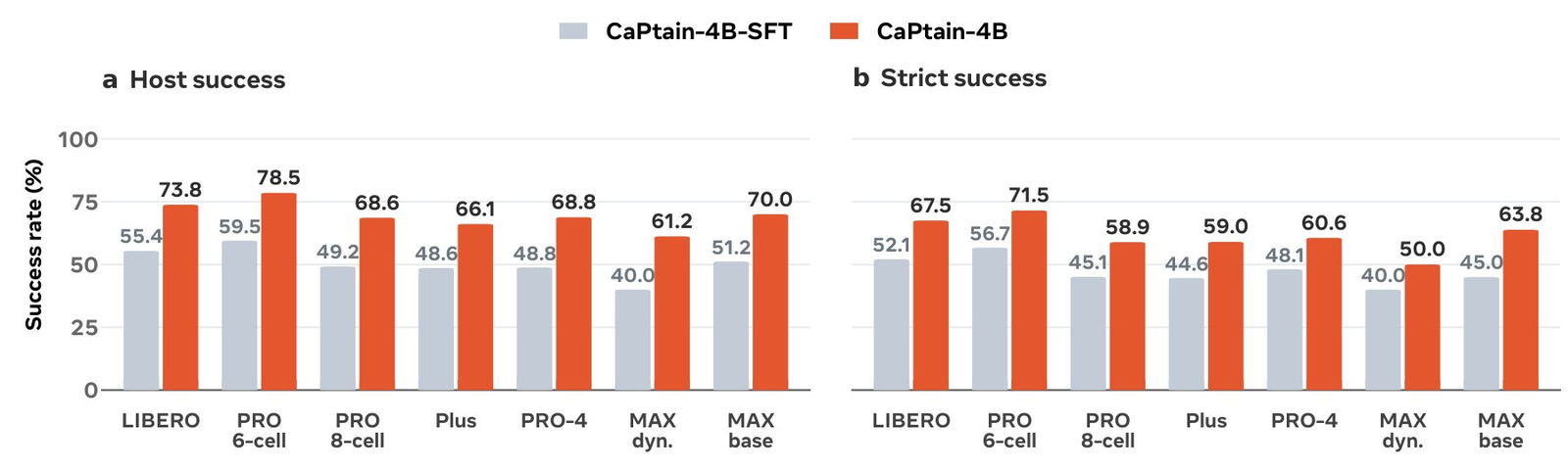
Host success asks whether the scene ends in the goal state. Strict success also requires that the agent declared it was done. The paper argues strict is the deployable number, since a robot that never says it has finished cannot be used, and I agree. On held-out LIBERO (240 episodes, initial states 11-16 of all 40 tasks), RL moves host from 55.4% to 73.8% and strict from 52.1% to 67.5%. RL gained 55 episodes and lost 11. False finishes fall from 7.1% to 2.1% of episodes and mean requests per episode from 39.1 to 32.6 (reported, Section 4.1, paired McNemar ).
The gains hold under perturbation, +17.6 to +21.2 host points across LIBERO-PRO, LIBERO-Plus and LIBERO-MAX, which is the more interesting result: end-to-end policies trained on LIBERO are known to collapse under the same suites. The paper quotes π0.5 falling from 97% on LIBERO to 12.8% under LIBERO-PRO's position and task perturbations (reported, from the LIBERO-PRO paper). A policy that reads object positions from the image at test time has less to memorise.
Three caveats from the paper's own appendices:
- The checkpoint was chosen for strict success. After about round 340, host success holds at
about 65% while strict success falls from about 60% to 44%: the policy keeps re-measuring solved
scenes instead of calling
finish(). The critic, trained on host success, values every solved state near 1 and so gives the decision to stop no credit. CaPtain-4B is the round-300 checkpoint (reported, Appendix I). The authors say finishing needs its own target. That is the most useful lesson in the paper for anyone doing multi-turn RL on agents. - One LIBERO task cannot be passed. The
libero_10task 5 predicate has a 3.5 mm offset that rejects correct flat placements; every model scores 0/6 on it (reported, Appendix K). - The comparison table mixes protocols. CaPtain-4B's 78.5% on LIBERO-PRO (3 suites) sits above K1 (77.2%), WAA (75.6%) and ASPIRE (71.7%), all frontier-model agents. But the protocol notes say some baselines use test-time oracle signals, memory from other seeds, privileged geometry or latched success with 100-500 turns. Read the table as "a 4B model is in the same range", not as a ranking (reasoned, from Appendix K).
Transfer and the real arm
Trained only on LIBERO, CaPtain-4B reaches 83.3% on SimplerEnv WidowX and 75.0 on CaP-Bench without further training. It does poorly where the embodiment changes: 22.6% on RoboTwin 2.0 (50 tasks, many of them bimanual; tasks that need two arms moving at once succeed in 0 of 35 instances) and 0.8% on RoboDojo's dual 6-DoF arms (reported, Section 4.3 and Appendix J). The transfer backends add inputs the benchmarks' official policies do not get, such as simulated depth, camera calibration and a wrist force estimate; the README lists them per benchmark (reported).
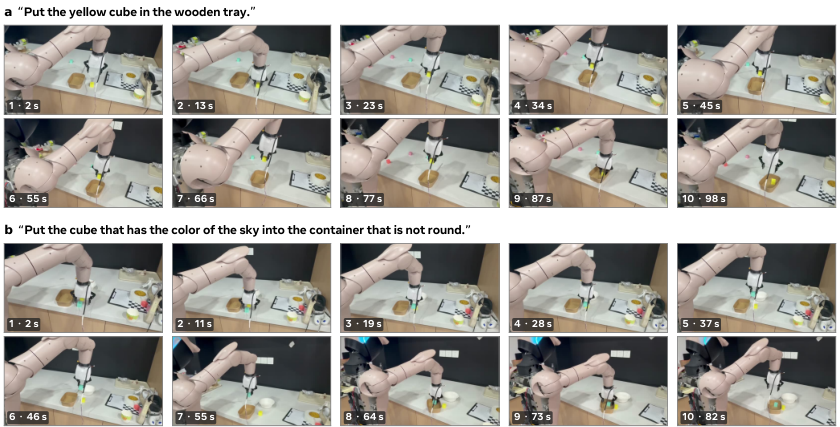
The real robot is an Astrabot XR1 arm. The policy is a checkpoint further fine-tuned on episodes from
a coarse simulated twin of the XR1, with primitive objects and no real-world data (reported, Section
4.4). The paper shows two successful episodes with step-by-step traces; the first takes 23 requests and
ends with finish() at 157.2 s (reported, Appendix O). There is no real-robot success rate, so this
shows the pipeline runs on hardware, not how often it works (reasoned).
What it costs
A CaPtain-4B LIBERO episode averages 32.6 requests, 16.6 physical actions and 7.3k output tokens,
and takes 417 s on a GPU shared by eight episodes, about 52 GPU-seconds of policy compute: $0.03-0.06
at $2-4 per GPU-hour. Published code agents report $0.18-0.24 (SPARK, WAA, RACaP) to $8-22
(OpenRUA) per episode (reported, Section 4.2). The figure excludes the perception services, and
those are not small: every point call goes to Molmo2-8B, a model about twice the policy's size
(reasoned). Training is the other half of the bill: about 120 H100-hours for SFT and about 1,290
H100-hours for RL to round 300, on 16 GPUs with eight serving vLLM, SAM 3, Molmo and 64-80
concurrent MuJoCo episodes (reported, Appendix M).
The weights
- architecture
- Qwen3_5ForConditionalGeneration
- task
- image-text-to-text
- library
- transformers
- license
- apache-2.0
- safetensors
- 2 shards
- largest file
- 5.35 GB
- files
- 16
- downloads
- 206
- likes
- 2
- languages
- en
repo last modified 2026-10-30
The Hugging Face API reports 5,174,964,736 BF16 parameters for CaPtain-4B against 4,659,865,088 for
base Qwen3.5-4B (measured). The difference is accounted for in sft/scripts/untie_base.py, which
copies the 248,320 × 2,560 embedding into a separate lm_head (635,699,200 parameters) and drops
the multi-token-prediction weights, about 120.6M by subtraction (measured). The language model is 32
layers, 24 of them Gated DeltaNet linear attention and 8 full attention, with a 24-layer vision tower
(measured, from config.json). It is a "4B" in the way Qwen3.5-4B is.
What I ran and what I did not
Ran (measured): the IK re-implementation, the toy critic, line counts, and reads of the configs, the request template and the Hugging Face metadata. Could not run: the repository's own code; the sandbox's permission layer refused to execute the clone, its reward and critic unit tests included, so both experiments are re-implementations of the code, not the code. The model (5.17B BF16 parameters) plus SAM 3 and Molmo2-8B does not fit this CPU box, so I have not reproduced a single LIBERO episode.
Takeaway
CaPtain is the clearest open recipe I have seen for training a small model to be the whole robot policy rather than the dispatcher in front of one. The parts that transfer beyond robotics are the credit rule and its warnings: score the next state at the same index so time cannot leak into credit, keep the policy's own behaviour out of the critic, and give "I am done" its own signal, because a value function trained on success will never reward stopping. The part that does not transfer, yet, is the arm: the code a 4B model learns to write still carries the reach of the robot it learned on.
Related on this site: FLUX 3 Action and Flex-π take the other road, one network from pixels to actions.