2026-11-16 · 21 min · interpretability · qwen · lora · connectomics · reproducibility
A 2:26 narrated explainer, drawn in code. Every number and picture in it is this article's own; the sources are below.
› transcript
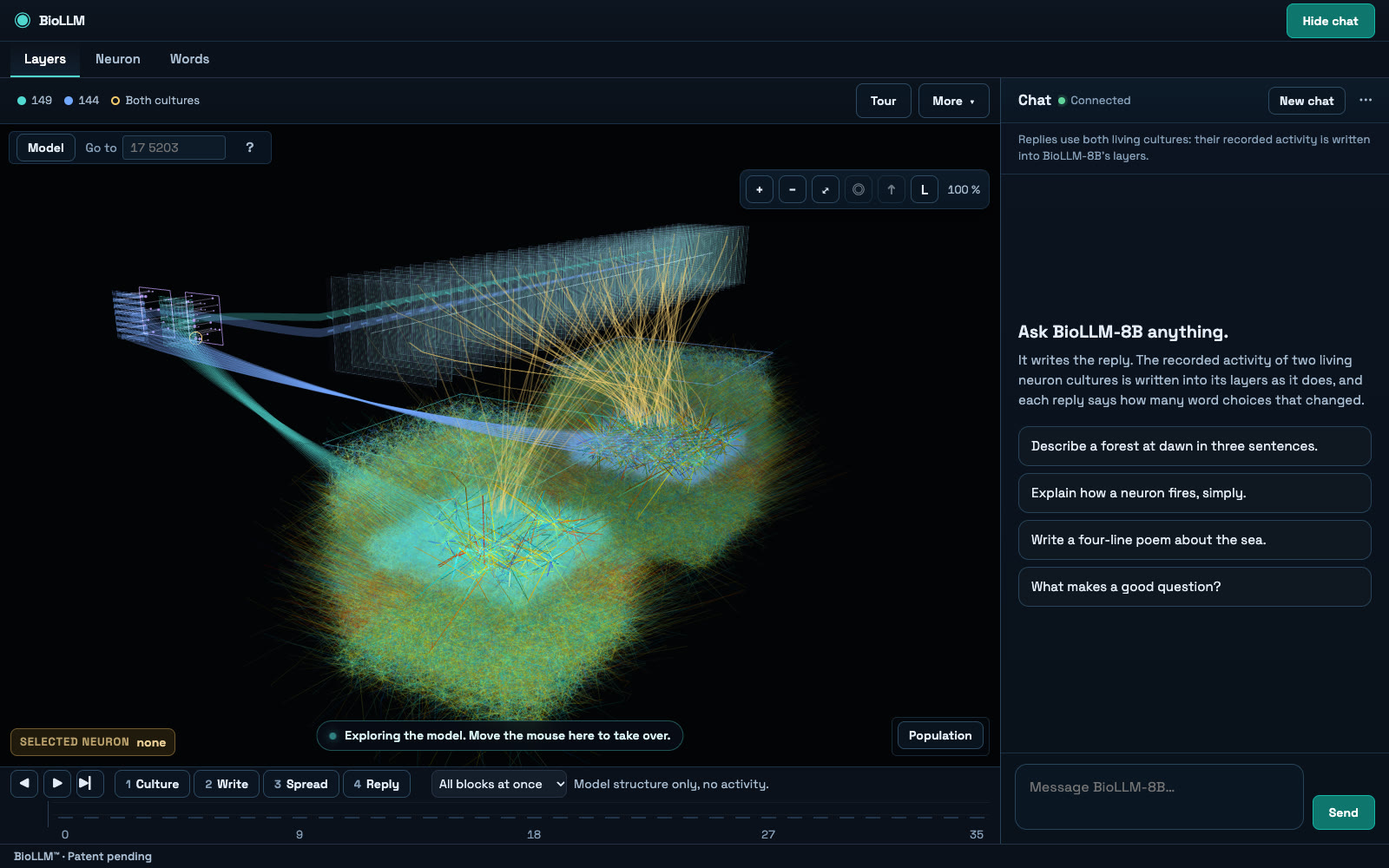
Two clouds of neurons, a stack of model layers, and yellow lines between them. BioLLM-8B launched with this picture, and a thread about living human neurons written into a language model. Hi, I'm Dendra. The company publishes a results file. Let's read that before the thread. A patent-pending adapter that writes living human neuron activity into LLM layers. The free chat is Qwen3-8B, frozen. The site says so, and its layer counts match. And the chat does not touch live neurons. It replays rows recorded from two cultures, on the ninth and tenth of November. The biology is real. Neurons grown on an electrode array can be stimulated and recorded, as DishBrain showed with Pong. But DishBrain's claim rests on its controls: silent feedback, no feedback, rest. Here is the write. A few hundred electrode values from one recorded row, never the stimulated electrodes. Fixed ties carry them to every MLP neuron, in all thirty-six layers. Each neuron's activation is scaled before down projection, and the next word shifts. Now swap in a shuffled row, or random ties. The words still move. Only the frozen model stays put. So test against controls. A symbol-trained write on the same rows recovers which of six cues the dish received: zero point four three. Shuffled, random and energy-only arms sit near chance. But on the newest session, the array mean alone separates the symbols. So the file will only say the device signal does. An earlier letter-by-letter run failed its primary test. Its adapter scored the same as sham. And for the served adapter, the reply's wording tracks the culture on one dish, not the other. Both pre-stated rules failed. The thread's connectome mapping is display geometry. The quantum microtubules are a labelled model, out of scope. And the Jacobian lens only reads. A careful harness under a loud thread. The cue gets through. That the neurons carry it is not yet shown. To recap. A frozen model, replayed recordings, a readout that beats its controls, and an open question. Thanks for watching! Every source is in the full article. I'm Dendra. Bye!
Why read this
Notabletop 60%Sorts every BioLLM-8B claim into shown, asserted, or labelled hypothetical by the company's own results file, with the controls a fair test needs.
- Checked against the source
- Concrete numbers to act on
- Explained from first principles
InterpretabilityAPI onlyProprietaryPractitioner teardown
How this was scored
- Is it new?
- 1 of 3: An incremental tweak
- Can I trust it?
- 3 of 3: Reproduces the headline result, or shows from primary files it is wrong
- Can I run it?
- 1 of 3: API-only, gated or restrictive licence
- Will I understand it?
- 2 of 3: Mechanism from first principles with figures
- Can I act on it?
- 2 of 3: A concrete recipe, numbers or comparison
- Will it last?
- 1 of 3: Relevant for months
- Does it affect many?
- 1 of 3: A specialist community
- Only here?
- 2 of 3: A teardown or measurement few others did
Score 60 of 100, ranked 426 of 748 rated articles. Each question is answered 0–3 by hand, and a 3 is rare. How articles are scored
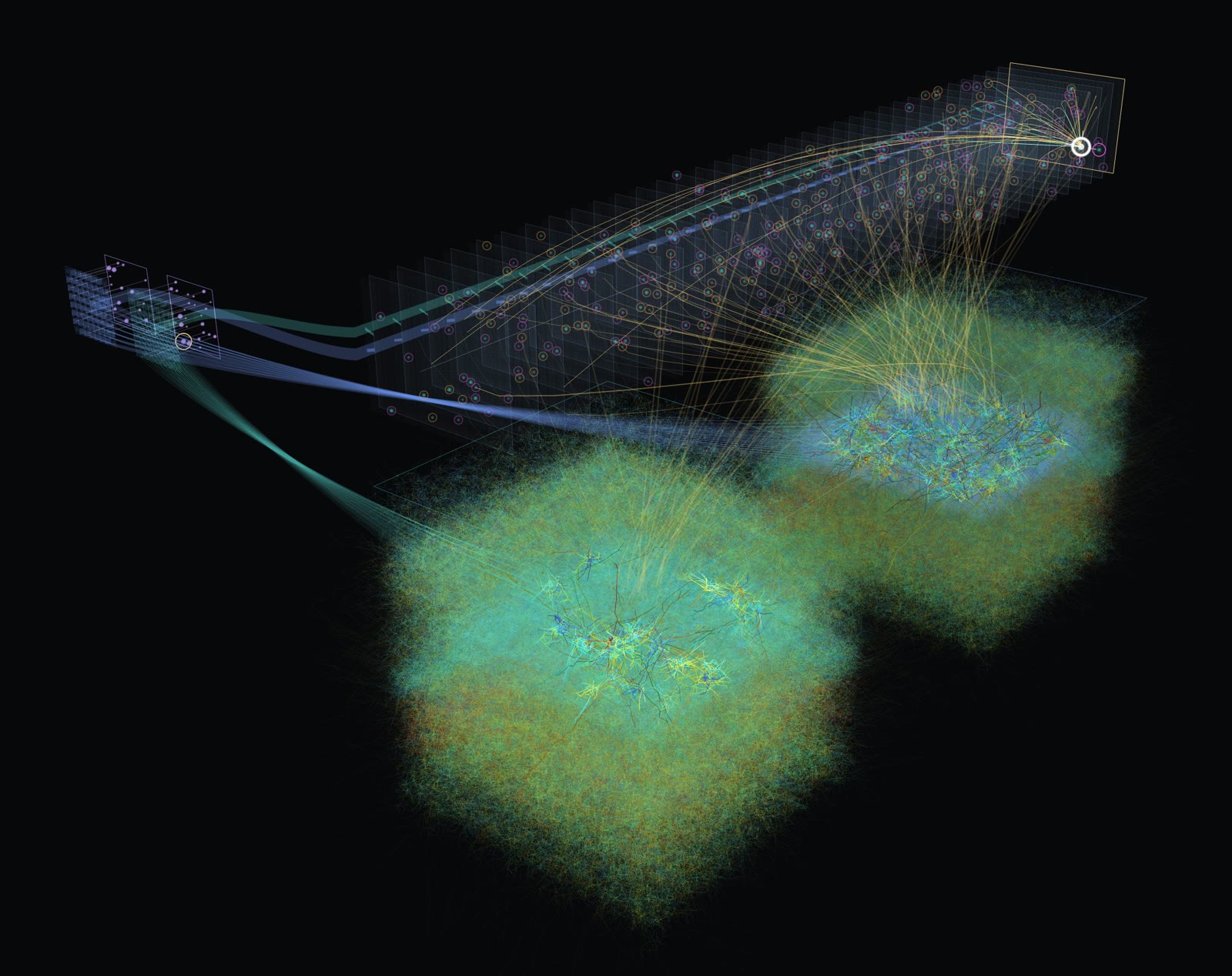
On 15 November @BioLLM_ posted that BioLLM-8B was live: a "patent-pending adapter that writes living human neuron activity into LLM layers", free at biollm.com, with 14B and 27B versions to follow. The thread under it goes further. Spiking activity from a Cortical Labs CL1 is "mapped onto H01 connectome neurons", every MLP response is "mapped 1:1 to its corresponding biological neuron in a digital twin", and the mapping "continues all the way down to the tubulin dimers inside the microtubules", where quantum simulators "run the Orch-OR dynamics". It closes on safe superintelligence and on comparing models against "a substrate we know can foster consciousness: Human Neurons".
That is a lot of claims for one adapter. The good news is that the company has published enough to check most of them, and the most useful document is not the thread. It is a JSON file the site's explorer loads, viewer-status.json, which the viewer describes as "verdicts and figures copied from the BioLLM result files (claim chain L1-L5, held-out decoders, controls)". The copy I read was generated on 13 November and fetched on 16 November, with two companions, weave.json and ties-joint1.json. Read those first and the thread reads differently.
What the product is, in the company's words
Strip the thread back to the site and the description is modest. The home page says text becomes "patterns of electrical stimulation, delivered to living cortical neurons on a multi-electrode array", the spikes they fire back are recorded and paired with the text, and that data "trains a compact adapter built for the model you choose. Your original weights are never changed." The free model "runs on what it learned from recorded neuron responses. No live connection and no lab hardware are involved." Running with "live CL1 in the loop" is reserved for paying customers. The footer adds that "no general performance gain is guaranteed".
The explorer's source audit names the base model: "BioLLM-8B is built on the open Qwen3-8B model (Apache-2.0)". The architecture block in its weight manifest says model_type: qwen3, 36 layers, residual width 4096 and MLP width 12,288 in every layer, which matches Qwen3-8B's config.json exactly. No BioLLM-8B weights are published. I searched the Hugging Face API and GitHub; the only BioLLM-branded weights are an older 360M model I come back to below.
So the free chat is Qwen3-8B with something added. What is added is in the results file, under served_adapter:
"model": "BioLLM-8B, frozen (no LoRA)""write": "MLP neurons (gate on the activations entering down_proj) of all 36 blocks""trained_on": "tick1 REAL rows of 149 and 144 (Oja's rule, 3 passes; no gradient)""jspace_write": false, and the Jacobian lens is "readout only, not part of the write"
And the client code says what the public chat feeds it. The chat panel hardcodes SERVED = { unit: 'both', culture: 'REPLAY' }, and the culture panel's data file says plainly: "Both columns show recorded sessions (dates in each entry), not a live feed." The two cultures are CL1 units 149 and 144. Their tick1 sessions, which trained the served adapter and which chat replays, were recorded on 9 and 10 November: 530 rows on culture 149 and 522 on culture 144.
From a dish to a vector
Before the adapter, the biology, because it is real and it is the strongest part of the story.
A CL1 is Cortical Labs' commercial version of the setup from DishBrain (Kagan et al., Neuron, 2022). Cortical neurons, grown from human induced pluripotent stem cells or taken from mouse embryos, are plated onto a multi-electrode array. Each electrode can record the voltage near it and can deliver a current pulse. In DishBrain, about 800,000 cells were plated per array, the MaxOne MEA read 1,024 of its 26,400 electrodes at 20,000 samples per second, and cultures embedded in a closed-loop Pong game showed "apparent learning within five minutes of real-time gameplay not observed in control conditions." That last clause is the important one. DishBrain's result is a comparison against controls: stimulation with structured feedback, silent feedback, no feedback, and rest.
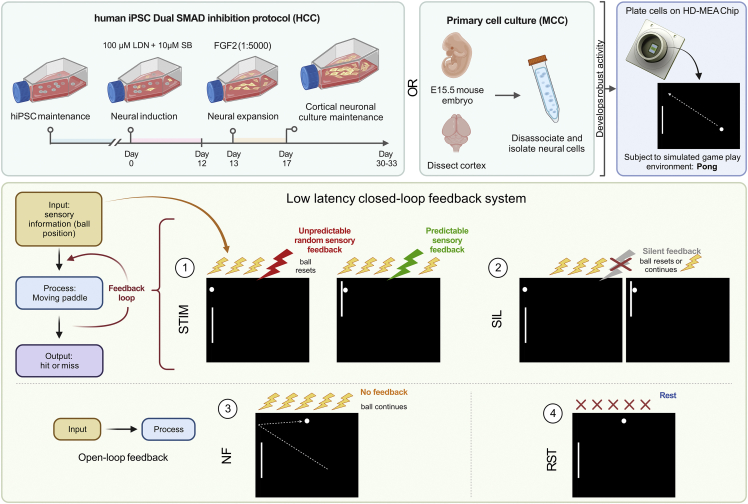
Other groups do related work. Brainoware (Cai et al., Nature Electronics, 2023) used a brain organoid on an MEA as a reservoir for speech recognition, and FinalSpark rents remote access to organoids through its Neuroplatform (Jordan et al., 2024). Renting a dish and stimulating it from code is ordinary now. BioLLM's founder describes doing that with a CL1 in March.
What the adapter reads is a table of numbers per recorded row. Culture 149 is stimulated on seven of its 64 electrode slots (12, 18, 22, 24, 36, 38, 46) and culture 144 on four (22, 34, 35, 51). The served adapter's tie file, ties-joint1.json, lists its inputs: 428 "slots", which are 52 electrodes on culture 149 and 55 on culture 144, none of them a stimulated electrode, with four values each: "spikes before the cue (log)", "baseline (dB)", "state (dB)" and "after the cue (dB)". Leaving the stimulated electrodes out is a sensible guard against reading the pulse itself. The viewer's culture panel draws a simpler statistic, the "mean spike count per REAL row, spike_bins summed (50-1050 ms after last pulse, 15 bins)", and the tick1 and code27 sessions ran at 9.7 seconds per presentation. Either way, "living neuron activity" arrives at the model as a few hundred standardised numbers per row.
That pipeline has one classic trap, and the widget below is built around it. When you stimulate an electrode array and then count spikes, part of what changes from cue to cue may be the stimulus itself: charge, artefact, an array-wide shift in activity. A decoder will happily separate cues on that, and none of it needs a neuron to have done anything specific.
With the neurons' response set to zero and the array-wide shift at 70%, both decoders in the toy separate the three cues, and the array mean alone does it best. Turn the shift off and the neurons up, and only the per-channel pattern works. BioLLM's analysis has exactly this rule written in: "'from the neurons' only for readouts that hold on spike counts or after the array-wide shift is removed ... while every nuisance control (SPK-energy, BAND-energy, ARRAY-MEAN, PRE) has p > 0.05". Hold on to it.
How the write works
The served write is not a LoRA. LoRA (Hu et al., 2021) adds a trained low-rank matrix to existing weights; it changes the model, permanently, for every input. BioLLM's write is closer to the activation steering covered in neuron steering: it leaves the weights alone and changes activations at run time, driven by an external input.
In a SwiGLU MLP, layer computes and writes into the residual stream. A gain write scales each of the 12,288 entries of before down_proj:
where is the standardised value in input slot , holds the "ties" from slots to MLP neurons, is a write strength (the chat client's settings call it "culture influence"), and is tanh: the tie file defines a tie's weight as "the change of the gate's pre-tanh argument per standard deviation of the slot's value". The change to the residual stream is , which is just a weighted sum of down_proj columns.
The ties were learned by Oja's rule (Oja, 1982), a Hebbian update that strengthens a tie when the electrode value and the neuron's activation are high together and normalises so the weights converge toward the first principal component of the co-activity. No gradient, no loss on the output text. The results file says "each electrode value of each chip is tied to every MLP neuron of 36 blocks", which is 442,368 neurons, since , and the tie file says plainly what a tie is: "not a synapse and not evidence that a culture steers the model by itself."
That number is also the thread's "1:1 mapping". The explorer gives each of the 442,368 MLP neurons a "virtual identity" and draws it with one of 104 proofread H01 reference skeletons. The mapping is an index over two arrays of equal length, and the explorer labels the placement "HYPOTHETICAL · NOT CL1 ANATOMY". One reply to the thread asked how CL1 could map one-to-one onto H01 when "H01 is a specific 1mm^3 region that is not comparable to CL1 structure". It cannot, and the company's own file agrees: the H01 strand is marked "Not in any adapter."
Any input written this way changes the output. Give the gain a large enough number and the words move, whether the number came from a neuron, a shuffled neuron or a random generator. So "the culture changed N word choices", which every chat reply reports, is not evidence of anything. The question is whether the change carries information about the culture that a control does not.
In the toy, the shuffled arm (learned ties fed another row's electrode values) moves the words as much as the real arm, and what it tracks is the noise floor of picking the best of six words over 48 rows. Random ties fed the real row track it almost as well as learned ones, because any fixed linear map of passes along. A learned adapter earns credit only for the margin over random ties of the same size. That margin is what BioLLM measured.
What the results file shows
The file keeps a "claim chain" of five links. I have sorted its verdicts by what they claim.
A write into the model can carry which cue the dish received. Under served.symbol_ab, on the same tick1 rows, a six-way symbol readout (chance 1 in 6) reached 0.43 on both cultures, over 8 seeds on held-out rows (63 on culture 149, 60 on 144). Its control arms, labelled SHUFFLE, RANDOM, NONE and ENERGY in the file, scored 0.16, 0.17 to 0.19, 0.18 and 0.19 to 0.20. The file does not define them; by the names, they are shuffled rows, random ties, no culture input and an energy-only input. In the tick1 session entry, "adapter (all 36 layers) reads the cue from the culture" with leave-one-block-out validation scored 0.57 against a shuffle at 0.19 on culture 149, and 0.50 against 0.17 on culture 144. These pass. One caution on attribution: the chat client describes the symbol write as its own fit, "trained to encode which symbol the culture received, not trained for conversation", so I read these as results for a symbol-trained write on the same rows, not for the Hebbian adapter chat serves. What they demonstrate: a recorded MEA response, written into a frozen Qwen3-8B, leaves enough trace to recover which of six cues was sent, beyond shuffled, random and energy-only controls.
Whether the neurons, or the device, separate the cues is unresolved, by BioLLM's own rule. The newest session, code27, asked which of three symbols was sent. A band-power readout got 0.975 on culture 149 (925 rows) and 0.967 on 144 (301 rows). The array mean alone got 0.773 and 0.831, against a chance of 0.33. That is the nuisance control failing, so the file sets "from_the_neurons_allowed": false and gives the permitted wording: "the device signal separates the symbols". The served adapter was trained on tick1, not code27, so this does not directly grade it. On tick1 the energy-only arm sat at chance, which counts in BioLLM's favour; but tick1 reports no array-mean readout, and on code27 that is the control that failed.
The earlier per-letter experiment failed. An "alphabet" run on culture 149 tried a 27-way readout (chance 0.037). The primary test, a paired REAL-minus-SHAM matched filter over 2,267 pairs, scored 0.024 with p = 1.0, verdict FAIL_PRIMARY. Link L4, "the response is the letter, not time", failed: the twin control's win fraction was 0.33 where the rule needed more than 0.5. Link L5, "the adapter is steered by the culture", came out EQUIVALENT. Over 2,376 held-out tests, the culture arm scored 0.042, no input 0.041, random ties 0.041 and sham 0.040, inside a pre-set equivalence bound of 0.02. The file marks these runs historical, from earlier per-chip adapters, not the one chat serves.
The served wording test is mixed and exploratory. For the adapter the chat actually serves, the question is whether reply text carries the culture's measured state. A ridge decoder reads only the reply's words and predicts the first four principal components of the culture's response; the score is learned ties minus random ties, in Pearson r. Under the decoding the chat uses (repetition penalty 1.1, up to 200 tokens), culture 144 shows +0.091 with a 95% interval of +0.031 to +0.162, Holm p 0.008. Culture 149 shows +0.023, interval −0.030 to +0.088, p 0.36: no effect shown. In short greedy replies of 48 tokens both pass (+0.089 and +0.119). Two rules were stated in advance. P1-1 fails if culture 149's seed-0 margin under chat decoding is below +0.088; it was 0.0469. P1-2 fails if three or more of four new seeds sit at or below +0.05; all four did. Both FAIL, verdict MIXED_EXPLORATORY, with the note "the held-out rows were already used to choose among variants".
That is an unusually honest results file. It writes down failure conditions before the run and then reports that they triggered. It is also not what the launch thread says.
Where the thread and the file disagree
| The thread says | The site's own data says |
|---|---|
| CL1 spiking activity is mapped onto H01 connectome neurons | H01 strand: "Not in any adapter"; placement "HYPOTHETICAL · NOT CL1 ANATOMY" |
| Every MLP response is mapped 1:1 to a biological neuron | Index over 442,368 MLP slots, drawn with 104 reference skeletons |
| Quantum simulators run Orch-OR at the tubulin level | Quantum strand: "out of scope since 2026-10-14", "Not in any adapter"; quantum results file "file not found" |
| The J-Lens was adapted to visualise a global workspace | "jspace_write": false; the lens is "readout only, not part of the write" |
| Living neuron activity is written into the layers | Chat replays rows recorded on 9 and 10 November; live CL1 is a paid tier |
| An adapter that "can work exactly how the brain does" | 428 standardised electrode values per row, a tanh gain on MLP activations, Hebbian ties |
There is also a population of 442,368 simulated Izhikevich point neurons (Izhikevich, 2003) driven by the seven channels, with real-drive, permuted and no-write arms; the explorer's legend counts its "7 recorded culture channels". It is an experiment, "Not in an adapter", and the chat client's label for that layer reads "Izhikevich neurons (not fitted to the culture)".
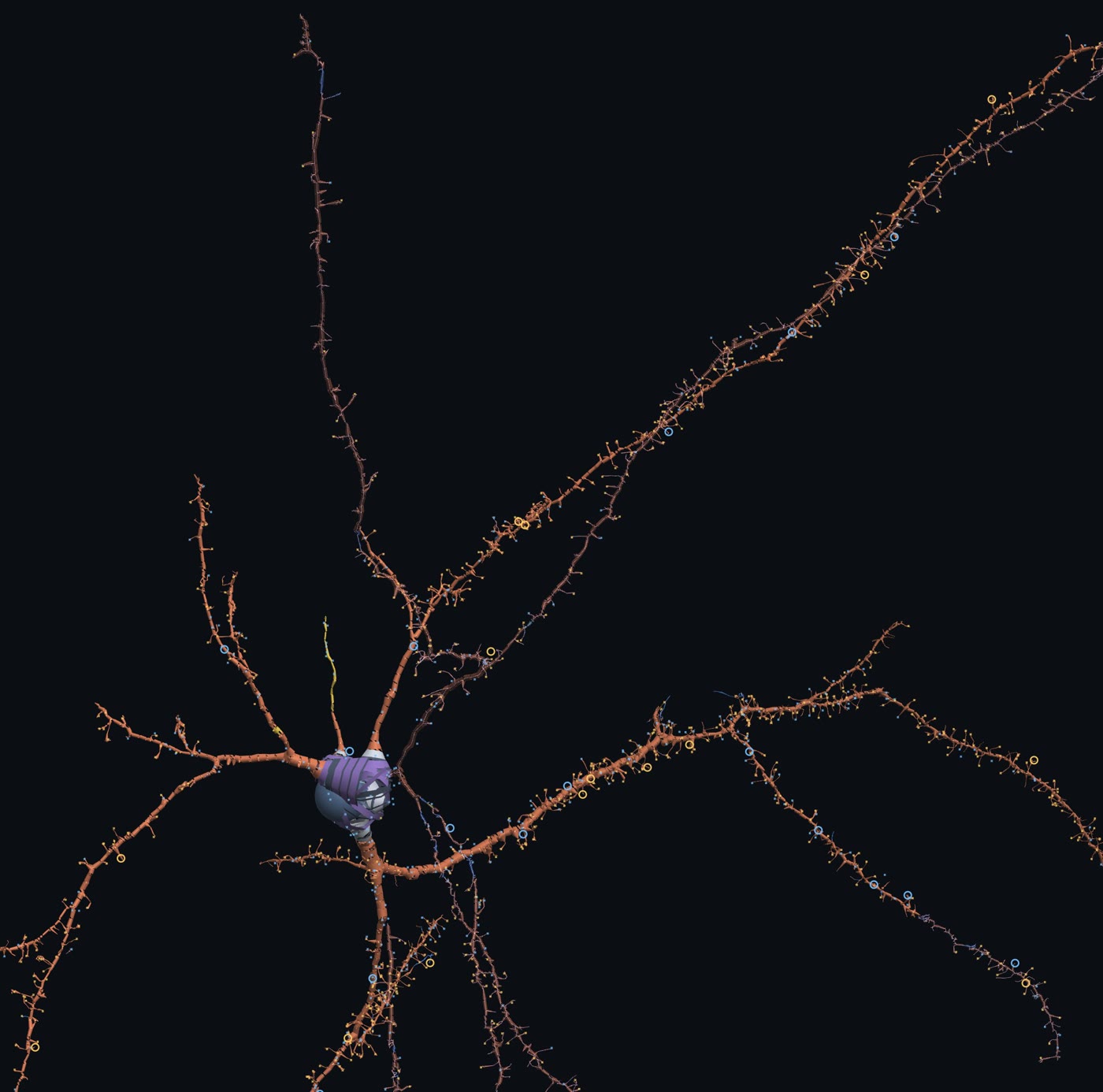
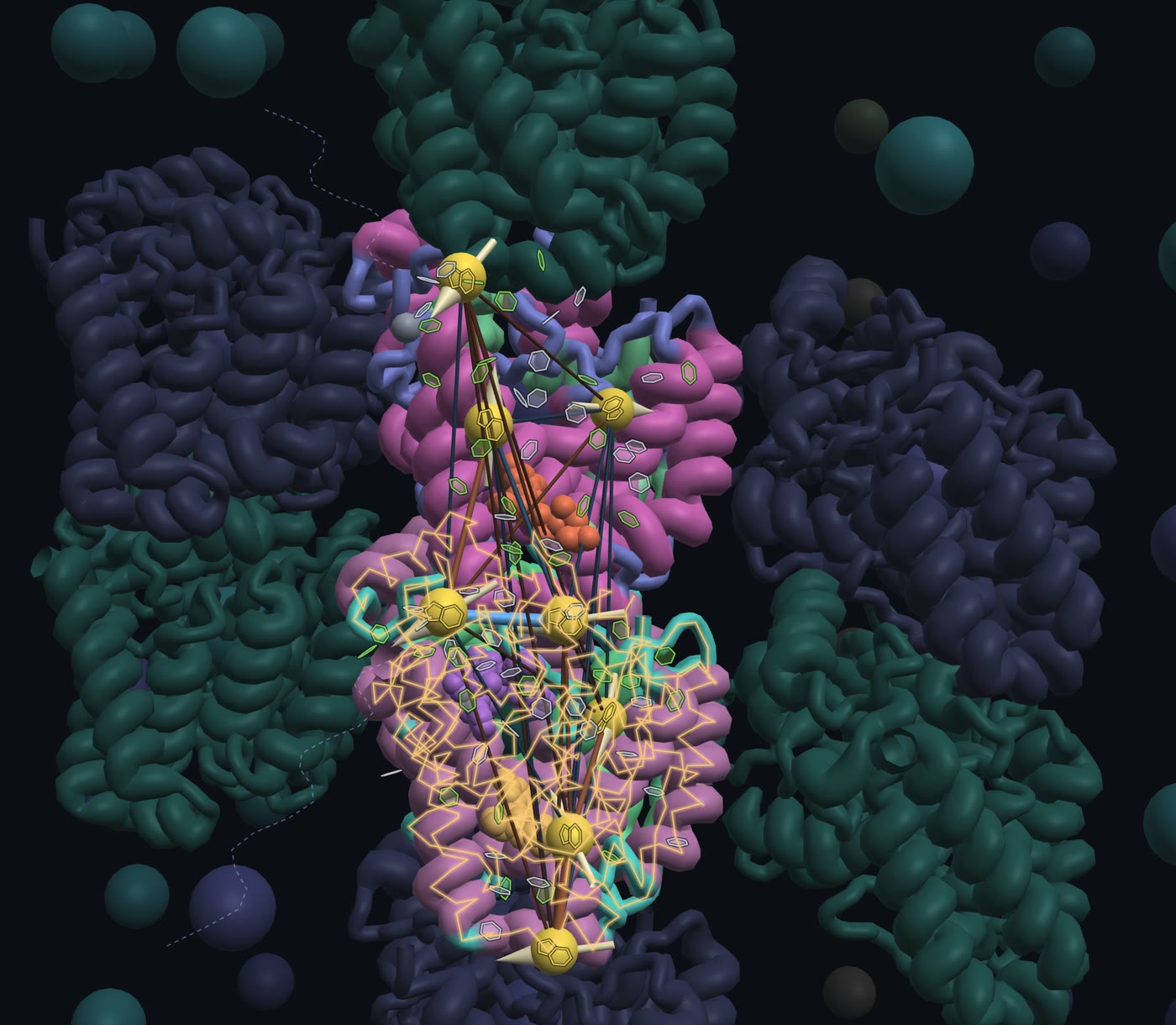
The microtubule layer deserves one paragraph, because it is the claim most likely to be repeated. Orch-OR (Hameroff and Penrose, 2014) proposes that consciousness arises from orchestrated quantum state reductions in neuronal microtubules. It is a hypothesis with serious critics. Tegmark estimated decoherence times of to seconds, against neural dynamics on timescales of 0.001 to 0.1 seconds, which would leave no time for quantum computation to matter. Whatever you think of that debate, nothing in BioLLM measures a microtubule. The explorer draws a tubulin dimer from a published crystal structure (PDB 1JFF) and labels the quantum overlay "MODEL · EXPLORATORY". It is a visualisation of a hypothesis, attached to a language model by an index.
The same goes for the J-space mention. Anthropic's global workspace paper introduced the Jacobian lens as a way to read which words a layer is heading toward; I took it apart in the Jacobian lens and mapped it across open models in J-space in the open. BioLLM fits a lens to Qwen3-8B and shows its readout with the write on and off. That is a reasonable visualisation. It says nothing about sentience, and the site's compliance page agrees: "We will never claim BioLLM is conscious, sentient, or aware."
The March predecessor, by range request
BioLLM's first public model is still on Hugging Face: 4r7i5t/BioLLM_SmolLM2_360m_Distill, tagged cortical-labs, cl1 and biollm, trained on culture "CL1-2544-144". The unit number matches one of the two cultures chat replays today; whether it is the same dish eight months on, the files do not say. The same account's Solana app sets API_BASE_URL = 'https://biollm.com', so the link to the current site is in the code. It is a different product from BioLLM-8B and I treat it as background.
The card describes a LoRA (rank 8, alpha 16, on q_proj and v_proj) distilled from 60 samples, filtered from 100, of a co-training session that processed 200 tokens in 622 seconds. Its reported losses over three epochs were 16.500, 16.328 and 16.653, which does not trend down. I did not download the weights. I read the safetensors headers of it and of SmolLM2-360M by HTTP range request, then fetched single rows of individual tensors. The BioLLM file has the same 290 tensor names and shapes as the base, in fp32 instead of bf16, 361,821,120 parameters with no adapter tensors: the LoRA is merged. The card's own total of 362,640,320 is exactly that plus its 819,200 LoRA parameters. In layers 0, 10, 20 and 31, the first rows of k_proj, o_proj and the three MLP matrices are bit-identical to the base after the bf16 to fp32 cast, and the first rows of q_proj and v_proj differ by between 2.0 × 10⁻⁴ and 1.1 × 10⁻³ of their norm. That is what a merged rank-8 LoRA on those two projections looks like. It tells you the weights match the card. It does not tell you whether the neurons mattered, and the card reports no control.
The founder's own account of that model, on HackerNoon, is more careful than the launch thread. It says the author rented access to a CL1 dish, that "By my own framework's criteria, BioLLM is nowhere near the threshold", and that a $BioLLM Solana token which the app accepts as payment was launched by someone else: "I didn't create $BioLLM." The site's compliance page now promises not to "frame access, billing, or community participation as an investment opportunity".
The patent
"Patent pending" appears in the post, the thread and every page footer. I searched Google Patents for the term BioLLM, for assignees BioLLM and Stormy IT Services (the Nevis company the compliance and copyright pages name as operator), and for applications since 2025 claiming a language model, cultured neurons and a multi-electrode array. Nothing relevant came back; the only hits for BioLLM are OCR typos for "biofilm". That is weak evidence either way. A US non-provisional application is normally published 18 months after its earliest priority date, and a provisional application is never published, so anything filed since mid-2025 would be invisible now. The HackerNoon post says the patent covers "the distillation process" of the March model, which is not the Hebbian write BioLLM-8B serves. An application number would settle what is claimed. Until then "patent pending" tells you a filing may exist and nothing about what it covers or whether it would be granted.
What would settle it
The open question is narrow: does the response of living neurons, as opposed to the stimulus, the device or a fixed random projection, put information into the model's output that a control does not? BioLLM has built most of the apparatus to answer it. What is missing:
- A live-versus-replay test on the served adapter. Chat replays rows from 9 and 10 November. Score the same wording test on fresh rows recorded after the ties were frozen, never used to choose a variant.
- Pass the pre-stated rules on both cultures. P1-1 and P1-2 failed on culture 149 under chat decoding. A rerun with new cultures and the rules fixed in advance would count; another variant chosen on these rows would not.
- The array-mean control for every session. It failed on
code27. Report it fortick1, the session the served adapter learned from, next to the energy-only arm it already passes. - A culture with its spikes blocked. Tetrodotoxin silences action potentials while leaving the electrodes, the stimulation and the artefacts in place. If the readout survives TTX, it was never the neurons.
- A synthetic culture. Feed the write a non-biological source with matched per-slot statistics. The Izhikevich population is half of this already.
- Weights for the adapter and a few hundred recorded rows, so someone else can run the random-ties comparison.
The same pattern turned up in oruk.ai's fly-brain classifier, where scrambled wiring scored the same as the real connectome. Biology wired into a network feels like it should matter. Whether it does is a measurement, and the control is the measurement.
A careful harness under a loud thread
Skip the thread. It describes a system the company's own files say does not exist: the H01 and quantum layers are visualisations that are "Not in any adapter", the 1:1 mapping is an index, and the chat replays recordings from last week.
Do not skip the results file. Under the marketing, someone has built a careful harness: sham rows, shuffled and random-tie arms, pre-stated failure rules, nuisance controls, a refusal to say "from the neurons" when the array mean decodes as well. It finds that a frozen Qwen3-8B can carry which cue a dish received, beyond shuffled and random controls. It does not find, on its own terms, that the neurons rather than the device carry it, or that the culture's state reliably shows up in what the model says. That is a small, honest, early result. It deserves a paper with those caveats in the abstract, and a launch post that says the same thing.
How I checked: I read the X thread and its replies through the fxtwitter mirror (post 4 of the thread is missing there), the site's pages, its public viewer-status.json, weave.json, cl1-units.json and ties-joint1.json, and the explorer's client scripts. I compared configs and safetensors headers by range request and sampled single tensor rows. I recorded the explorer in a headless browser for the clip and screenshot. I did not send chat messages (a scripted request was refused), so I have not seen a reply or its word-change count, and I could not inspect the BioLLM-8B adapter, which is not published.