2026-11-12 · 23 min · agents · infrastructure · security · sandboxing
A 4:50 narrated explainer, drawn in code. Every number and picture in it is this article's own; the sources are below.
› transcript
Your agents spend most of the day waiting. So why is every one of them still holding memory? Hi, I'm Brielle! Agent Substrate is a Kubernetes runtime that turns a waiting agent into a snapshot. Let's see how, and what its density claim measures. Chapter one. An agent mostly waits. Follow one turn of a coding agent. It sends the conversation to a model and waits for tokens. It runs a tool, a search or a test. Only this part works the sandbox. Then it waits for a person: minutes, hours, or a day. Kubernetes gives you two bad options. Keep a pod per session and pay for idle memory. Or delete pods between turns, and pay a cold start and the lost state. Substrate takes a third way. A waiting agent becomes a snapshot, and comes back on whichever warm worker is free. Chapter two. Actors on warm workers. Here's the idea. Freeze an idle agent, memory and files, into a snapshot. When the next request arrives, restore it onto any free warm worker. Picture a fleet of actors, each a stateful agent. While they wait, each is just a snapshot in storage, and the worker pods sit warm and empty. Requests arrive. Three actors are restored, memory and all, into free slots. One finishes its turn. A suspend call checkpoints it back to storage, freeing its slot. A request comes for a different actor. It wakes into the freed slot. Any free worker will do. A request names its actor in a header and reaches the router: Envoy, with a small processor in front. If the actor is suspended, the router asks the control plane to resume it. Under a lease, the scheduler samples two workers with room and takes the less loaded. On that node, a supervisor restores the snapshot into a sandbox, from a local copy if it has one, else from the bucket. Then the router tunnels the request in, over mutual TLS. The project draws the same path, numbered: route, resume, restore from the snapshot bucket, deliver. And on the way out, every tool call goes through the egress gateway, which holds the credentials. Each template is booted once and checkpointed. New actors start from that golden snapshot, so none pays a cold boot. A request resumes it. A cold start has become a memory restore. While it runs, it holds a slot at its full memory limit. When your harness calls suspend, the checkpoint lands on the node's disk and the call returns. The upload follows five minutes later, and the local copy stays for thirty, so a quick wake skips the download. The project's own demo: three Claude Code agents sharing two worker pods. The third waits for a pod. Chapter three. Where ten x comes from. Take a fleet of N agents, each with a memory limit M. One sandbox per agent holds N times M, all the time. Multiplexed, only the S running actors hold a slot, each at its limit plus a small runtime overhead. If agents run a tenth of the time and never collide, S is a tenth of N, and the ratio is ten. The multiple is the duty cycle. Perfect staggering gives ten x at any size. But you size a pool for busy moments, not averages. Sized for the ninety-ninth percentile, two hundred and fifty agents get six point eight x. Only at a million agents does it reach nine point nine. That is why millions and ten x travel together. Chapter four. What zero trust means here. Zero trust has a definite shape in this code. Every running actor gets its own short-lived certificate. All outbound traffic goes through one gateway. No rule, or a failed lookup, means no traffic. The agent sends a placeholder header, and the gateway swaps in the real key outside the sandbox. The code also shows what is not there yet. Nothing in this commit decides an agent is idle. Your harness calls suspend. The benchmark harness is in the repository. The run behind the ten x is not. And the Claude Code demo puts its API key in plain environment variables. Idle agents become snapshots, so you pay only for the ones running. The density is your duty cycle. Measure it first. To recap. Idle actors live as snapshots and wake on warm workers. Density tends to one over their running share. Keep keys at the gateway. Every source is in the full article. I'm Brielle. Bye!
Why read this
Notabletop 60%Reads Agent Substrate's scheduler, snapshot and egress code to derive where '10x density' comes from, who suspends an agent, and what zero-trust covers today.
- Original analysis
- Runs on a laptop CPU
- Widely used
Agents & harnessesApache-2.0Practitioner tool
How this was scored
- Is it new?
- 1 of 3: An incremental tweak
- Can I trust it?
- 2 of 3: Measures key facts from files, code or configs
- Can I run it?
- 2 of 3: Open code or weights with real limits
- Will I understand it?
- 2 of 3: Mechanism from first principles with figures
- Can I act on it?
- 2 of 3: A concrete recipe, numbers or comparison
- Will it last?
- 2 of 3: A reference for a year or more
- Does it affect many?
- 2 of 3: A widely used model, tool or lab release
- Only here?
- 2 of 3: A teardown or measurement few others did
Score 66 of 100, ranked 267 of 740 rated articles. Each question is answered 0–3 by hand, and a 3 is rare. How articles are scored
NVIDIA's AI infrastructure account opened its post on Wednesday with a line every agent operator recognises: "AI agents sit idle most of the time. You're still paying for every second." The fix it offered was Agent Substrate, "an open-source, zero-trust runtime, now in the @CloudNativeFdn Sandbox, running millions of agents at 10x the density of standard containers." The replies asked what I wanted to know. One wanted the baseline and workload mix behind the 10x. Another asked whether the isolation boundary is a shared kernel or something closer to a microVM. A third asked how fast an idle agent wakes up.
I cloned agent-substrate/substrate at commit e472ffb (12 November 2026, a week after v1.0.0) and read it. I did not deploy it. This piece explains the runtime from the bottom: why agents idle, what has to sit inside the wall, how a snapshot makes an idle agent cheap, and where a density multiple like 10x actually comes from. Then it checks the zero-trust claims against the code.
Agent Substrate: the core system
- license
- Apache-2.0
- branch
- main
- forks
- 734
- open issues
- 1.2K
- source
- 15.1 MB
- commit date
- 2026-11-12
GitHub REST API, 2026-11-12 — branch, commit, commitDate, createdAt, description, forks, homepage, languages, license, openIssues, pushedAt, stars, topics
Whose runtime this is
The post reads as an NVIDIA launch. The repository says otherwise. MAINTAINERS.md lists nineteen maintainers: sixteen from Google and three from Solo. The CNCF sandbox application (cncf/sandbox#523) was filed in September. The automated pre-review flagged the repository as younger than the six-month minimum (created 13 May 2026), and the TOC moved it forward anyway as "a fast moving area." The vote passed on 28 September with eight in favour, none against, three not voting. Onboarding then waited on a contribution agreement between Google and the CNCF. It is open as cncf/sandbox#542.
NVIDIA's part is upstream work, and it is real. NVIDIA's technical blog post, by Ekin Karabulut and Omer Yahud, lists request parking in the router (#221, authored by Yahud, and its follow-up #1229), per-container CPU and memory limits for microVM sandboxes (#859), and a device-per-container design on Kubernetes Dynamic Resource Allocation for GPUs (#752, still open). The "10x" sentence in the post is the project README's own, word for word: "engineered to safely run millions of agents and tools with 10x higher density than standard containers." So whatever the 10x is, it is the project's claim, which NVIDIA repeats. NVIDIA's post also still contains the line "Guide link placeholder – add when supplied" where its getting-started guide should be.
This site has met Substrate before, one layer up. Google's ax agent runtime is a client of Substrate's control API, and that article took Substrate's isolation and snapshots as given. This one opens them.
An agent is a process that mostly waits
Take one turn of a coding agent. It sends the conversation to a model and waits for tokens. The reply asks for a tool: rg over the repository, a test run, a file edit. The tool takes milliseconds to a few seconds. The output goes back to the model, and the agent waits again. Between turns it waits for a human, and humans take minutes or hours. An approval gate can take a day.
The sandbox holding that agent does useful work only while a tool runs. During the model call it is a process blocked on a socket. During the human wait it is a process blocked on nothing at all. But its state matters: the cloned repository, the build cache, the shell's working directory, a language server's index, whatever the harness keeps in memory. Throw that away and the next turn starts from a cold clone.
Kubernetes gives you two bad options for this. Keep one Pod per session, and you pay for memory the session holds while it does nothing. Delete Pods between turns, and every turn pays what NVIDIA's post lists as a trip through the API server, admission, etcd, the scheduler, the kubelet, an image pull and network setup. That takes seconds and loses the state. DeepSeek's DSec measured the first option on its RL fleet: about 90% of sandboxes drew under 5% of their requested CPU. It packed CPU past 50x and kept memory resident, because memory is the thing a running process cannot give back.
Substrate goes after the memory. Its bet is that a waiting agent does not need to be a process at all.
What has to sit inside the wall
An agent runs code it wrote, against inputs an attacker may have written. A runtime for it has to contain four things.
- Execution. The agent's processes must not reach the host kernel's full syscall surface, or each other.
- Network. Outbound traffic is how a prompt-injected agent exfiltrates data, so egress must be default-deny with an allowlist.
- Secrets. If the API key is in the sandbox, the agent can read it, print it, or send it anywhere egress allows.
- State at rest. Once you snapshot memory, the snapshot holds everything the process held, including secrets, so storage becomes part of the boundary.
The usual isolation choices trade these against cost.
| Boundary | What separates the agent from the host | Can it snapshot a running process? |
|---|---|---|
| Process sandbox (bubblewrap, seccomp, Landlock) | Namespaces and syscall filters on the shared kernel | Not natively |
| Plain container (runc) | Namespaces and cgroups on the shared kernel | CRIU, with many exceptions |
gVisor (runsc) | A user-space kernel, the Sentry, intercepts syscalls | Yes: runsc checkpoint / runsc restore |
| microVM (Firecracker, Cloud Hypervisor) | A KVM guest kernel behind a small VMM | Yes: VM memory snapshots |
| WebAssembly | A bytecode VM with no POSIX underneath | Trivially, but it cannot run git or node |
Process sandboxes are what Claude Code uses locally (its bwrap argv and seccomp program), and NVIDIA's own OpenShell moves the boundary into Landlock and a seccomp supervisor. They are cheap, and they share a kernel with every other tenant. Substrate refuses that outright: "Plain Linux containers are not supported." It runs every actor under gVisor or under Kata Containers on Cloud Hypervisor. Both have a native way to freeze a running sandbox to bytes and thaw it later, and that property, not isolation alone, is why these two were chosen. WebAssembly snapshots for free but cannot run the binaries a coding agent shells out to.
Actors, workers and a snapshot in between
Substrate splits the agent from the machine. An actor is a stateful instance of a workload: a record in PostgreSQL, a snapshot in object storage, and a state (SUSPENDED, RESUMING, RUNNING, SUSPENDING). A worker is a pre-started Kubernetes Pod in a WorkerPool, a sandbox host waiting for work. Kubernetes manages the workers, which change slowly. Substrate's own control plane, ate-api-server, manages the actors, which change constantly. The docs are blunt about why: the Kubernetes API server "is not designed to handle millions of resources."
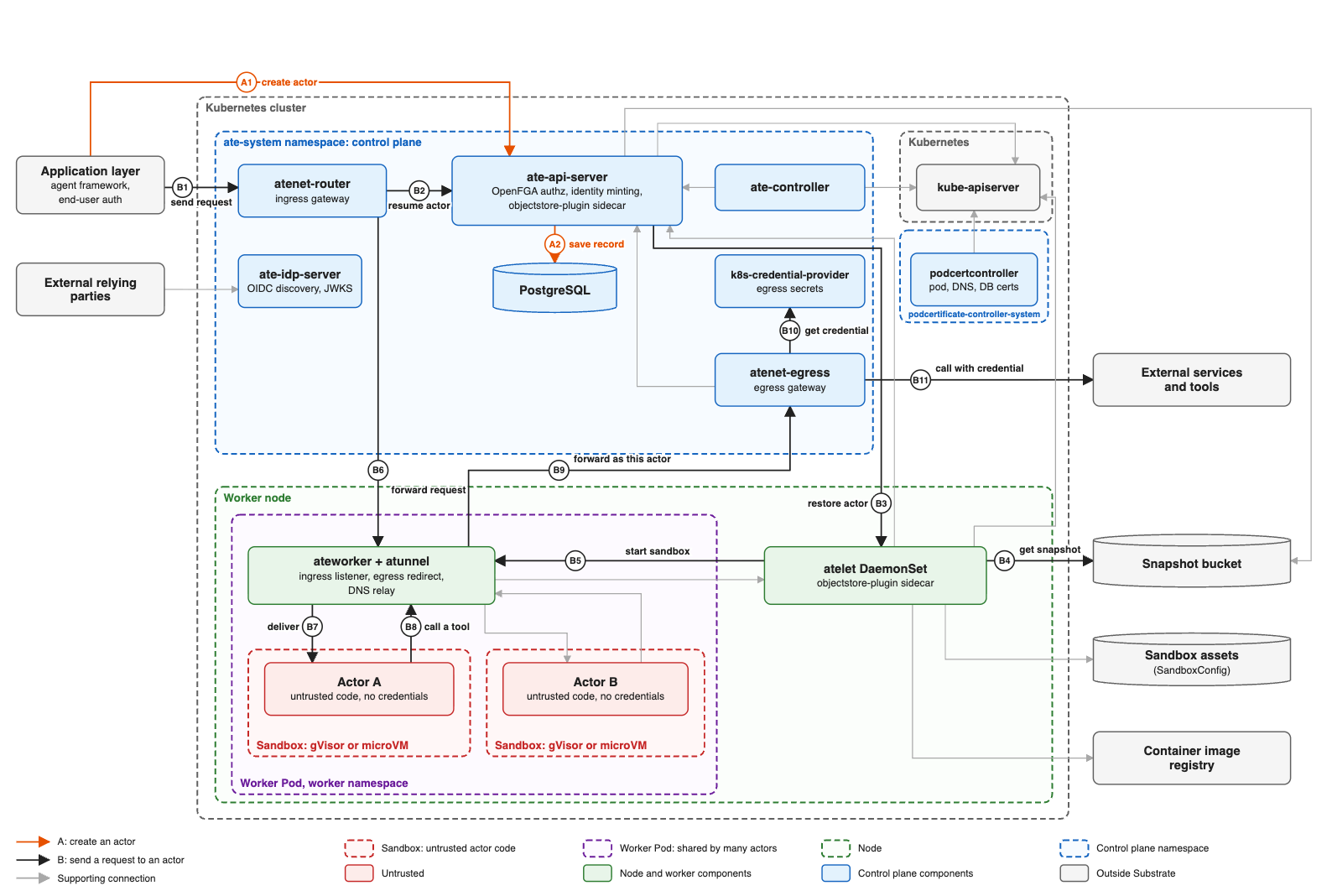
The path of one request, as the code runs it:
- An application sends HTTP to
atenet-router(Envoy with anext_procprocessor), naming the actor in anate-target-actor: <atespace>/<actor>header. - The processor calls
ResumeActor. Inworkflow_resume.go, a running actor returns immediately, before any lock, because the router calls this on every request. A suspended one takes a per-actor lease in PostgreSQL, then gets a worker. - The scheduler (
scheduling.go) filters workers with room, samples two at random and takes the less loaded: the power of two choices. Load is the higher of slot use and memory or CPU use. atelet, a DaemonSet on that node, restores the actor's latest snapshot into the worker's sandbox, from a node-local copy if it still has one, otherwise from GCS or S3 through an object-store plugin sidecar. A wakeup probe confirms the process is answering.- The router opens an mTLS
CONNECTtunnel toatunnelon the worker, which forwards into the actor's own network namespace.
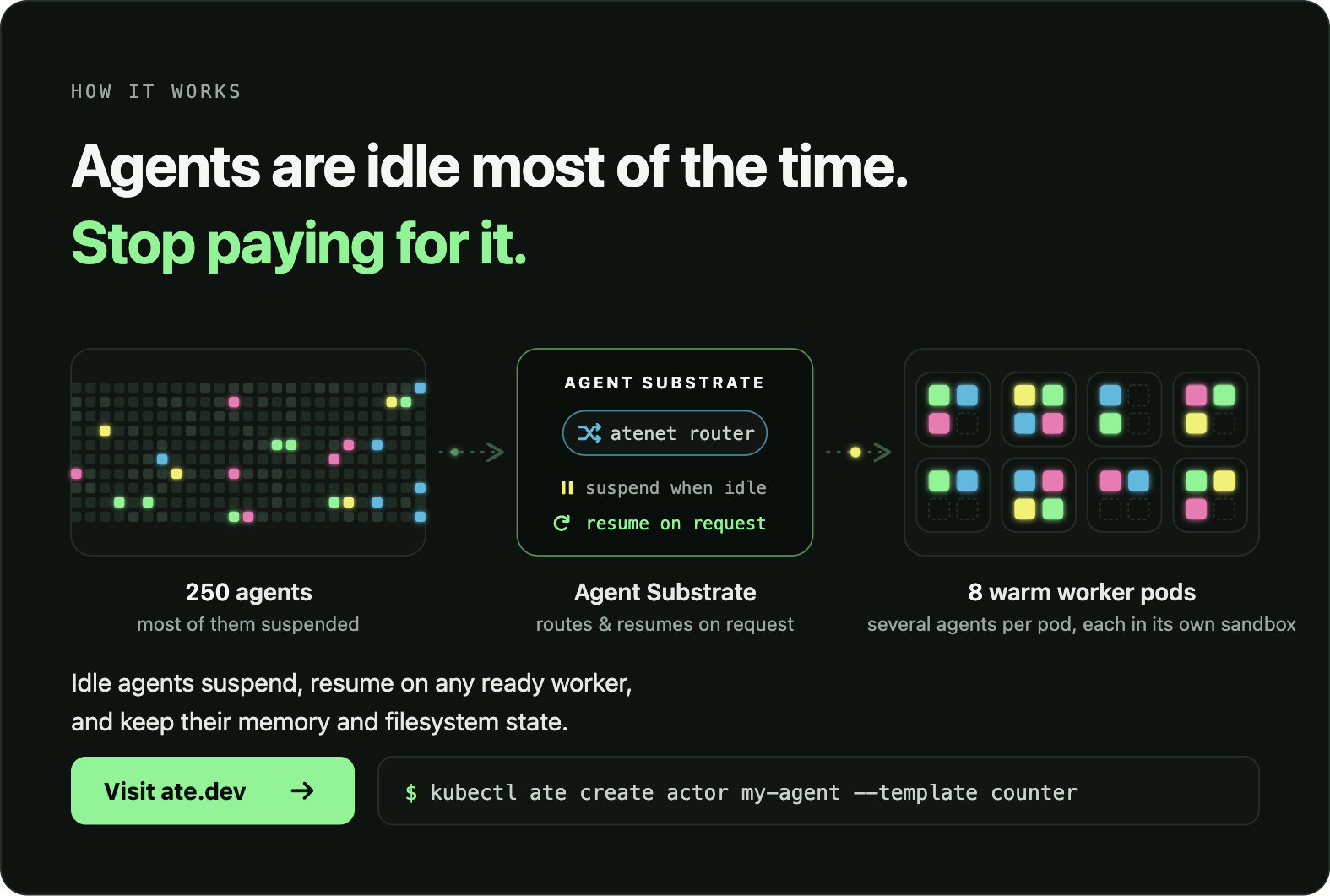
A worker is not one agent. Each ateworker hosts up to --max-actors actors at once (default 1000), each in its own gVisor sandbox or microVM. That is why the hero figure can show 250 agents on 8 pods: a pod is a host for sandboxes, not a sandbox.
What a suspend writes
A snapshot has three fidelities, set per ActorTemplate, each including the one before:
VOLUMES: the contents ofDurableDirvolumes.ROOTFS: plus every file written to the container's root filesystem since boot.MEMORY(the default): plus the running process tree and its RAM.
MEMORY is what makes "resume where it left off" true. On gVisor the worker runs runsc checkpoint with -image-path for the memory image and -fs-checkpoint-paths for the filesystem bundles, and restores with runsc restore -background (from the worker's internal_flags.json), which keeps loading pages after the sandbox is already running. The architecture doc notes the gVisor path still needs a runsc with --allow-connected-on-save, a workaround for a networking bug on resume. On microVMs, Cloud Hypervisor takes a VM memory snapshot, and the root filesystem's writable layer lives on the host behind virtio-fs, so it ships as a tar rather than as guest RAM.
The fast path for a new actor is the golden snapshot. When you create an ActorTemplate, Substrate boots it once, lets it warm up, checkpoints it, and keeps that image. Every actor created from the template starts by restoring it, so no actor ever pays a cold boot on its first request. A cold container start becomes a memory restore.
Suspends are asynchronous by default. SuspendActor returns once the checkpoint is written on the node's disk. atelet uploads it after --snapshot-upload-delay (5 minutes by default) and drops the local copy after --snapshot-detach-delay (30 minutes). An actor that wakes inside half an hour on the same node skips the download entirely. The docs state the risk plainly: an asynchronous suspend can lose state if the node dies before the upload.
The restore mode on microVMs shows how much of this is still being tuned. Cloud Hypervisor can restore guest memory on demand through userfaultfd, faulting pages in as the guest touches them, so an idle restored guest holds only its working set. prefault.go explains why Substrate does not use that today: from Cloud Hypervisor 53, the userfaultfd handler prefaults every page in the background, and "the prefault storm starves" the guest until it fails its wakeup probe. On those versions, and on any version it cannot parse, the worker falls back to an eager copy of the whole snapshot. The ate-setup installer assembles its local microVM assets from defaultCloudHypervisorVersion = "v53.0"; the GKE SandboxConfig template pins its assets by hash, so I cannot tell its version from the repository. On assets built from that default, a restore reads the full memory image up front.
Nothing in this commit decides an agent is idle
The README's hero says "suspend when idle." I looked for the code that decides an actor is idle and could not find it. There is no idle timer, no TTL and no reaper in ate-api-server, atelet or the router. The architecture doc says it in passing: hibernation is "Triggered by an explicit SuspendActor call." Every caller of SuspendActor in the tree is a client (kubectl ate, the benchmark load generators, the template reconciler building golden snapshots) or the worker-side path below.
That worker path is half built. internal/ateworker/suspend lets a worker ask, through atelet, for an actor it hosts to be suspended, and the control plane authorises it by checking the caller's node identity against its own records. The comments describe the intended trigger: "an actor that pushes an idleness signal does not necessarily push it again." But nothing in cmd/ constructs a Requester at this commit. The plumbing exists; the signal does not.
So in practice your harness decides. In the ax article, ax suspends the actor when a turn closes. In the Claude Code demo, the dashboard suspends an agent when its task timer ends. The demo video's own caption says "After a short idle window, substrate suspends the agent again", which the demo's README contradicts: the dashboard does it.
This is where NVIDIA's Dynamo pitch fits. Its blog describes Dynamo returning "projected time to first token" and GPU-pool saturation so Substrate could "suspend it during a longer inference wait, or resume it as the model response approaches completion." That is exactly the missing decision: if the next token is twenty seconds away, checkpoint now; if it is two hundred milliseconds away, stay resident. The blog itself says "parts of the Dynamo agent integration are experimental." At e472ffb, it is a direction.
The same reading answers a question the ax article left open: whether Substrate refuses a second activation of an actor that is already running. It does not. ResumeActor on a running actor returns that actor, and the lease serialises state transitions, not callers. Two replicas of a harness can both "resume" one actor and both get it back as running. I did not read the router or atunnel for a per-actor request limit, but nothing in the resume path refuses the second caller. Exclusion over a conversation is still the harness's job, so the ax article's framing stands.
Where 10x comes from
Start with what a running actor costs. The scheduler's Booking charges a worker the actor's memory limit, plus the runtime's declared overhead. The microVM worker declares 4 MiB plus 8 MiB per GiB of limit, for Cloud Hypervisor, virtiofsd and the host page tables (actorOverhead in cmd/ateworker-microvm/run.go). The gVisor worker declares none. There is no memory overcommit among running actors: the limit is reserved whether the agent uses it or not.
A suspended actor costs no worker memory at all. It costs a snapshot in object storage.
So compare a fleet of agents, each with memory limit , each running a fraction of the time.
where is the number of worker slots you need and is the per-actor overhead. If agents were perfectly staggered, , and the ratio is : an agent that runs 10% of the time gives you 10x, and one that runs a third of the time gives you 3x. The README's own range, "10x–30x Oversubscription", corresponds to agents running between about 10% and about 3% of the time. That is the whole source of the multiple. It is a statement about the workload. Two runtimes holding the same agents would get the same ratio if both could swap them out.
Perfect staggering is the generous case. Requests arrive when they arrive, and you size the pool for a tail, not a mean. If agents run independently, the number running at once is binomial, with mean and standard deviation . Sizing for the 99th percentile adds standard deviations. On my arithmetic:
| Fleet | Running share | Mean running | Slots at p99 | Density |
|---|---|---|---|---|
| 250 agents | 10% | 25 | 37 | 6.8x |
| 10,000 agents | 10% | 1,000 | 1,070 | 9.3x |
| 1,000,000 agents | 10% | 100,000 | 100,698 | 9.9x |
| 10,000 agents | 30% | 3,000 | 3,107 | 3.2x |
At the demo's scale, a 10% duty cycle gives you under 7x. The 10x shows up only when the fleet is large enough for bursts to average out, which is why "millions of agents" and "10x" travel together in the pitch. Correlated traffic (a batch of RL rollouts dispatched at once, everyone opening their laptop at nine) needs more headroom than the independent model gives. Request parking is the other lever: a router that holds a request for up to --parked-request-budget (5 seconds by default, with at most 1024 parked) lets you run nearer the mean and pay in queueing delay instead of idle slots.
For the demo's own sandbox, a 2 GiB Claude Code template, 250 agents in pods of their own hold 500 GiB. Thirty-seven microVM slots at 2,068 MiB each hold about 75 GiB. That is real money saved, but it is 6.8x, not 10x, and it ignores the price of the swap: object storage for every suspended actor, a checkpoint write on every suspend, and a restore read on every wake.
Is there a measured 10x anywhere? Not in the repository. The benchmarking guide documents a Locust harness that writes actors_per_node, actors_per_vcpu and actors_per_gb_ram for each run, then says "none of them are checked into the repository." It is careful about its own numbers: actors are "derived, not counted" (peak users times actors per user), and "a workload that creates and deletes actors as it goes never holds them all at the same time, so its real density is lower than reported." The only run reports checked in measure the atunnel proxy's CPU per request, not density. The architecture doc lists north-star targets (100 ms resume at p95, a billion agents per cluster, 1000 wakeups per second) next to the README's present-tense "less than 500ms" and "more than 500 activations per second." I could not find the setup behind the 10x at e472ffb, so read it as the project's estimate for mostly-idle agents. The ax article said Substrate ships a benchmarking/ directory to reproduce its numbers. The harness is there. The results are not.
The same guide is frank about what breaks under load. A pause-and-resume cycle under load takes "tens of seconds." A restore wave onto a node whose sandboxes are burning CPU makes the wakeup probe time out and crashes the actor, and "Substrate does not steer restores away from busy nodes." Above about a thousand sandboxes per host, the kernel's ARP neighbour table overflows unless you raise gc_thresh3. Above a few hundred per node, the kubelet's heartbeat starves and the taint manager evicts the whole node. Every one of those is the price of density, written down by the people paying it.
Zero trust, read from the code
"Zero-trust" is a phrase that usually means nothing. Here it has a definite shape, and the security doc grades each part as Met, In Progress or Future, which is more honesty than most projects offer.
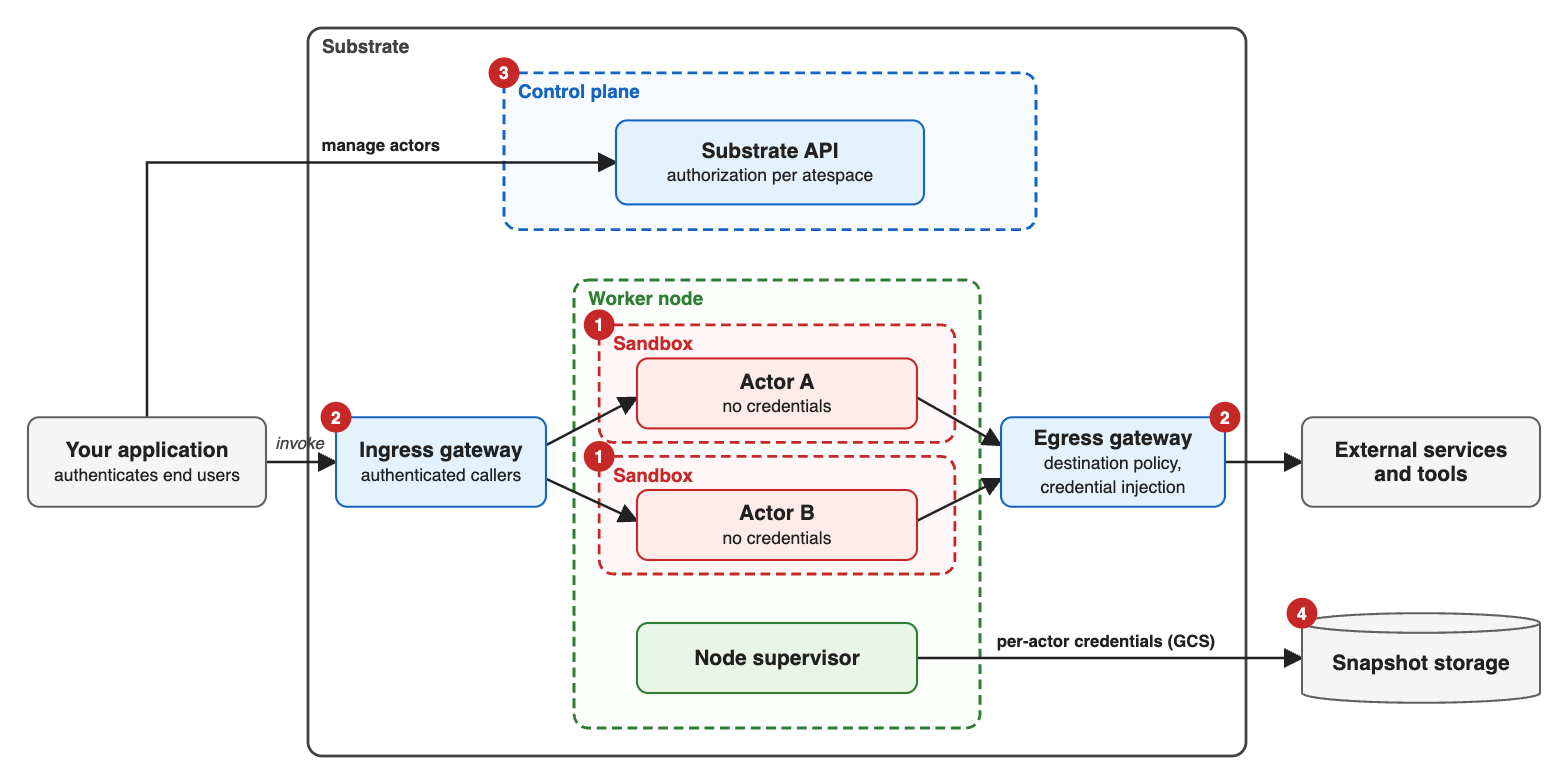
Identity. Every running actor gets a short-lived X.509 certificate with a SPIFFE ID of the form spiffe://<trust.domain>/actor/<atespace>/<name> (the format is in internal/resources/spiffe.go; the security guide gives the lifetime as an hour). The egress gateway can also mint a JWT for the actor on demand. Actors also carry a UID, so the docs promise that an actor deleted and recreated under the same name can be told apart from the old one.
Egress. An actor's outbound connections leave its network namespace through atunnel to atenet-egress. The gateway authenticates the actor by its certificate, looks up its EgressPolicy, and denies anything no rule allows. The code fails closed in the places that matter (cmd/atenet/internal/router/egress/egress.go): a policy with no rules gets a 403 ("Can authorize nothing, so the same posture as having no policy"), and if the actor-identity CA or the policy lookup fails, the answer is a 503. DNS goes through a relay filtered against the policy's hostnames, and non-TCP traffic is dropped.
Secrets. For an https rule, the gateway terminates the actor's TLS (the actor trusts a projected gateway CA) and applies replaceHeaders effects. The actor sends Authorization: placeholder; the gateway asks a credential provider for the secret named by credentialUri, swaps it in, and re-originates TLS to the real host.
rules:
- https:
    hostnames: ["api.example.com"]
    effects:
      replaceHeaders:
      - header: Authorization
        prefix: "Bearer "
        credentialUri: ate-secret://k8s.io/default/ns1/example-api/token
The key never enters the sandbox, so it never enters a snapshot. Perplexity's SPACE and OpenShell arrived at the same design, which is a good sign that it is the right one. What it does not stop is use: a prompt-injected agent cannot read the key, but it can still call api.example.com with it, as often as the policy allows. The policy is the boundary, so write it per endpoint, not per host.
What the security doc itself marks unfinished: worker pods still run as root with SYS_ADMIN and NET_ADMIN (In Progress); per-actor snapshot encryption and re-authorising a tenant before a restore (Future); per-actor storage tokens on S3, where GCS has them (Future); actor-to-actor authorisation (Future); quotas and anti-DoS throttling (Future). None of that is hidden. It is the table in docs/security/security.md.
The flagship demo puts the key in the sandbox
The demo that shows Claude Code multiplexing does not use any of this. Each of its three ActorTemplates sets the key as an ordinary environment variable:
  - name: ANTHROPIC_API_KEY
    value: "${ANTHROPIC_API_KEY}"
...
snapshotConfig:
  preferredFidelity: SNAPSHOT_FIDELITY_MEMORY
The template's comment says the key "is substituted into the container env as a plain value." The egress policy for api.anthropic.com:443 passes TLS through, so the gateway never sees the request it could have injected into. With MEMORY fidelity, the process environment is part of what a checkpoint captures. By my reading that puts the key in the golden snapshot and in every suspend after it, in a bucket that per-actor encryption does not yet cover. I did not inspect a snapshot to confirm it. The security table marks "Zero Ambient Credentials" as Met, and for the runtime that is fair: the gateway can do it. The demo most people will copy shows the opposite pattern.
The fix is one https rule with a replaceHeaders effect on x-api-key and a placeholder in the template. If you deploy this for real, do that first.
What NVIDIA adds
Separate from the press language, NVIDIA's contributions point at the right problems. Request parking turns a pool saturated for a few hundred milliseconds into a short wait instead of a 503, which is what lets anyone run near the mean in the table above. Per-container limits on microVMs stop a runaway sidecar from killing the agent beside it; gVisor still runs every container in one Sentry and ignores per-container limits (docs/reference/sandbox-classes.md). GPU sandboxes are the hard one. A GPU checkpoint can usually be restored only onto the same GPU model, sometimes only with the same driver, so the proposed design records device properties with each snapshot and falls back to a cold start when no matching device is free. That design is on DRA and is not merged.
The larger idea is the Dynamo feedback loop above. An agent's longest waits are on the model, and the inference server is the only component that knows how long a wait will be. Wiring that into the suspend decision is what would turn "suspend when idle" from a slogan in a figure into a policy.
Would I run it
For sessions shaped like the hero figure (long human gaps, short bursts of tool calls, state that is expensive to rebuild), on Kubernetes, with untrusted code, Substrate is the most complete open design I have read. gVisor or a microVM per agent, memory snapshots, a golden image per template, an egress gateway that holds the keys, and a separate control plane because the Kubernetes API server was never going to hold a million actors.
I would not take the 10x into a capacity plan. Measure your own duty cycle first. Log, per session, the seconds it spends executing against the seconds it spends waiting, and put the ratio into the calculator above. If your agents run more than a third of the time, the multiple is near 3x and every suspend costs a checkpoint. If your fleet is in the hundreds, bursts eat a third of your slots. And you will write the idle policy yourself, because at this commit nothing else does.
Two things I would check before production. First, that your harness never puts a secret in an actor template, whatever the demo does. Second, the restore path on your node pool: on Cloud Hypervisor 53 and later, microVM restores are eager copies, and the benchmarking guide's own failure list (probe timeouts on busy nodes, neighbour-table overflow, kubelet starvation) is the list of things you will hit first.
What I read
Everything here comes from reading, not running: the repository at e472ffb (README, docs/concepts/architecture.md, docs/security/security.md, docs/guides/benchmarking.md, docs/guides/egress-credential-injection.md, docs/reference/sandbox-classes.md, the scheduler, workflow_resume.go, the ateworker-gvisor and ateworker-microvm restore code, internal/ateworker/suspend, the egress gateway, and the claude-code-multiplex demo), the CNCF sandbox issues, NVIDIA's blog post and the X post with its replies. The slot and density table, the 500 GiB and 75 GiB figures, and the calculator are my arithmetic on the scheduler's booking rule under an independence assumption, not measurements. I did not deploy Substrate, run its benchmarks or open a snapshot.